 FREE UK SHIPPING OVER £35!
The Spin Doctor Europadisc's Weekly Column
Good News from Bru Zane, Bad News from the BBC...
8th March 2023
8th March 2023
 First, the bad: just a week after our piece about the plight of radio orchestras (1 March), the BBC has announced a response to its 2022 review into its classical music services, and the results are worse than many had feared. Not only are they proposing a 20% reduction in salaried roles at its three English-based orchestras (the BBC Symphony, Philharmonic and Concert Orchestras), but the BBC Singers – the UK’s only full-time professional choir – is to be axed entirely. To describe this news as a bombshell would be to understate the unanimity of the response from Britain’s classical community. The decision – announced with the meaningless verbal glosses of management-speak by executives on six-figure salaries – is all the more cruel as next year would have marked the centenary of the foundation of what eventually became the BBC Singers.
Yet beyond the insensitivity of the timing (professional musicians have been through a particularly hellish few years, what with the Covid pandemic and new challenges to touring, many of them down to Brexit), the decision is yet another nail in the coffin of classical music in Britain. How often do we hear from the powers that be the aspiration to be ‘world-leading’? And yet, when we actually manage to produce something that truly is world-class, the rug is pulled out from under its feet. There are few other full-time chamber choirs out there – perhaps only the SWR Vokalensemble of Stuttgart rivals the BBC Singers in terms of quality and reputation – and as an example of what can be achieved by the combined forces of human voices in repertoire that ranges from Radio 4’s The Daily Service, via medieval and Renaissance repertoires, to the demands of contemporary avant-garde scores, the BBC Singers have stood at the pinnacle of the profession for many decades.
While several essentially freelance and part-time professional vocal ensembles have excelled in specialist repertoires, ancient and modern, the breadth of coverage of the BBC Singers has been its abiding strength. Founded in 1924 under Stanford Robinson as the ‘Wireless Chorus’, in 1927 it became the ‘Wireless Singers’, and in 1934 – now under the direction of Leslie Woodgate – the BBC Singers, the name it has retained – following a brief period as the BBC Chorus – to the present day. Its history is a particularly distinguished one, conducted in its early years by Stravinsky, Schoenberg and Elgar, and subsequently by the likes of Karajan, Furtwängler, Walter, Beecham and Klemperer.
Originally subdivided into two octets, one tackling more elusive repertoire, the other singing lighter fare, the BBC Singers has enjoyed a particularly close association with new music. Its list of major premieres and commissions, from Milhaud and Martin to Xenakis and Dillon, puts most similar ensembles in the shade, and its discography is an extensive one (for a selection, see below). The Singers had a particularly warm working relationship with Pierre Boulez, while to wider audiences it is most familiar from its annual contributions to the Last Night of the Proms. Its recent chief conductors have included the late Stephen Cleobury and David Hill, while the current occupier – Sofi Jeannin – is also the first woman to hold the post. (It would be nice if she were not also the last…)
Inevitably the latest announcement will reignite the debate over whether a state-funded broadcaster should be financing the arts, in particular a full-time vocal ensemble in what would be regarded by many as a field of only minority interest. But it is surely precisely such fields that deserve support from the Reithian principles that still (supposedly) underpin the BBC’s very existence. As we must have remarked before, economics (including the provision of healthcare, education and defence) may make life possible, but the arts – and culture more generally – make life worth living. Among the many phrases trotted out by BBC executives to justify the latest cuts (and let’s not mince our words, for that’s exactly what they are), they brandished a commitment to ‘Creating agile ensembles that can work flexibly and creatively, working with more musicians and broadcasting from more venues’. That looks, to us, very much like a description of what the BBC Singers already do: so why axe them? The decision already seems to be final; in the absence of such visionaries as John Reith, William Glock, George Lascelles and John Drummond (who could argue the case for the arts with regimes far more amenable to their views than the present bunch of bean-counters), the outlook looks bleak indeed.
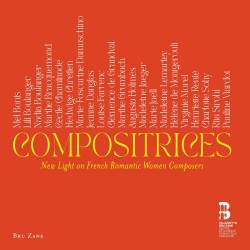
Among the musical figures to rally in support of the BBC Singers is the composer Judith Bingham, who has reached out to the Master of the King’s Music, Judith Weir, to plead the Singers’ cause. As it happens (and here comes the good news), this is a particularly happy week for the ever-increasing representation of women composers on disc, albeit those of earlier generations. The Palazzetto Bru Zane, renowned for its classily produced releases of French opera in particular, this week releases a wide-ranging 8-disc box set entitled Compositrices: New Light on French Romantic Women Composers. Although forsaking its luxury book format for a more standard capbox, it is still very attractively presented, even if the accompanying booklet (lavishly illustrated) lacks texts for the vocal works ranged across the collection.
The anthology is broad in scope – from exquisite salon miniatures to large-scale orchestra works – and the chronological reach is large. The earliest composer is Hélène de Montgeroult (1764–1836), with the even less well-known Virginie Morel (1799–1869) not far behind, while the most recent are Charlotte Sohy (1887–1955) and Nadia Boulanger (1887–1979). Alongside more familiar names – Louise Farrenc, Pauline Viardot, Cécile Chaminade, the Boulanger sisters – there are such rarities as Hedwige Chrétien, Marthe Bracquemond, Marie-Foscarine Damaschino, Marthe Grumbach, and the almost completely unknown Madeleine Lemariey (‘active early 20th century’ is the only biographical information). All are more than worthy of investigation.
So far we’ve only managed to listen closely to a fraction of the over 10 hours’ worth of music in this fascinating set, but what is already evident is the sheer range of styles and talents on offer, and the impressive standard of the recorded performances. Tenor Cyrille Dubois does the honours for all the piano-accompanied songs, a splendid achievement in itself, although a wider distribution of ranges involving other singers would sometimes have been welcomed. But these recordings were made in challenging times (2019–22), making the achievement all the more impressive. Solo and chamber music are similarly well served, while the orchestral contributions – all from French orchestras – are especially fine.
Sohy’s Symphony in C sharp minor (1917) is a particularly interesting find, its brooding opening reminiscent of Rachmaninov’s Isle of the Dead, while the fast concluding third movement contains many imaginative orchestral touches. A trio of orchestral works around 1909 by Mel Bonis show her to be a particularly deft orchestrator in the Impressionist vein, while a selection of her piano works on CD 3 contains passages of coruscating beauty. Morel’s eight Études mélodiques combine astonishing grace with dazzling velocity, and there’s a welcome new recording of Farrenc’s Mendelssohnian Third Symphony from the Orchestre national de Metz Grand Est under David Reiland. Finally, we’ll put in a word for the heady post-Wagnerian late Romanticism of Nadia Boulanger’s La Sirène (1908), a 30-minute sequence of three scenes for three solo voices and orchestra which shows this highly influential figure in 20th-century music at her most ambitious.
Just about anywhere you dip into this new Bru Zane box, there’s something to delight and surprise the ears, and collectively it’s a superb tribute to the tradition of women composers in France over a period of more than a century. At a most attractive price (about £5 per disc), this set is a much-needed tonic in what is in other respects rather a grim week for classical music.
BBC Singers (select discography)
Feshareki - Aetherworld NMCD266
B Hughes - I Am the Song SIGCD451
Birtwistle - Angel Fighter NMCD211
Weir - Storm SIGCD421
Brian - The Tigers SBT31496
Jackson - Airplane Cantata SIGCD381
Birtwistle - The Moth Requiem SIGCD368
Cowie - Gesangbuch SIGCD331
Payne - Phoenix Mass NMCD159
McCabe - Visions 8573053
Bennett - My Dancing Day SIGCD293
Bingham - Remoter Worlds SIGCD144
Maconchy - Music for Voices LNT127
One star, at last (Carols of our time) SIGCD067
Poulenc - Gloria, Stabat Mater CHAN9341
Swayne - Cry NMCD016
Latest Posts
Music of the Iberian Peninsula, Part 3: More observations on the Golden Age
16th June 2026
Our last visit to the Iberian peninsula, a fortnight ago, was an insanely ambitious, necessarily broad-brush survey of the Spanish and Portuguese Golden Age, covering vocal and instrumental music, the sacred and the secular. This week, we take a more concise and (I hope) focussed look at a few of the sacred vocal masterpieces which exemplify the particular fervour and intensity of this remarkable period of musical history. They reflect the special place the peninsula had as a bulwark against the Reformation that had taken... read more
read more
Music of the Iberian Peninsula, Part 3: More observations on the Golden Age
16th June 2026
Our last visit to the Iberian peninsula, a fortnight ago, was an insanely ambitious, necessarily broad-brush survey of the Spanish and Portuguese Golden Age, covering vocal and instrumental music, the sacred and the secular. This week, we take a more concise and (I hope) focussed look at a few of the sacred vocal masterpieces which exemplify the particular fervour and intensity of this remarkable period of musical history. They reflect the special place the peninsula had as a bulwark against the Reformation that had taken... read more
read more
Carl Schachter, Arnold Whittall, and why music analysis matters
9th June 2026
Two recent deaths have robbed the world of music analysis of a pair of its most revered figures. Carl Schachter, who has died at the age of 93, was a pupil of (and subsequently collaborator with) Felix Salzer, himself one of Heinrich Schenker’s foremost students. Schachter continued to enrich and broaden the teaching of Schenkerian analysis, including important work on its application to issues of rhythm (which Schenker, focussing on harmonic and contrapuntal matters, largely bypassed). His influence went well beyond the... read more
read more
Carl Schachter, Arnold Whittall, and why music analysis matters
9th June 2026
Two recent deaths have robbed the world of music analysis of a pair of its most revered figures. Carl Schachter, who has died at the age of 93, was a pupil of (and subsequently collaborator with) Felix Salzer, himself one of Heinrich Schenker’s foremost students. Schachter continued to enrich and broaden the teaching of Schenkerian analysis, including important work on its application to issues of rhythm (which Schenker, focussing on harmonic and contrapuntal matters, largely bypassed). His influence went well beyond the... read more
read more
Music of the Iberian Peninsula, Part 2: ‘O quam gloriosum’ – The Spanish and Portuguese Golden Age
2nd June 2026
Over the past fortnight, I’ve been bathed in the most glorious, radiant, transformative light. Not the UK’s recent unseasonable heatwave, but the extraordinary vocal polyphony of the Siglo de Oro: the Spanish (and Portuguese) ‘Golden Century’. Extending from the late 15th to the early 17th century, this was a time of remarkable artistic flowering on the Iberian Peninsula, coinciding with the emergence of Spain and Portugal as global imperial powers with extensive colonial territories in the Americas, Africa and Asia. The... read more
read more