 FREE UK SHIPPING OVER £35!
The Spin Doctor Europadisc's Weekly Column
When the Music Vanishes
12th May 2026
12th May 2026
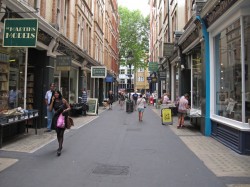 Many of you may think that classical music has already vanished from our streets. The days when a modest-sized city like Europadisc’s home patch in Nottingham could boast no fewer than three specialist classical shops are long gone. In central London, where the likes of Caruso & Co, Farringdon Records, Direction Dean Street and Orchesography plied their trade, even the tenacious Harold Moores in Great Marlborough finally shut up shop in early 2017. Mounting rents, business rates and online competition have been sounding the death knell for independent music retailers for years now, and the nose-dive that music education has taken since the Covid-19 outbreak has further intensified an already desperate situation.
Last week I was in London for the first night of the revival of Deborah Warner’s hard-hitting (and extremely topical) production of Britten’s Peter Grimes: a stunning achievement by all concerned, not least tenor Allan Clayton in the title role and Jakub Hrůša at the helm of the Covent Garden orchestra. As is customary on my London trips, I popped along to Cecil Court, one of the small pedestrian-only streets that run between St Martin’s Lane and Charing Cross Road, and the site of some of the capital’s best little antiquarian shops. To my horror, the redoubtable Travis & Emery, specialists in music and books about music for the last 65 years, was not only closed for the day but also announcing its imminent move (to an online presence only, it seems), effectively ending more than six decades of trading in the heart of London.
Just a stone’s throw away from the London Coliseum, and within easy walking distance of Covent Garden, Travis & Emery – for many years run by the formidable Valerie Emery, a former Bletchley Park codebreaker and widow of the Bach specialist Walter Emery – has been a treasured haven for musicians, music lovers and students amid the bustle of the West End. I’ve been a customer there on and off since my student days, more than four decades ago (!), and have lost track of the number of books and scores I’ve bought there, ranging from books on music theory and analysis, and life-and-works studies, to vocal scores of rare operas and programme booklets featuring legendary performers.
Among my most recent purchases were the four-volume New Grove Dictionary of Opera (long coveted!) and ‘back-up’ copies of biographies of Dvořák and Smetana. The disappearance of Travis & Emery from their central London base is not completely surprising: in a world where not just music literacy but also the market for writings about music is shrinking, and with rents as high as they surely are, it’s a miracle that they’ve lasted as long as they have. Take a look at the shops now attached to any opera house these days – even the ‘elite’ premises of Covent Garden and Glyndebourne – and, where once you’d find a generous array of specialist books on operatic subjects, not to mention libretti, today in their stead there’s a tenuously-related selection of merchandise, everything from pocket umbrellas and throws to soft toys, but almost nothing that is likely to enhance your appreciation of the works being performed.
Perhaps it is assumed that we have all we need to appreciate music and related arts via YouTube, streaming and AI. Yet the loss not just of music literacy but a wider audience for intelligent writings about music is certainly a cause for deep concern, and one that is likely to lead to the further closure of any specialist shops abroad. Even the revered Doblinger’s on Dorotheergasse in Vienna has been battling threats of closure, while its attached antiquarian music shop has already folded. Nothing, of course, is forever, but we do seem to be living through a kind of 'extinction era' as far as classical music provision via traditional shops is concerned.
I hope that Travis & Emery can find a way forward, and wish them will for the future. But it’s a sad day for those who relished the thrill of the chance purchase, the unlooked-for item that suddenly leapt out at one. It was just such a casual find that led me to snap up, on one of my more recent visits, a particularly beautiful facsimile of William Byrd’s great keyboard anthology My Ladye Nevells Booke. Other chance finds over the years include The Letters of Arturo Toscanini (ed. Harvey Sachs) with their mixture of private passions, professional insight and political commitment; the Diaries of Alma Mahler-Werfel (ed. Antony Beaumont), unmissable for their evocation of turn-of-the-century Vienna; and the Notebooks and Conversations of Sviatoslav Richter (ed. Bruno Monsaingeon), often deliciously indiscreet, and required reading for anyone interested in the phenomenon of this enigmatic genius.
Latest Posts

Music of the Iberian Peninsula, Part 2: ‘O quam gloriosum’ – The Spanish and Portuguese Golden Age
2nd June 2026
Over the past fortnight, I’ve been bathed in the most glorious, radiant, transformative light. Not the UK’s recent unseasonable heatwave, but the extraordinary vocal polyphony of the Siglo de Oro: the Spanish (and Portuguese) ‘Golden Century’. Extending from the late 15th to the early 17th century, this was a time of remarkable artistic flowering on the Iberian Peninsula, coinciding with the emergence of Spain and Portugal as global imperial powers with extensive colonial territories in the Americas, Africa and Asia. The... read more
read more
‘Call Me Flott’: A Tribute to Felicity Lott
26th May 2026
The acclaimed lyric soprano Felicity Lott, who has died at the age of 79, was an example of that rare breed among international singers: someone who combined star quality, wit, intelligence and humanity. During her half-century career she stood out for the refinement, clarity and textual responsiveness she brought to the music of Mozart and Richard Strauss, at a time when specialism in the former and sheer vocal power and OTT theatricality in the latter were increasingly the norm. These same strengths characterised her wider... read more
read more
Music of the Iberian Peninsula: Beginnings
19th May 2026
Nestling at the southwestern-most tip of Europe, the Iberian Peninsula has long held charms for the rest of the continent. It is still one of the most popular destination for west-European holidaymakers seeking a mixture of sun and exoticism. In the world of classical music, it has attracted composers from the Neapolitan expat Domenico Scarlatti, and French composers like Bizet, Chabrier and Ravel, to Rimsky-Korsakov in far-away St Petersburg. The allure of Hispania is partly due to its geographic location as a peninsula... read more
read more
Five Years of the Spin Doctor!
6th May 2026
A couple of weeks ago, I was told by Europadisc’s proprietor that it is now five years since we first launched the Spin Doctor column. Where has the time gone? The original brief was fairly succinct and deliberately left open to a wide range of options: to write a weekly column, roughly the same length as (or a little longer than) our Disc of the Week reviews, on any subject broadly related to recorded classical music. As the first columns appeared while the knock-on effects of the Covid pandemic were still being felt, the... read more
read more
Michael Tilson Thomas (1944–2026)
28th April 2026
For over half a century, the conductor, pianist, composer and pedagogue Michael Tilson Thomas, who has died at the age of 81, cut a distinctive figure on the international musical scene. Slim, graceful, often balletic on the podium, he brought a unique mixture of refinement and vitality to his music-making. A protégé and friend of Leonard Bernstein, he was just as committed to the championing of American music, though his tastes extended perhaps further, from Gershwin and Ives to Lou Harrison and Morton Feldman. And in the... read more
read more