 FREE UK SHIPPING OVER £35!
The Spin Doctor Europadisc's Weekly Column
Remembering Alfred Brendel
24th June 2025
24th June 2025
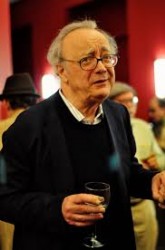 In the hushed closing bars of the development section, the solo pianist plays a blurred sequence of chromatically descending diminished chords over a rhythmicised dominant pedal in the horns. Suddenly, the piano interrupts itself with fortissimo octave Fs in the treble clef, and then a dramatic downward sweep of octave semiquavers leading back to the C major recapitulation in the full orchestra. This is the climactic midpoint of the first movement of Beethoven’s Piano Concerto no.1, and in the first of his four commercially released recordings (a rather sedate affair, recorded in Stuttgart in the mid-1960s), Alfred Brendel – who died last week at the age of 94 – plays it relatively straight, the descending semiquavers fingered out, although (as with many other pianists) this involves a fudge, missing out the thunderous bass G that underpins the descent.
How different is Brendel’s second recording from ten years later, with the London Philharmonic and Bernard Haitink! As well as being taken at a generally snappier tempo, at this crucial point he brings the bass G forward, so that it sounds after the top Fs, but before the cascading downward octaves, which are now executed as a giant glissando. It’s a thrilling solution to this Beethovenian challenge, and one that Brendel repeated in his subsequent recordings with Levine and Rattle. Other pianists have emulated this solution (among them Brendel’s former pupil Paul Lewis), but none so compellingly. For those who found Brendel’s playing too detached or cerebral, it’s a handy rejoinder, and one which highlights the pianist’s particular affinity with the witty and disruptive elements in Beethoven’s music.
Born on 5 January 1931 in Vízmberk, northwest Moravia (present-day Loučná nad Desnou, Czech Republic) to German-speaking parents, Brendel and his family moved when he was just three to Zagreb, where he started piano lessons. A few years later the family moved to Graz, where his piano lessons continued up to the age of 16; thereafter he was essentially self-taught. His first recital, in 1948, was of fugal works by Bach, Brahms, Liszt (a composer whose works he championed at a time of relative neglect) and himself: a bold and uncompromising programme for such a debut! At the same time, he was already exercising his literary and artistic talents, which he continued to nurture throughout his life, and for which he had more time following his retirement from public concert-giving sixty years later, in December 2008.
Apart from Liszt, early in his career Brendel championed the music of Busoni: he won fourth prize at the inaugural Ferruccio Busoni International Piano Competition in 1949, and in 1953 recorded the Fantasia contrappuntistica in Vienna for the American SPA label, whose recent reissue (along with the premiere recording of Liszt’s Weihnachtsbaum from 1952) on APR has been enthusiastically greeted. Other surprising entries in his early discography include Prokofiev’s Fifth Piano Concerto (1950: his first recording) and Balakirev’s Islamey. Although he had no formal piano tutoring from 16 onwards, Brendel attended masterclasses with Paul Baumgartner, Eduard Steuermann and Edwin Fischer.
It was the latter who, together with Cortot and Kempff, was one of the young Brendel’s pianistic models, and this influence helped to shape his focus on the classics: Bach and Mozart, but also Beethoven – apart from the concertos, Brendel’s 1960s recordings for Vox/Turnabout included his first cycle of the piano sonatas as well as the complete variations and bagatelles. Two later complete cycles of the sonatas on Philips cemented Brendel’s reputation as a Beethovenian of stature, distinguished from the aristocratic Arrau, the patrician clarity of Kempff, the sinewy strength of Gilels and the cool brilliance of Pollini by an unfussy authoritativeness, trusting in the score rather than any personal whim or fashion. (Brendel did not subscribe to historically-informed notions of authenticity: his was a different kind of authenticity, that of faith in the score and the work.)
Yet, even more than Beethoven, it was his championing of the piano music of Schubert and Haydn – both widely neglected over half a century ago – that defined Brendel’s career, and that brought out the best in him. The witty twinkle characteristic of Brendel the man, evident in his writings, his lectures and his private conversations, found an ideal foil in Haydn’s keyboard works, where the protean manipulation of a single thematic cell is the closest musical equivalent to the punning and wordplay of such geniuses as Leonardo, Shakespeare, Donne and Joyce. In Schubert, meanwhile, it helped in achieving a rare balance between gentle yet keen humour and uniquely vulnerable lyricism, all without a hint of sentimentality. Similarly his Mozart – including his Philips cycle of the piano concertos with the ASMF and Marriner, and the later selections with Mackerras and the Scottish Chamber Orchestra (an especially happy collaboration) – were totally devoid of kitsch without ever coming across as cool or detached.
Brendel’s partnerships with singers were rare but immensely rewarding, including acclaimed Winterreise recordings with Dietrich Fischer-Dieskau and Matthias Goerne. Yet if in the recording studio and the concert hall he increasingly concentrated on his ‘core repertoire’ of Haydn, Mozart, Beethoven, Schubert and Schumann, his musical tastes were adventurous. He was a particularly persuasive exponent of Schoenberg’s Piano Concerto (heard at its best in the later of his two recordings with conductor Michael Gielen), as well as a committed follower of the contemporary music scene, and was a familiar figure in concert audiences. He was especially close to Harrison Birtwistle, who in turn set some of Brendel’s wryly witty poems to music. I last saw them in lively conversation before a 2014 pre-concert talk in London, with Brendel praising Birtwistle’s new piano concerto Responses: Sweet Disorder: ‘You gave the piano its due, which is more than can be said of [Birtwistle’s earlier work] Antiphonies.’
My fondest memory of Brendel, however, is not a live event, but of wandering round Vienna’s Innere Stadt (old town, lit. ‘inner city’) to the accompaniment of his 1988 recording of Beethoven’s Diabelli Variations. The crisp rhythms, beautifully-judged speeds and explosive accents just the right side of idiosyncrasy all seemed a perfect match for the heady mixture of old imperial grandeur, side-street coffeehouse intimacy, and the shades of vanished musical geniuses that seem to haunt every corner. No wonder that Brendel returned to Vienna – a city where he had mixed fortune in the past – for his farewell concert in December 2008, with his old friend Charles Mackerras conducting the Vienna Philharmonic in Mozart’s ‘Jeunehomme’ Concerto, K271, an old Brendel favourite, and chosen, no doubt, with that trademark twinkle in the eye.
A few recommendations from the current listings:
Alfred Brendel plays Busoni & Liszt: The SPA Recordings APR_5655
Schubert - Complete Impromptus, Moments musicaux 4560612
Mozart - The Great Piano Concertos Vol.1: Nos. 19-21, 23 & 24 (ASMF / Marriner) 4422692
Alfred Brendel: My Musical Life (DVD) SU71419
Alfred Brendel: On Music (Three Lectures) (DVD) 703408
Alfred Brendel in Portrait (DVD) OA0811D
Latest Posts
Music of the Iberian Peninsula Part 4: The Spanish and Portuguese Baroque
30th June 2026
For many music lovers, the Baroque era immediately conjures images of Bach's intricate counterpoint, Handel's majestic choruses, Vivaldi’s dazzling violin concertos or Charpentier’s sumptuous vocal music. Yet on the southwestern edge of Europe another remarkable musical tradition flourished during the seventeenth and early eighteenth centuries. The Iberian Peninsula developed a distinctive Baroque voice that combined religious intensity, courtly sophistication and popular vitality. Drawing upon centuries of cultural exchange... read more
read more
Carl Maria von Weber: Visionary of German Romanticism
23rd June 2026
When audiences think of early nineteenth-century German music, the towering figures of Beethoven, Schubert, and later Wagner often dominate the conversation. Yet between the Classical world of Mozart and the mature Romanticism of Wagner stands a composer whose influence was both profound and transformative: Carl Maria von Weber (1786–1826). Composer, conductor, pianist, critic, and visionary dramatist, Weber played a pivotal role in shaping the future of German opera and helping define the musical language of... read more
read more
Music of the Iberian Peninsula, Part 3: More observations on the Golden Age
16th June 2026
Our last visit to the Iberian peninsula, a fortnight ago, was an insanely ambitious, necessarily broad-brush survey of the Spanish and Portuguese Golden Age, covering vocal and instrumental music, the sacred and the secular. This week, we take a more concise and (I hope) focussed look at a few of the sacred vocal masterpieces which exemplify the particular fervour and intensity of this remarkable period of musical history. They reflect the special place the peninsula had as a bulwark against the Reformation that had taken... read more
read more
Music of the Iberian Peninsula, Part 3: More observations on the Golden Age
16th June 2026
Our last visit to the Iberian peninsula, a fortnight ago, was an insanely ambitious, necessarily broad-brush survey of the Spanish and Portuguese Golden Age, covering vocal and instrumental music, the sacred and the secular. This week, we take a more concise and (I hope) focussed look at a few of the sacred vocal masterpieces which exemplify the particular fervour and intensity of this remarkable period of musical history. They reflect the special place the peninsula had as a bulwark against the Reformation that had taken... read more
read more
Carl Schachter, Arnold Whittall, and why music analysis matters
9th June 2026
Two recent deaths have robbed the world of music analysis of a pair of its most revered figures. Carl Schachter, who has died at the age of 93, was a pupil of (and subsequently collaborator with) Felix Salzer, himself one of Heinrich Schenker’s foremost students. Schachter continued to enrich and broaden the teaching of Schenkerian analysis, including important work on its application to issues of rhythm (which Schenker, focussing on harmonic and contrapuntal matters, largely bypassed). His influence went well beyond the... read more
read more