 FREE UK SHIPPING OVER £35!
The Spin Doctor Europadisc's Weekly Column
The Return of the Composer-Performer/Performer-Composer
9th August 2023
9th August 2023
 However familiar the idea of the ‘composer’ of music – the person who thinks up and writes down the notes – is to us now, it’s a relatively recent concept. Until a few centuries ago there were just musicians who, as part of their occupation, wrote music for performance by themselves and their colleagues. Some of the earliest named composers in the Western canon – figures like Léonin, Pérotin and (a little later) Machaut – were essentially clerics whose duties involved making music for the greater glory of God. Additionally, Machaut was a poet, and even if his total corpus of music hadn’t survived, he would still be remembered as one of the great literary figures of his age.
The association of individuals with the music they wrote began to take root in the Renaissance, when such figures as Dufay, Ockeghem and Josquin became renowned for their masses and motes, many of which achieved widespread popularity even among those who had no idea who the originators were. It was during the Baroque period – and especially with the advent of music publishing – that the notion of a composer of a piece of music really blossomed (which didn’t stop many works appearing with misattributions or in inaccurate editions!). Even then, the likes of Buxtehude, J.S. Bach and Vivaldi were best known to their contemporaries as performers (the first two as organists, the latter as a violinist).
In the Classical era, Mozart and Beethoven both made their names as brilliant pianists, with renown for their compositions coming later. Beethoven’s career as a performer was cut short by his encroaching deafness, and it is perhaps with the Beethoven Myth that the idea of the composer as distinct from both his performers and his audiences – in a sort of ivory compositional tower – really sank in. Nevertheless, the 19th century was also the heyday of the composer-performer, with Chopin, Liszt and Paganini heading the ranks of virtuosi who also wrote musically and technically demanding music. The Romantic tradition of the composer-performer had a late flowering in the figure of Rachmaninov, and even the early modernist Bartók had to support himself during his early years in the United States by playing, and was more renowned as a performer and ethnomusicologist than as a composer.
During the early years of the 20th century a proliferation of performer-composers headed by Leopold Godowsky and Fritz Kreisler gained wide popularity through their virtuoso transcriptions and pastiches, all essentially in a late Romantic idiom. In a less secular context, musicians active in the church, whether as organists or choral directors, continued to compose music either as part of their duties or as offshoots of it. Of the two best-known examples, most of Bruckner’s organ works were improvised rather than written down, while his choral music – motets and masses – remains a significant part of his output; Messiaen’s organ music – especially that on religious themes – bridges the supposed barrier between sacred and secular.
During the long Romantic era, composers from Berlioz and Wagner to Mahler, Strauss and even Elgar made a considerable mark as conductors, often in the music of others as much as themselves (Mahler was renowned for his Wagner performances, Strauss especially for his Mozart). During the 20th century, conductors including Furtwängler, Walter and Klemperer were active composers, although the relative merits of their works continue to be debated. Leopold Stokowski achieved huge success as a transcriber of everything from Bach and Purcell to Mussorgsky and Wagner in sensational orchestral versions.
Nothing better illustrates the divide in the common perception of composer and performer (‘we write the music; you perform it’) than the story of how Harrison Birtwistle sold his clarinets when he realised that he wanted to be a composer rather than a performer. And although many composers of the 20th century were extremely fine performers (Boulez, for example, as well as being a prominent conductor, was a pianist capable of performing his own sonatas, although rarely if ever in public), pianist-conductor-composers like Bernstein and Previn were the exception rather than the rule. (Mention should be made, however, of the Finnish conductor Leif Segerstam, who to date has composed an astonishing 352 symphonies!) Nevertheless there were a number of composers of more ‘highbrow’ music who specialised in performances of their own music, often through practical necessity, including such contrasting figures as Terry Riley, Gavin Bryars and Michael Finnissy.
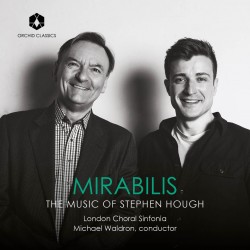
Recent years, however, have seen a flourishing of high-profile musicians who both perform and compose. Baritone Roderick Williams and pianist Stephen Hough have both achieved renown as composers in a broadly neo-Romantic idiom, and both have discs devoted to their choral music (that by Hough, including his Missa Mirabilis, is due for release next month.) The Turkish pianist Fazıl Say has also made his mark as a composer, with his music increasingly featuring in the programmes of other musicians. At the more challenging end of the spectrum, British composer Thomas Adès is widely known as a conductor (with a Beethoven symphony cycle to his name) as well as a pianist, while his own music, though often challenging, has met with considerable acclaim. Outstanding among the younger generation, the French vocalist Héloïse Werner has made a name for herself in music (including many of her own compositions) which frequently stretch the human voice to its limits.
Are we living in a new ‘golden era’ of composer-performers? As ever, time will tell, but this is a subject to which we hope to return soon. There are many other names to mention, particularly among younger musicians, who could take up several columns. For now, here’s a shortlist of our top recommendations from among today’s field.
Recommended recordings:
Adès conducts Adès - Piano Concerto, Totentanz (Gerstein, BSO) 4837998
Mirabilis: The Music of Stephen Hough (London Choral Sinfonia/Waldron) ORC100256
Hough, Dutilleux & Ravel - String Quartets (Takács Quartet) CDA68400
Troy Sonata: Fazıl Say plays Say 9029550465
4 Cities: Cello Sonatas by Say, Debussy, Janáček, Shostakovich (Altstaedt, Say) 9029586724
Héloïse Werner: Phrases (Werner et al.) DCD34269
R Williams - Sacred Choral Works (Trinity Laban Chapel Choir/Allwood) SIGCD517
A Shropshire Lad: English Songs Orchestrated by Roderick Williams (Williams, Halle/Elder) CDHLL7559
Latest Posts
Music of the Iberian Peninsula, Part 3: More observations on the Golden Age
16th June 2026
Our last visit to the Iberian peninsula, a fortnight ago, was an insanely ambitious, necessarily broad-brush survey of the Spanish and Portuguese Golden Age, covering vocal and instrumental music, the sacred and the secular. This week, we take a more concise and (I hope) focussed look at a few of the sacred vocal masterpieces which exemplify the particular fervour and intensity of this remarkable period of musical history. They reflect the special place the peninsula had as a bulwark against the Reformation that had taken... read more
read more
Music of the Iberian Peninsula, Part 3: More observations on the Golden Age
16th June 2026
Our last visit to the Iberian peninsula, a fortnight ago, was an insanely ambitious, necessarily broad-brush survey of the Spanish and Portuguese Golden Age, covering vocal and instrumental music, the sacred and the secular. This week, we take a more concise and (I hope) focussed look at a few of the sacred vocal masterpieces which exemplify the particular fervour and intensity of this remarkable period of musical history. They reflect the special place the peninsula had as a bulwark against the Reformation that had taken... read more
read more
Carl Schachter, Arnold Whittall, and why music analysis matters
9th June 2026
Two recent deaths have robbed the world of music analysis of a pair of its most revered figures. Carl Schachter, who has died at the age of 93, was a pupil of (and subsequently collaborator with) Felix Salzer, himself one of Heinrich Schenker’s foremost students. Schachter continued to enrich and broaden the teaching of Schenkerian analysis, including important work on its application to issues of rhythm (which Schenker, focussing on harmonic and contrapuntal matters, largely bypassed). His influence went well beyond the... read more
read more
Carl Schachter, Arnold Whittall, and why music analysis matters
9th June 2026
Two recent deaths have robbed the world of music analysis of a pair of its most revered figures. Carl Schachter, who has died at the age of 93, was a pupil of (and subsequently collaborator with) Felix Salzer, himself one of Heinrich Schenker’s foremost students. Schachter continued to enrich and broaden the teaching of Schenkerian analysis, including important work on its application to issues of rhythm (which Schenker, focussing on harmonic and contrapuntal matters, largely bypassed). His influence went well beyond the... read more
read more
Music of the Iberian Peninsula, Part 2: ‘O quam gloriosum’ – The Spanish and Portuguese Golden Age
2nd June 2026
Over the past fortnight, I’ve been bathed in the most glorious, radiant, transformative light. Not the UK’s recent unseasonable heatwave, but the extraordinary vocal polyphony of the Siglo de Oro: the Spanish (and Portuguese) ‘Golden Century’. Extending from the late 15th to the early 17th century, this was a time of remarkable artistic flowering on the Iberian Peninsula, coinciding with the emergence of Spain and Portugal as global imperial powers with extensive colonial territories in the Americas, Africa and Asia. The... read more
read more