 FREE UK SHIPPING OVER £35!
The Spin Doctor Europadisc's Weekly Column
How to Celebrate a Jubilee
31st May 2022
31st May 2022
 The music industry loves anniversaries. The centenaries, sesquicentenaries, bicentenaries (and so on) of composers’ births, deaths and other significant occasions (the 2013 centenary of Stravinsky’s Le Sacre du printemps, for example) provide excuses for new recordings, reissues and box-set compilations of varying enormity and expense. Even literary figures with musical leanings (like Proust) are celebrated with themed releases, as are other significant figures from history, including royalty. So it’s a little surprising that this year’s Platinum Jubilee, marking 70 years of the reign of Queen Elizabeth II, is being met with such a muted response from the classical record companies. Perhaps, with question marks over the health of the nonagenarian monarch, the forward planning necessary for a new recording was felt to be just too risky. Or maybe there’s a more widespread ambivalence among international industry executives to the whole issue of royalty in the 21st century.
The only release designed to coincide with the jubilee itself is Warner’s new remastering of the official recording of Elizabeth II’s coronation service, which actually took place 69 years ago, on 2 June 1953. Squeezed onto a single disc, this historic recording includes the inevitable coronation fare by Handel, Parry, Stanford and Walton, alongside choral works by Dyson, Gibbons, W.H. Harris, Vaughan Williams and Wesley, and specially-composed fanfares by Ernest Bullock (who had overseen the music for the coronation of George VI in 1937). Purely orchestral items by Elgar, Bax (the serving Master of the Queen’s Music) and Bliss (soon to become Bax’s successor) are not included. Nevertheless, for those who wish to celebrate over the Jubilee weekend, this timely reissue – resurrecting the packaging of the original 3-LP set – ticks many of the right boxes.
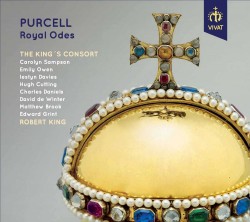
Looking further afield, there’s no shortage of discs with royal themes and dedicated celebratory music. For those who regard Stanford, Parry et al. as de rigueur on such occasions, Celebration: Royal Music from Westminster Abbey, featuring the Abbey Choir and London Brass under Martin Neary on the Musical Concepts label, is straight from the horse’s mouth, so to speak, and attractively priced to boot. Arguably even more impressive, however, is I Was Glad: Sacred Music of Stanford & Parry, with the King’s Consort and its Choir plus soloists Carolyn Sampson and David Wilson-Johnson under Robert King on the Vivat label. It includes a spine-tingling performance of the title track (complete, appropriately enough, with ‘Vivats’) in the version performed at George V’s coronation, and Sampson on radiant form in Stanford’s G major Service.
For those who regard the golden age of royal music as somewhat earlier, there is plenty to choose from. The King’s Consort, this time with the Choir of New College, Oxford, again deliver with their Hyperion recording of Handel’s four Coronation Anthems, coupled with an impressive account of the Music for the Royal Fireworks featuring specially-constructed giant timpani! Among other choirs to have recorded Handel’s anthems is The Sixteen under Harry Christophers, and two of the anthems (Zadok the Priest and Let thy hand be strengthened) feature on Music of the Kingdom, an impressively wide-ranging single-disc compilation of music reaching from the 15th-century Edmund Turges, via Tallis, Byrd, Gibbons and Purcell, all the way up to Britten’s Elizabethan-themed coronation tribute Gloriana.
More recently, The Sixteen’s discography has extended to a widely-acclaimed series of Purcell’s ‘Welcome Songs’ composed for Charles II (four volumes to date) and James II (a single disc), which throws new light on this under-appreciated corner of Restoration culture. Beautifully sung and played, in performances that bring out all the inventiveness as well as the surprising richness of the relatively restrained scorings, these releases are essential listening for anyone even remotely interested in this period of British musical history. The King’s Consort, too, has recently begun revisiting this territory on their own label, with two discs of Royal Odes so far revealing new depths of insight alongside their earlier complete survey for Hyperion from 1992. A welcome indication of how well this music ‘travels’ is a new disc of three of Purcell’s odes – Fly, bold rebellion, From those serene and rapturous joys and Why are all the Muses mute? – from Le Banquet Celeste and Damien Guillon on the Alpha label.
There are some, however, who would argue that the golden age of British and English royal music dates back still further – further back, indeed, than the Elizabethan and Tudor eras. We have previously sung the praises of The Binchois Consort under Andrew Kirkman for their immersively compelling Music for the King of Scots: Inside the Pleasure Palace of James IV. Just as absorbing, however, is Music for Henry V and the House of Lancaster, which includes gloriously forthright performances of jewels by such early English Renaissance composers as Leonel Power, Walter Frye, Thomas Damett and John Cooke, as well as a Gloria by one ‘Roy Henry’: King Henry V himself! This music from an age when life was fragile and precious feels surprisingly relevant to our own times, and an era when music was so valued that even monarchs took part in its creation is a timely corrective for a culture where the latest playlists can be streamed with a mere touch of the screen.
However you choose to spend the Jubilee holiday, there’s much more to explore musically than the inevitable parade of pop-culture artists currently billed to appear at the Palace on 4 June. Listen out for the new anthem by Judith Weir (the current Master of the Queen’s Music) at the St Paul’s service 3 June. And wouldn’t a fine (if belated) tribute be a survey of new British classical music across the changing landscape of the past 70 years? Record companies: it’s no too late to redeem yourselves!
A few recommendations:
The Coronation of HM Queen Elizabeth II: Music from the Official Recording 5419714933
Celebration: Royal Music from Westminster Abbey MC144
I Was Glad: Sacred Music of Stanford & Parry VIVAT101
Handel - Fireworks Music and Coronation Anthems CDA66350
Music of the Kingdom COR16122
Purcell - Royal Welcome Songs for King Charles II (Vol.1) COR16163
Purcell - Royal Odes (King’s Consort) VIVAT121
Purcell - Royal Odes (Le Banquet Celeste) ALPHA780
Music for Henry V and the House of Lancaster CDA67868
Latest Posts
Music of the Iberian Peninsula, Part 3: More observations on the Golden Age
16th June 2026
Our last visit to the Iberian peninsula, a fortnight ago, was an insanely ambitious, necessarily broad-brush survey of the Spanish and Portuguese Golden Age, covering vocal and instrumental music, the sacred and the secular. This week, we take a more concise and (I hope) focussed look at a few of the sacred vocal masterpieces which exemplify the particular fervour and intensity of this remarkable period of musical history. They reflect the special place the peninsula had as a bulwark against the Reformation that had taken... read more
read more
Music of the Iberian Peninsula, Part 3: More observations on the Golden Age
16th June 2026
Our last visit to the Iberian peninsula, a fortnight ago, was an insanely ambitious, necessarily broad-brush survey of the Spanish and Portuguese Golden Age, covering vocal and instrumental music, the sacred and the secular. This week, we take a more concise and (I hope) focussed look at a few of the sacred vocal masterpieces which exemplify the particular fervour and intensity of this remarkable period of musical history. They reflect the special place the peninsula had as a bulwark against the Reformation that had taken... read more
read more
Carl Schachter, Arnold Whittall, and why music analysis matters
9th June 2026
Two recent deaths have robbed the world of music analysis of a pair of its most revered figures. Carl Schachter, who has died at the age of 93, was a pupil of (and subsequently collaborator with) Felix Salzer, himself one of Heinrich Schenker’s foremost students. Schachter continued to enrich and broaden the teaching of Schenkerian analysis, including important work on its application to issues of rhythm (which Schenker, focussing on harmonic and contrapuntal matters, largely bypassed). His influence went well beyond the... read more
read more
Carl Schachter, Arnold Whittall, and why music analysis matters
9th June 2026
Two recent deaths have robbed the world of music analysis of a pair of its most revered figures. Carl Schachter, who has died at the age of 93, was a pupil of (and subsequently collaborator with) Felix Salzer, himself one of Heinrich Schenker’s foremost students. Schachter continued to enrich and broaden the teaching of Schenkerian analysis, including important work on its application to issues of rhythm (which Schenker, focussing on harmonic and contrapuntal matters, largely bypassed). His influence went well beyond the... read more
read more
Music of the Iberian Peninsula, Part 2: ‘O quam gloriosum’ – The Spanish and Portuguese Golden Age
2nd June 2026
Over the past fortnight, I’ve been bathed in the most glorious, radiant, transformative light. Not the UK’s recent unseasonable heatwave, but the extraordinary vocal polyphony of the Siglo de Oro: the Spanish (and Portuguese) ‘Golden Century’. Extending from the late 15th to the early 17th century, this was a time of remarkable artistic flowering on the Iberian Peninsula, coinciding with the emergence of Spain and Portugal as global imperial powers with extensive colonial territories in the Americas, Africa and Asia. The... read more
read more