 FREE UK SHIPPING OVER £35!
The Spin Doctor Europadisc's Weekly Column
Remembering Birtwistle
21st April 2022
21st April 2022
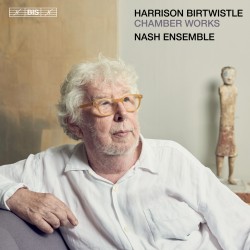 Those who know Harrison Birtwistle’s music only from such headline-grabbing works as Punch and Judy, Earth Dances and the now-notorious Last Night of the Proms premiere Panic may be surprised to know that the composer himself was one of the gentlest, sweetest souls one could ever meet. Certainly there was an underlying steely determination and self-belief that is evident even in the seemingly slightest of his works, not to mention the occasional grunting, curmudgeonly aside – the result of a fundamentally shy, introspective and melancholy nature, and years of facing down reactionary objections to his music. Yet his wonderfully dry wit, his gift for deadpan non sequitur, delivered with a twinkle in the eye, and interest in friends and colleagues, earned him the lasting love and respect of those with whom he worked and came into contact through his art. Throughout the new music community, he was affectionately known simply as ‘Harry’.
Harrison Birtwistle, who died on 19 April 2022 at his home in Wiltshire at the age of 87, was in many ways an old-fashioned composer. He worked, at the most basic level, with pitches, duration and their organisation. Notions of ‘inspiration’ were alien to him, although his music was deeply rooted in the landscape of rural Lancashire around Accrington, where he grew up. An aptitude for the clarinet was developed by playing in a local wind band and in the theatre pit for G&S operettas, and eventually earned him a place at the Royal Manchester College of Music in 1952. While there, along with contemporaries Peter Maxwell Davies, Alexander Goehr, pianist John Ogdon and trumpeter Elgar Howarth, he formed the New Music Manchester group, cofounding the Pierrot Players, and encountered such crucial musical influences as Stravinsky, Messiaen and Varèse – very different from the British musical mainstream of the time. Birtwistle and Davies’s shared interest in medieval music led to an abiding fascination with organisational principles in music such as isorhythm.
After national service and further clarinet studies at the Royal Academy of Music with Reginald Kell, Birtwistle seemed to be set on the path to becoming a performing musician. However, the acceptance of his 1957 wind quintet Refrains and Choruses for the 1959 Cheltenham Festival put him decisively on the creative path of the composer (as a declaration of intent, he subsequently sold his clarinets). Two further ensemble works, the violently gestural Tragoedia for 10 players (1965, its formal divisions derived from classical Greek theatre) and the powerful Verses for Ensembles (1968-69) established Birtwistle as a force to be reckoned with. During a period in the States he finished his first substantial music theatre piece, the ‘tragical comedy or comical tragedy’ Punch and Judy, which premiered at the 1968 Aldeburgh Festival and is said to have caused Benjamin Britten and Peter Pears to walk out at the interval.
Punch and Judy, like Tragoedia, reveals Birtwistle’s enduring concern with ritual and myth, both of which became recurring themes throughout his oeuvre, sometimes overtly, more often at deep structural and organisational levels. Another key work, the large-scale orchestral piece The Triumph of Time (1971), together with Melencolia I (1976), evinced a fascination with the Renaissance engravings of Albrecht Dürer, and more importantly with confronting the issue of unfolding time as well as a special attraction to the melancholic muse. The slow-moving wheels of The Triumph of Time in particular were prophetic of things to come.
In 1984, Birwtistle composed the third in a ‘trilogy’ of commissions from the London Sinfonietta, Secret Theatre, premiered at his 50th birthday concert. Its preoccupation with line and pulse, with soloists and ensemble, ‘cantus’ and ‘continuum’, and its requirement for soloists to walk to positions separate from the main ensemble, made visible (and audible) Birtwistle’s fascination with ritual and the theatrical. He was the first music director of Peter Hall’s National Theatre from 1975, and his bold, spare music for the National’s production of The Oresteia in Tony Harrison’s northern vernacular translation played a large part in its success.
Throughout the 1970s and the first half of the 80s, Birtwistle devoted much of his time to the vast operatic project, initially commissioned by the Royal Opera House, that was to become The Mask of Orpheus, eventually premiered by English National Opera to huge acclaim in 1986. Setting a complex, multi-layered libretto by Peter Zinovieff, with a vast orchestra of wind and percussion requiring two conductors, and with crucial electronic components realised by Barry Anderson, this was a re-examination of the Orpheus myth from multiple perspectives, with each of the three main characters (Orpheus, Eurydice and Aristaeus) represented in triplicate (as human, as hero and as myth). The mind-boggling intricacies of the score and libretto did nothing to detract from the epic sweep of the score, its archetypal power, or indeed its moments of extreme lyric beauty, all in Birtwistle’s own uncompromisingly challenging musical idiom.
1986 also saw the premiere of the huge orchestral work Earth Dances, whose title refers to the quasi-geological layering of levels of musical organisation, moving at different rates and in different registers, so that one senses the Earth itself literally ‘dancing’. Hailed as a Rite of Spring for the 1980s, this work, and the subsequent premiere of the ‘mechanical pastoral’ chamber opera Yan Tan Tethera, with its roots in English folk myth and landscape, cemented Birtwistle’s position as the leading British composer of his generation, as well as earning much attention from international performers. Many commentators date Birtwistle’s ‘late style’ from this time.
The 1980s also saw an increasing focus on songs for voice with ensemble accompaniment, in such works as Songs by Myself (1984), Words Overheard (1985) and Four Songs of Autumn (1986). Birtwistle’s highpoint as a song composer came a little later, however, with the settings of Paul Celan that alternate with string quartet movements in Pulse Shadows (1989-96), and the Nine Settings of Lorine Niedecker (1998-2000). But Birtwistle’s highest profile works undoubtedly remained his operas, among which the large-scale Gawain (1990-91), The Second Mrs Kong (1993-94) and The Minotaur (2005-07) are the outstanding examples. Nevertheless, it was an orchestral work, Panic for saxophone, drum kit, winds and percussion, commissioned for the 1995 Last Night of the Proms that brought him to widest attention and notoriety. A work of dithyrambic elementalism and uncompromisingly modernist musical language, it was bound to raise the hackles of the traditionalists, yet it has held up astonishingly well to repeated performance and listening in the years since (much like its ‘sister’ work, Endless Parade for trumpet, vibraphone and strings, of 1986-87).
A few recommended recordings:
The Mask of Orpheus (BBCSO / Davis, Brabbins) NMCD050
Secret Theatre etc. (London Sinfonietta / Howarth) NMCD148
Gawain (ROH / Howarth) NMCD200
The Minotaur (ROH / Pappano) OA1000D / OABD7052D
Songs (Alice Rossi, Das Neue Ensemble, Kuss Quartet et al.) TOCC0281
Chamber Works (Nash Ensemble) BIS2561
On a dark day for classical music, the deaths have also been announced of two astonishing classical performers: the legendary Romanian pianist Radu Lupu at the age of 76 (renowned above all for his peerless Schubert and Brahms), and the American pianist Nicholas Angelich, frequent chamber music collaborator with Martha Argerich and a considerable soloist in his own right, at the far too young age of 51. We mourn them both.
Latest Posts
Music of the Iberian Peninsula, Part 3: More observations on the Golden Age
16th June 2026
Our last visit to the Iberian peninsula, a fortnight ago, was an insanely ambitious, necessarily broad-brush survey of the Spanish and Portuguese Golden Age, covering vocal and instrumental music, the sacred and the secular. This week, we take a more concise and (I hope) focussed look at a few of the sacred vocal masterpieces which exemplify the particular fervour and intensity of this remarkable period of musical history. They reflect the special place the peninsula had as a bulwark against the Reformation that had taken... read more
read more
Music of the Iberian Peninsula, Part 3: More observations on the Golden Age
16th June 2026
Our last visit to the Iberian peninsula, a fortnight ago, was an insanely ambitious, necessarily broad-brush survey of the Spanish and Portuguese Golden Age, covering vocal and instrumental music, the sacred and the secular. This week, we take a more concise and (I hope) focussed look at a few of the sacred vocal masterpieces which exemplify the particular fervour and intensity of this remarkable period of musical history. They reflect the special place the peninsula had as a bulwark against the Reformation that had taken... read more
read more
Carl Schachter, Arnold Whittall, and why music analysis matters
9th June 2026
Two recent deaths have robbed the world of music analysis of a pair of its most revered figures. Carl Schachter, who has died at the age of 93, was a pupil of (and subsequently collaborator with) Felix Salzer, himself one of Heinrich Schenker’s foremost students. Schachter continued to enrich and broaden the teaching of Schenkerian analysis, including important work on its application to issues of rhythm (which Schenker, focussing on harmonic and contrapuntal matters, largely bypassed). His influence went well beyond the... read more
read more
Carl Schachter, Arnold Whittall, and why music analysis matters
9th June 2026
Two recent deaths have robbed the world of music analysis of a pair of its most revered figures. Carl Schachter, who has died at the age of 93, was a pupil of (and subsequently collaborator with) Felix Salzer, himself one of Heinrich Schenker’s foremost students. Schachter continued to enrich and broaden the teaching of Schenkerian analysis, including important work on its application to issues of rhythm (which Schenker, focussing on harmonic and contrapuntal matters, largely bypassed). His influence went well beyond the... read more
read more
Music of the Iberian Peninsula, Part 2: ‘O quam gloriosum’ – The Spanish and Portuguese Golden Age
2nd June 2026
Over the past fortnight, I’ve been bathed in the most glorious, radiant, transformative light. Not the UK’s recent unseasonable heatwave, but the extraordinary vocal polyphony of the Siglo de Oro: the Spanish (and Portuguese) ‘Golden Century’. Extending from the late 15th to the early 17th century, this was a time of remarkable artistic flowering on the Iberian Peninsula, coinciding with the emergence of Spain and Portugal as global imperial powers with extensive colonial territories in the Americas, Africa and Asia. The... read more
read more