 FREE UK SHIPPING OVER £35!
The Spin Doctor Europadisc's Weekly Column
From the BBC Archives: BBC Legends Vol.3
15th March 2023
15th March 2023
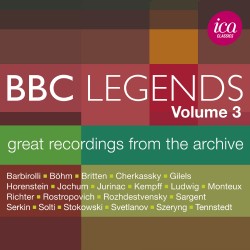 The recent spiral of apparent wilful self-destructiveness at the BBC has caused dismay among many of our regular respondents to this column. How timely, then, that a new box of BBC Legends – delayed from its original release date because of production issues – has finally become available thanks to the efforts of ICA Classics. A 20-disc set of ‘great recordings from the archive’, all of which were originally issued separately, brings together many legendary conductors and soloists from what now seems like a golden age of radio broadcasts. As with volumes 1 and 2 of this series, volume 3 is sure to disappear quickly, despite the fact that – unlike the original single-disc releases – it comes without any supporting documentation (apart from basic recording information on the back of the individual wallets). Still, at less than £4 per disc, this set is unlikely to set you back anything like as much as seeking out the original discs, many of which now exchange hands for high prices second-hand.
Chronologically, these recordings – from a mixture of mono and stereo tapes – range from April 1957 (Emil Gilels in Beethoven, Scriabin and Prokofiev, in remarkably vivid sound) to August 1987 (Gennadi Rozhdestvensky and the BBC Symphony Orchestra in ballet music by Tchaikovsky and Stravinsky). The sound quality ranges from more than acceptable to only just tolerable (a muddy, rather constricted Mozart Requiem from the 1971 Aldeburgh Festival under Benjamin Britten, and Beethoven’s ‘Choral’ Symphony from the London Philharmonic Orchestra and Klaus Tennstedt at the Royal Festival Hall with inexplicably wayward balance).
Among the orchestral performances, a 1977 RFH concert of the Second Symphonies of Schubert and Brahms from the London Symphony Orchestra and Karl Böhm, and a pair of late Haydn symphonies (nos. 100 and 101) from the LPO under Eugen Jochum at the same venue in 1973, amply demonstrate why these conductors’ live performances frequently outshine their studio recordings in terms of spontaneity and élan. A marvellously clear-headed and (in its later stages) vibrant ‘Eroica’ Symphony from Pierre Monteux and the Royal Philharmonic Orchestra from November 1960 stands comparison with his two studio accounts from Vienna and Amsterdam, while a lively account of Strauss’s Don Juan with the BBC Northern Symphony Orchestra from the following month shows why Monteux should never be underestimated in the Germanic repertoire.
Other orchestral discs worth savouring are Elgar’s Introduction and Allegro and First Symphony from John Barbirolli and the Hallé Orchestra at the 1970 King’s Lynn Festival (recorded just a few days before the conductor’s death), and a powerful 1984 account of Schubert’s ‘Great’ C major Symphony from the LPO and Tennstedt at the RFH, in mercifully better sound than the above-mentioned ‘Choral’ Symphony. The BBC Symphony Orchestra isn’t as extensively represented as one would like, but its contributions are all fine ones: Sibelius’s Second Symphony under Stokowski at the 1964 Proms, building from a slow opening to a tremendously thrilling close, rugged accounts of the Fourth Symphonies of Vaughan Williams and Sibelius under Malcolm Sargent (at the 1963 and 1965 Proms respectively), and a winning performance of Act 2 of Tchaikovsky’s Nutcracker under Rozhdestvensky, complemented by Stravinsky’s Scènes de ballet and (from April 1981) excerpts from Shostakovich’s The Bolt. Each of these recordings adds force to the argument for securing the BBCSO’s important place in the UK’s musical life.
The BBCSO and Sargent also feature in a 1961 Proms account of Strauss’s Four Last Songs from the great Austrian soprano Sena Jurinac, a nicely animated account that stands in welcome contrast to some of the more soupily indulgent performances out there, and in which one soon forgets the limitations of the ‘period’ Royal Albert Hall sound. The rest of that disc is given over to another great singer, mezzo-soprano Christa Ludwig: Mahler’s Lieder eines fahrenden Gesellen with the Philharmonia Orchestra under André Cluytens, captured in clean, well-focussed sound from the RFH in December 1957, and songs by Mahler, Brahms and Richard Strauss from the Wigmore Hall in 1978 accompanied by Geoffrey Parsons.
In concerto repertoire, Shura Cherkassky is by turns imposing and animated in Tchaikovsky’s First Piano Concerto with Solti and the LSO at the Festival Hall in January 1968 (stereo), the main coupling being an exciting 1982 Wigmore Hall performance of Mussorgsky’s Pictures at an Exhbition with Cherkassky on dazzling form. Mstislav Rostropovich is on peak form in July 1965 RFH performances with the LSO of cello concertos by Haydn, Saint-Saëns and Elgar (the latter two conducted by Rozhdestvensky). Henryk Szeryng’s 1972 account of Vivaldi’s Four Seasons with the English Chamber Orchestra sounds a tad dated by today’s historically-informed standards, but anyone who yearns for the ’good old days’ of plentiful vibrato and unashamed virtuosity will find much to enjoy in these performances from the Queen Elizabeth Hall, the main coupling being a pert performance of Mozart’s Violin Concerto no.3.
Solo recitals by Wilhelm Kempff (marvellously lucid Bach, Beethoven and Schubert from 1969), Sviatoslav Richter (Beethoven, Schumann, a typically forthright Schubert ‘Wanderer’ Fantasy, and a thrilling Chopin C sharp minor Étude encore, all from 1963), Rudolf Serkin (Bach, Reger and Beethoven – a splendid ‘Waldstein’! – from 1973, and Gilels (including Scarlatti and Debussy from 1984) complete a starry line-up of performances.
Although representing only the tiniest fraction of the BBC’s vast archive of classical performances from the past 80-or-so years, all these discs provide a salutary reminder of the importance of a national broadcaster in preserving historical performances by great musicians – including their own house orchestras. No wonder these limited-edition box sets have a habit of selling out very quickly!
The Recording:
BBC Legends Vol.3 ICAB5167
Latest Posts
Music of the Iberian Peninsula, Part 3: More observations on the Golden Age
16th June 2026
Our last visit to the Iberian peninsula, a fortnight ago, was an insanely ambitious, necessarily broad-brush survey of the Spanish and Portuguese Golden Age, covering vocal and instrumental music, the sacred and the secular. This week, we take a more concise and (I hope) focussed look at a few of the sacred vocal masterpieces which exemplify the particular fervour and intensity of this remarkable period of musical history. They reflect the special place the peninsula had as a bulwark against the Reformation that had taken... read more
read more
Music of the Iberian Peninsula, Part 3: More observations on the Golden Age
16th June 2026
Our last visit to the Iberian peninsula, a fortnight ago, was an insanely ambitious, necessarily broad-brush survey of the Spanish and Portuguese Golden Age, covering vocal and instrumental music, the sacred and the secular. This week, we take a more concise and (I hope) focussed look at a few of the sacred vocal masterpieces which exemplify the particular fervour and intensity of this remarkable period of musical history. They reflect the special place the peninsula had as a bulwark against the Reformation that had taken... read more
read more
Carl Schachter, Arnold Whittall, and why music analysis matters
9th June 2026
Two recent deaths have robbed the world of music analysis of a pair of its most revered figures. Carl Schachter, who has died at the age of 93, was a pupil of (and subsequently collaborator with) Felix Salzer, himself one of Heinrich Schenker’s foremost students. Schachter continued to enrich and broaden the teaching of Schenkerian analysis, including important work on its application to issues of rhythm (which Schenker, focussing on harmonic and contrapuntal matters, largely bypassed). His influence went well beyond the... read more
read more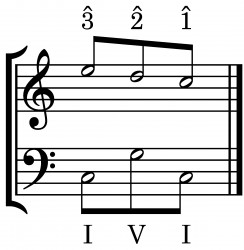
Carl Schachter, Arnold Whittall, and why music analysis matters
9th June 2026
Two recent deaths have robbed the world of music analysis of a pair of its most revered figures. Carl Schachter, who has died at the age of 93, was a pupil of (and subsequently collaborator with) Felix Salzer, himself one of Heinrich Schenker’s foremost students. Schachter continued to enrich and broaden the teaching of Schenkerian analysis, including important work on its application to issues of rhythm (which Schenker, focussing on harmonic and contrapuntal matters, largely bypassed). His influence went well beyond the... read more
read more
Music of the Iberian Peninsula, Part 2: ‘O quam gloriosum’ – The Spanish and Portuguese Golden Age
2nd June 2026
Over the past fortnight, I’ve been bathed in the most glorious, radiant, transformative light. Not the UK’s recent unseasonable heatwave, but the extraordinary vocal polyphony of the Siglo de Oro: the Spanish (and Portuguese) ‘Golden Century’. Extending from the late 15th to the early 17th century, this was a time of remarkable artistic flowering on the Iberian Peninsula, coinciding with the emergence of Spain and Portugal as global imperial powers with extensive colonial territories in the Americas, Africa and Asia. The... read more
read more