 FREE UK SHIPPING OVER £35!
The Spin Doctor Europadisc's Weekly Column
Voices Unsung: Considering Melodrama
18th January 2023
18th January 2023
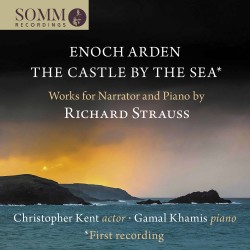 An upcoming release of Stravinsky's The Soldier's Tale from musicians of the Hallé Orchestra under Mark Elder (for release next month) got the Spin Doctor thinking about other vocal works in which the voices, rather than singing, declaim in speech. The practice, known as melodrama, whereby the spoken word alternates with (or in some instances is declaimed over) passages of music, is more widespread than one might think, and an often overlooked corner of the vocal repertoire. Commentators are divided on whether melodrama constitutes a distinct genre, or instead merely a technique: in fact, examples of both abound. The most famous instances of the technique on the operatic stage are the dungeon scene in Act 2 of Beethoven's Fidelio and the Wolf's Glen scene in Weber's Der Freischütz.
The roots of melodrama go back to the mid-1700s, although the use of music and speech together for dramatic ends is probably as old as drama itself. But the creation of works with the aim of balancing the two is generally traced back to Jean-Jacques Rousseau, whose 1762 ‘scène lyrique’ Pygmalion was first set to music by Horace Coignet (1770). Further melodramatic settings of Rousseau's text, in German, by Anton Schweitzer (now lost) and Franz Asplmayer further raised its profile, particularly in Vienna. But it was a 1779 setting of Rousseau's 'monodrama' by the Bohemian musician Georg Benda that had the most impact, together with his earlier settings of the 'duodramas' (what television producers would call 'two-headers') Ariadne auf Naxos (1775, text by J.C. Brandes) and Medea (1775, Gotter). Mozart wrote enthusiastically of the two latter works to his father Leopold in 1778-79, and it is thus unsurprising that he himself employed the technique to great effect in two numbers of his incomplete Singspiel Zaide of the same years.
Italian examples of melodrama (known in Italian as 'melologo') include Pugnani's Werther (c.1790), but it was in German-speaking countries that the technique really took root. While in France the melodrama generally took the form of short, independent episodes of music alternating with the spoken text, German settings tended towards greater continuity of thought and musical integrity. This is why works such as Benda's Pygmalion, however contrived or self-conscious they might feel to us today, still manage to maintain an artistic unity that withstands the tests of time.
In the course of the 19th century, the techniques of melodrama were increasingly widely used: apart from Fidelio, Beethoven used melodrama in his music for The Ruins of Athens, König Stephan and Egmont (in the latter's the penultimate number, the hero's farewell to life). Schubert made use of it in Die Zauberharfe, Des Teufels Lustschloss and three numbers in Fierrabras; but perhaps his most interesting deployment of melodrama is in the voice-and-piano setting Abschied von der Erde, D829 (1826), where the voice recites the poem over the piano accompaniment. The works of other, minor Viennese composers too made the Habsburg capital a thriving centre for melodrama.
Melodrama features prominently in many works of the French Revolutionary opéra comique (including Cherubini's Les Deux Journées of 1800). In Italy, meanwhile, it became standard practice to use melodrama to signal the reading of letters during the course of the action, as shown by Verdi in Macbeth and La traviata. A particularly vibrant branch of melodrama thrived in the Czech lands, among which Fibich's Hippodamia trilogy (1910-13) is an outstanding example, while Ludvík Čelanský (1870-1930) – now remembered, if at all, as the founding conductor the Czech Philharmonic Orchestra – composed at least half a dozen examples.
Nevertheless, it was Vienna that continued to nourish the genre into the 20th century: Schoenberg used the technique to various extents in such works as Gurrelieder, Pierrot lunaire, Die Jakobsleiter, Die glückliche Hand and Moses und Aron (where it signifies Moses's inability to communicate directly with the people he leads), while passages in Berg's operas Wozzeck and Lulu reflect its continuing influence and potency. Casting the net somewhat wider, works as various as Busoni's Arlecchino, Walton's Façade, Weill's Happy End and Stravinsky's Perséphone all tapped into the powerful expressive possibilities (part heightening of speech, part distancing) of juxtaposing speech with music. One of the best-known examples remains one of Richard Strauss's lesser-known works, his 1897 setting of Tennyson's Enoch Arden, which became a speciality of Dietrich Fischer-Dieskau's in his later years, and which has also attracted actors of the calibre of the late Bruno Ganz (best known to international audiences for his role in the 2004 film Downfall about Hitler's final days).
Although the blurring of genre distinctions and musical techniques in the late 20th and early 21st centuries makes tracing the continued influence of melodrama rather tricky, the fruits of its almost two centuries of existence are ripe for exploration, by musicians, audiences and (we hope) recording companies.
Further reading:
Sarah Hibberd (ed.): Melodramatic Voices: Understanding Music Drama (Farnham: Ashgate Publishing, 2011)
Recommended recordings:
Benda - Pygmalion (Patzke, Apotheosis Orchestra / Bernolet) RAM1809
Schubert - Abschied von der Erde (AL Richter / Huber) PTC5186839
R Strauss - Enoch Arden, The Castle by the Sea (Kent / Khamis) SOMMCD0651
R Strauss - Enoch Arden (Ganz / Gerstein) MYR025
Latest Posts
Music of the Iberian Peninsula, Part 3: More observations on the Golden Age
16th June 2026
Our last visit to the Iberian peninsula, a fortnight ago, was an insanely ambitious, necessarily broad-brush survey of the Spanish and Portuguese Golden Age, covering vocal and instrumental music, the sacred and the secular. This week, we take a more concise and (I hope) focussed look at a few of the sacred vocal masterpieces which exemplify the particular fervour and intensity of this remarkable period of musical history. They reflect the special place the peninsula had as a bulwark against the Reformation that had taken... read more
read more
Music of the Iberian Peninsula, Part 3: More observations on the Golden Age
16th June 2026
Our last visit to the Iberian peninsula, a fortnight ago, was an insanely ambitious, necessarily broad-brush survey of the Spanish and Portuguese Golden Age, covering vocal and instrumental music, the sacred and the secular. This week, we take a more concise and (I hope) focussed look at a few of the sacred vocal masterpieces which exemplify the particular fervour and intensity of this remarkable period of musical history. They reflect the special place the peninsula had as a bulwark against the Reformation that had taken... read more
read more
Carl Schachter, Arnold Whittall, and why music analysis matters
9th June 2026
Two recent deaths have robbed the world of music analysis of a pair of its most revered figures. Carl Schachter, who has died at the age of 93, was a pupil of (and subsequently collaborator with) Felix Salzer, himself one of Heinrich Schenker’s foremost students. Schachter continued to enrich and broaden the teaching of Schenkerian analysis, including important work on its application to issues of rhythm (which Schenker, focussing on harmonic and contrapuntal matters, largely bypassed). His influence went well beyond the... read more
read more
Carl Schachter, Arnold Whittall, and why music analysis matters
9th June 2026
Two recent deaths have robbed the world of music analysis of a pair of its most revered figures. Carl Schachter, who has died at the age of 93, was a pupil of (and subsequently collaborator with) Felix Salzer, himself one of Heinrich Schenker’s foremost students. Schachter continued to enrich and broaden the teaching of Schenkerian analysis, including important work on its application to issues of rhythm (which Schenker, focussing on harmonic and contrapuntal matters, largely bypassed). His influence went well beyond the... read more
read more
Music of the Iberian Peninsula, Part 2: ‘O quam gloriosum’ – The Spanish and Portuguese Golden Age
2nd June 2026
Over the past fortnight, I’ve been bathed in the most glorious, radiant, transformative light. Not the UK’s recent unseasonable heatwave, but the extraordinary vocal polyphony of the Siglo de Oro: the Spanish (and Portuguese) ‘Golden Century’. Extending from the late 15th to the early 17th century, this was a time of remarkable artistic flowering on the Iberian Peninsula, coinciding with the emergence of Spain and Portugal as global imperial powers with extensive colonial territories in the Americas, Africa and Asia. The... read more
read more