 FREE UK SHIPPING OVER £35!
The Spin Doctor Europadisc's Weekly Column
Works in Focus: Hans Rott's Symphony in E major
19th October 2022
19th October 2022
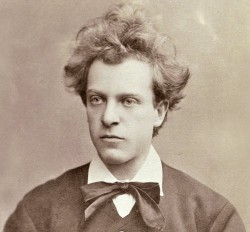 At the time of the centenary of his death, the composer Hans Rott (1858-1884) was virtually unknown to all but a few specialists in the music of Bruckner and Mahler. He had studied organ and composition with the former as a gifted but ill-fated student at the Vienna Conservatory, where the latter was not only a contemporary but a room-mate. His surviving output – encompassing songs, chamber music and several orchestral pieces – was saved for posterity after his tragically early death (from tuberculosis, following a complete mental breakdown in late 1880) by a couple of admirers, the philologist Josef Seemüller and the architect Friedrich Löhr. In June 1878 Bruckner had hailed Rott as 'a talented most charming and unassuming ... [who] improvises wonderfully. ... He is my best pupil so far.'
Rott's biggest impact, however, was on the young Mahler, two years his junior. And one work in particular made an indelible impression: Rott's Symphony no.1 in E major (1878-80), whose first movement was mocked in 1878 by his examiners at the conservatory (in reaction to which Bruckner exclaimed, 'Sirs, don't mock, you will hear great things of that name'). Despite the setback, Rott dug in to complete the symphony, but it was turned down for performance by Hans Richter, and a subsequent rebuffal by Brahms served as a tipping point for the young composer's decline into mental illness. The work lay unperformed until March 1989, tucked away in the archives of the Austrian National Library. When it finally emerged in public – over a century after its completion, performed by the university forces of the Cincinnati Philharmonia Orchestra under Gerhard Samuel – it caused a minor sensation, for here in embryo were several motivic and harmonic ideas that subsequently featured in the early and mature symphonies of Mahler.
It was in the summer of 1900 that Mahler had borrowed the manuscript of Rott's Symphony from Friedrich Löhr, and its four-movement design, culminating in a large-scale finale, may have served as a prompt to continue exploring the potentials of the four-movement symphonic design already used in the definitive version of Mahler's First Symphony, as well as in the nearly-completed Fourth. One big difference between those two works and Rott's Symphony is that the latter lacks any explicit programme, as would Mahler's four-movement Sixth Symphony (hammer blows notwithstanding).
The relatively classical orchestration of Rott's Symphony (conventionally referred to as 'no.1', although all that survives of a second are a few sketches) may – like the trumpet theme with which it opens – hark back to Bruckner, but its thematic, textural and harmonic aspects clearly anticipate Mahler. Indeed, writing to his friend and biographer Natalie Bauer-Lechner, Mahler declared: 'What music has lost in him is immeasurable. His First Symphony ... already soars to such heights of genius that it makes him - without exaggeration - the founder of the New Symphony as I understand it ... he and I are like two fruits from the same tree, produced by the same soil, nourished by the same air.'
There are references to Rott's work as late as Mahler's Seventh (1904-05): the sudden emergence from a resounding C major cadence of an A flat major triad in the trumpets with rapid diminuendo (Rott first movement, Mahler 7 fifth movement). Also notable is a clear reminiscence of Rott's third-movement scherzo in the equivalent movement of Mahler's Fifth. Yet, although we know from Mahler's own testimony that he examined the score in the summer of 1900, he was clearly acquainted with it much earlier. How else to explain the striking similarities between the Ländler-like main theme of Rott's scherzo and the scherzos of both Mahler's First (1887-88) and Second (1888-94) symphonies?
Arguably even more astonishing is the almost note-for-note lifting of a climactic phrase in from Rott's 'Sehr langsam' second movement as a recurring climax passage in the vast concluding slow movement of Mahler's Third Symphony. Mahler may have owned to examining Rott's Symphony in the summer of 1900, by which time he was already establishing himself as a major symphonic composer, but his indebtedness to Rott's prodigious inventiveness, clearly ahead of its time, extended to works where he was still finding his way as a symphonist.
Yet Rott's Symphony is remarkable for far more than being a motivic quarry for his younger friend and contemporary. There are, admittedly, moments where his youthful inexperience shows – not least in an overfondness for the triangle in orchestral tuttis, and a clear penchant for counterpoint – and certain ideas might have been developed more thoroughly with the benefit of greater experience. But the formal design – in which each movement is progressively longer than the preceding one – is novel and ambitious, and while there's often a grandiose monumentality to much of the music, the noble opening Alla breve movement and the framing slow sections of the finale have a deep expressive impact.
Harmonically, the use of third-related keys (C major and A flat major - both of them a major third away from the Symphony's tonic) is notable. The main section of the third movement positively teems with ideas, while the 'trio', in slower tempo, looks forward to Mahler and beyond as much as it harks back to Bruckner. Shades of Bruckner and Wagner are there (Rott attended the first Bayreuth Festival in 1876), alongside the clear anticipations of Mahler. Above all, however, there's a freshness and immediacy to the music, coupled with a visionary inventiveness, that recalls Schumann at his best.
Had Rott lived longer and in better health, he would surely have become a major creative force in Austro-German music at the turn of the century. As it is, he still forms a crucial link between Bruckner and Mahler in the development of the 'New Symphony', and his Symphony throughly merits the attention it is at last receiving. Although still a rarity on concert programmes, it has been fortunate on disc. Among notable recordings are a 1989 Hyperion recording (deleted but worth keeping an eye out for) with the Cincinnati forces that gave its belated premiere, which captures the thrill of new discovery and has the benefit of detailed notes by Rott expert Paul Banks. More recently, a 2020 recording by the Gürzenich Orchestra of Cologne under Christopher Ward impressed us with its tonal bloom and sure sense of pacing. Also worth seeking out is a 2010 account by Paavo Järvi and the Frankfurt Radio Symphony Orchestra (RCA/Sony), who bring greater tonal depth to the music.
Now many of the work's earlier recordings are put well and truly in the shade by a stunning new Deutsche Grammophon disc from Jakub Hrůša and his Bamberg Symphony Orchestra. Hrůša's affection for the work is evident in every bar, and although his pacing is a little more spacious than either Ward or Järvi, this is never to the detriment of the overall momentum, but rather makes just the right amount of space for the Bamberg orchestra's renowned richness of tone. Among a plethora of notable details, the cavernous timpani at the third movement's central climax is particularly thrilling, and there's outstanding solo work from every section. It is, above all, the sense of an integrated whole that makes this new disc so compelling, and the couplings – Mahler's 'Blumine' from the first version of his First Symphony, and Bruckner's Symphonic Prelude in C minor (previously attributed to both Mahler and Rott) – could hardly be more apt. This prestigious release should ensure that many more listeners become familiar with this tragically short-lived but crucially importnat composer.
Further reading:
- Paul Banks, 'Hans Rott, 1858-1884', The Musical Times, vol.125 no.1699 (September 1984), 493-95
- Paul Banks, 'Hans Rott and the New Symphony', The Musical Times, vol.130, no.1753 (March 1989), 142-47
Recommended recordings:
- Gürzenich Orchester Köln / Christopher Ward (Capriccio) C5414
- Bamberger Symphoniker / Jakub Hrůša (DG) 4862932
Latest Posts
Music of the Iberian Peninsula, Part 3: More observations on the Golden Age
16th June 2026
Our last visit to the Iberian peninsula, a fortnight ago, was an insanely ambitious, necessarily broad-brush survey of the Spanish and Portuguese Golden Age, covering vocal and instrumental music, the sacred and the secular. This week, we take a more concise and (I hope) focussed look at a few of the sacred vocal masterpieces which exemplify the particular fervour and intensity of this remarkable period of musical history. They reflect the special place the peninsula had as a bulwark against the Reformation that had taken... read more
read more
Music of the Iberian Peninsula, Part 3: More observations on the Golden Age
16th June 2026
Our last visit to the Iberian peninsula, a fortnight ago, was an insanely ambitious, necessarily broad-brush survey of the Spanish and Portuguese Golden Age, covering vocal and instrumental music, the sacred and the secular. This week, we take a more concise and (I hope) focussed look at a few of the sacred vocal masterpieces which exemplify the particular fervour and intensity of this remarkable period of musical history. They reflect the special place the peninsula had as a bulwark against the Reformation that had taken... read more
read more
Carl Schachter, Arnold Whittall, and why music analysis matters
9th June 2026
Two recent deaths have robbed the world of music analysis of a pair of its most revered figures. Carl Schachter, who has died at the age of 93, was a pupil of (and subsequently collaborator with) Felix Salzer, himself one of Heinrich Schenker’s foremost students. Schachter continued to enrich and broaden the teaching of Schenkerian analysis, including important work on its application to issues of rhythm (which Schenker, focussing on harmonic and contrapuntal matters, largely bypassed). His influence went well beyond the... read more
read more
Carl Schachter, Arnold Whittall, and why music analysis matters
9th June 2026
Two recent deaths have robbed the world of music analysis of a pair of its most revered figures. Carl Schachter, who has died at the age of 93, was a pupil of (and subsequently collaborator with) Felix Salzer, himself one of Heinrich Schenker’s foremost students. Schachter continued to enrich and broaden the teaching of Schenkerian analysis, including important work on its application to issues of rhythm (which Schenker, focussing on harmonic and contrapuntal matters, largely bypassed). His influence went well beyond the... read more
read more
Music of the Iberian Peninsula, Part 2: ‘O quam gloriosum’ – The Spanish and Portuguese Golden Age
2nd June 2026
Over the past fortnight, I’ve been bathed in the most glorious, radiant, transformative light. Not the UK’s recent unseasonable heatwave, but the extraordinary vocal polyphony of the Siglo de Oro: the Spanish (and Portuguese) ‘Golden Century’. Extending from the late 15th to the early 17th century, this was a time of remarkable artistic flowering on the Iberian Peninsula, coinciding with the emergence of Spain and Portugal as global imperial powers with extensive colonial territories in the Americas, Africa and Asia. The... read more
read more