 FREE UK SHIPPING OVER £35!
The Spin Doctor Europadisc's Weekly Column
New and recent Schubert recordings
29th September 2022
29th September 2022
 The late theatre director Peter Brook once wrote that ‘Shakespeare’s plays are like planets. In an incessant movement, they approach us for a moment, then move away swirling in their orbit’. Might Schubert’s music perhaps occupy a similar sphere? The mixture of ardent lyricism and aching, sometimes gaunt introspection, of Biedermeier charm and proto-Romantic emotional turmoil, is a particularly powerful feature of his works. It makes him difficult to pigeonhole as either a Classical or Romantic composer; in this respect (also in his penchant for sudden major-minor contrasts, and the centrality of song to his output) he anticipates Mahler, who straddled the transition of late Romanticism and early Modernism, without fully belonging to either.
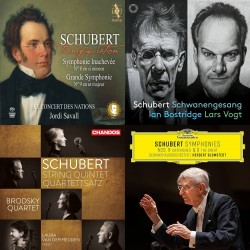
A veritable bevy of recent high-profile recordings suggests that, during the dark days of the global Covid pandemic, performers may have found particular solace in Schubert’s uniquely touching musical voice. Most striking for us was the almost simultaneous release of three separate recordings of the composer’s last two symphonies, No.8 in B minor (the ‘Unfinished’) and No.9 in C major (the ‘Great’). Both René Jacobs’s account with the B’Rock Orchestra of Belgium (the concluding disc in a Schubert cycle on Pentatone) and Jordi Savall’s with Le Concert des Nations (on AliaVox) are performed on period instruments. The veteran Herbert Blomstedt (now in his 96th year!) heads the revered Gewandhausorchester of Leipzig in accounts which, while bringing the glorious depth of tone for which that orchestra is renowned, are still remarkably stylish.
In both symphonies, the competition is strong. Our own favourites include Furtwängler and Wand (both in Berlin), and Mackerras (with the Scottish Chamber Orchestra on Telarc), not forgetting Carlos Kleiber in No.8 (Vienna, on DG), or Erich Kleiber (Hamburg) and Adrian Boult (BBCSO, LPO) in No.9. Yet this new trio of recordings have much to offer, both for seasoned Schubertians and more occasional or new listeners.
In the ‘Unfinished’ Symphony, Blomstedt is the most expansive of the three, bringing out the work’s touching lyricism, as well as its moments of powerful intensity, with his customary care and sense of the long line. This is an immaculately played and balanced account, the tempi fairly traditional, but with surprisingly clean and stylish playing, and vibrato not overdone. By contrast, Jacobs’s pacing is more iconoclastic, particularly in a briskly paced account of the Andante con moto second movement. He also precedes each of the work’s two movements (all that Schubert completed of this mighty torso) with spoken extracts (in German) of a text entitled Mein Traum (‘My Dream’) that Schubert penned on 3 July 1822, just a few months prior to writing out the clean autograph score. It might sound gimmicky, yet the association of this text with the ‘Unfinished’ Symphony has gained new traction in recent years. And some passages from it go right to the heart of Schubert’s emotional world: ‘For long, long years I sang songs. When I sang of love, it turned to pain. And again, when I sang of pain, it turned to love.’
It might be hard to reconcile this strand of thought with the almost matter-of-fact manner in which Jacobs treats the symphony’s two surviving movements, yet the benefits of the period instruments, with rasping horns and wonderfully clear wind textures, are everywhere apparent. There is, however, an astringency to the orchestral sound that does not afflict Savall’s performance: more spacious than Jacobs, his performance steers a mid-course, without in any sense compromising the music’s intense expressivity. Indeed, there’s a palpable sense of immediacy to the AliaVox recording, notwithstanding the slightly boomy acoustics (particularly in tutti passages) of the Collégiale (Church of Sant Vicenç) de Cardona. This places an emphasis on the bass lines, which is all to the good in Schubert’s music, where the harmonic foundations underpinning the upper details are so crucial. Among the many fine qualities here, the understated way with the cellos’ famous G major second subject in the first movement and the distinctive thwack of the period timpani in the development section are particularly memorable.
In the Ninth Symphony, similar distinctions apply, although all three clock in around the 62’ mark (with all repeats observed). Here the sense of rhythmic propulsion is even more crucial than in Beethoven’s Seventh Symphony, and considerably more difficult to bring off. All three conductors have a fine overall control of the work’s trajectories, but the combination of security and drive from Savall is most infectious. Another decided plus is the marvellously plangent yet centred sound of Paolo Grazzi’s solo oboe playing in the flowing Andante second movement. In the Scherzo, strings dig into the main theme, and there’s some exceptionally nimble timpani playing, while the Trio has just the right degree of Viennese Schwung and Gemütlichkeit, with the wind chords positively blooming.
In the closing Allegro vivace, Savall is brisker than the more serene Blomstedt and (by a shade) Jacobs, and you feel it in the sense of cumulative excitement. The strings’ unison Cs in the coda are more detached under Savall than either of his rivals, accented and almost brusque – evoking memories of Mozart’s Commendatore knocking at the door, and a refreshing departure from the norm. More controversially, he makes an old-fashioned diminuendo on the final bar (though the note itself is not sustained for too long). None of this, however, dents the overwhelming sense of elation, either in this movement or Savall’s performance as a whole. With a surer feeling than Jacobs for the nodal architectural points in both works, it’s this recording that just pips the other two to the post, although in truth we could happily live with any (or, better still, all!) of them.
To pass from the ‘Great’ C major Symphony to the contemporaneous String Quintet is to enter a different world. Although cast in the same key, and on a similarly ambitious formal scale, this is a world of intense intimacy and delicacy, contrasting with the symphony’s very public face and ebullient rhythmic impulse. In a new recording made in December 2021, the widely-acclaimed Brodsky Quartet together with young cellist Laura van der Heijden present an account that focuses not on the music’s well-trodden ‘autumnal’ glow, but on the music’s gorgeously translucent textures. Every strand seems to matter, yet there’s no textural clogging as a result. Tempi are as spacious as the music demands, yet the performance seems to speak of the soft, radiant light of early spring as much as anything. The first movement is particularly beautiful in this regard, the music wearing its epic proportions lightly, the opening and closing chords treated with exceptional delicacy of shading, and even the punctuating cadential chords are deftly placed and voiced.
The Quintet’s great Adagio has wonderful poise as well as melting tenderness; the central turbulent F minor section, while not entirely free of suggestions of emotional pain, seems more benign and accepting (or resigned?) than usual, while the closing bars are imbued with a heartstopping fragility. There’s a huge contrast with the bucolic opening of the Scherzo, but the textures still have that admirable clarity, for all the music’s forceful dance accents. It is the bleak D flat major Trio that brings us down to earth, as sombre as it should be, a reminder of the underlying seriousness of even Schubert’s brightest creations.
The Quintet’s Allegretto finale, meanwhile, brings out the stylised Hungarian-style dance rhythms to perfection, and the inner detail (such as the viola’s ricocheting triplets against the second subject) is again fabulously clear. The concluding Più allegro is properly thrilling, the articulation phenomenal, yet without forcing the sound in a manner that would sit ill with the rest of this magical performance. The disc concludes with an equally attractive account of the impassioned C minor Quartettsatz of 1820, making this one of the most outstanding recordings of Schubert’s greatest chamber music in recent memory.
Other attractions on the horizon include the posthumously assembled song-cycle Schwanengesang, D957, from baritone Andrè Schuen and pianist Daniel Heide (DG), and the final instalment of Paul Lewis’s acclaimed long-term survey of Schuberts piano sonatas. But we close here with another, particularly poignant account of the Schwanengesang (‘Swan Song’), the collection of songs to texts by Rellstab and Heine plus the concluding ‘Die Taubenpost’ (to words by J.G. Seidl) that was published by Tobias Haslinger just a few months after Schubert’s death. Recorded at London’s Wigmore Hall in November 2021, it features tenor Ian Bostridge in as fine form as we have ever heard him, partnered by pianist Lars Vogt, who died earlier this month at the age of 51.
These songs are as touching and searingly intense as anything that Schubert composed, from the surface joy of ‘Liebesbotschaft’ and ‘Frühlings-Sehnsucht’, through the rhetorical power of ‘Der Atlas’ and the tender reflection of ‘Ihr Bild’ to the bleak desolation of ‘Der Doppelgänger’. Bostridge brings his customary insight and huge experience to these songs and texts, and those who may prefer this cycle performed by a baritone should hear this performance: there’s a dark, baritonal quality to the more instrospective or demonstrative numbers that is enormously powerful, while the lighter songs have a remarkable radiance to them. Lars Vogt is crucial to the musical success here: the unanimity of intent is palpable, and he illuminates the detail of the piano parts with unfailing intelligence and involvement without ever drawing undue attention away from the singer. In context, the little postlude to the final song is unbearably touching.
Many recordings of Schwanengesang couple it with one of the first Classical songs cycles, Beethoven’s An die ferne Geliebte. Bostridge and Vogt go for a less obvious mini-cycle (or multi-section single song), Die Einsamkeit (‘Loneliness’) of some ten years earlier, to a text by Johann Mayrhofer. It’s an absorbing work, abundant in contrasts and emotionally wide-ranging. This superbly nuanced performance, coupled with one of the accounts of Schwanengesang now on disc, makes this new Pentatone title an urgent recommendation for all lovers of song, and a moving tribute to Lars Vogt’s artistry.
The recordings:
- Symphonies 8 & 9 (Blomstedt) 4863045
- Symphonies 8 & 9 (Jacobs) PTC5186894
- Symphonies 8 & 9 (Savall) AVSA9950
- String Quintet & Quartettsatz (Brodsky Quartet, van der Heijden) CHAN10978
- Schwanengesang (Bostridge, Vogt) PTC5186786
Latest Posts
Music of the Iberian Peninsula, Part 3: More observations on the Golden Age
16th June 2026
Our last visit to the Iberian peninsula, a fortnight ago, was an insanely ambitious, necessarily broad-brush survey of the Spanish and Portuguese Golden Age, covering vocal and instrumental music, the sacred and the secular. This week, we take a more concise and (I hope) focussed look at a few of the sacred vocal masterpieces which exemplify the particular fervour and intensity of this remarkable period of musical history. They reflect the special place the peninsula had as a bulwark against the Reformation that had taken... read more
read more
Music of the Iberian Peninsula, Part 3: More observations on the Golden Age
16th June 2026
Our last visit to the Iberian peninsula, a fortnight ago, was an insanely ambitious, necessarily broad-brush survey of the Spanish and Portuguese Golden Age, covering vocal and instrumental music, the sacred and the secular. This week, we take a more concise and (I hope) focussed look at a few of the sacred vocal masterpieces which exemplify the particular fervour and intensity of this remarkable period of musical history. They reflect the special place the peninsula had as a bulwark against the Reformation that had taken... read more
read more
Carl Schachter, Arnold Whittall, and why music analysis matters
9th June 2026
Two recent deaths have robbed the world of music analysis of a pair of its most revered figures. Carl Schachter, who has died at the age of 93, was a pupil of (and subsequently collaborator with) Felix Salzer, himself one of Heinrich Schenker’s foremost students. Schachter continued to enrich and broaden the teaching of Schenkerian analysis, including important work on its application to issues of rhythm (which Schenker, focussing on harmonic and contrapuntal matters, largely bypassed). His influence went well beyond the... read more
read more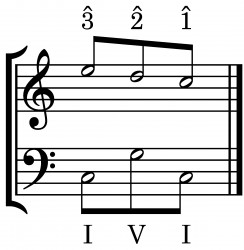
Carl Schachter, Arnold Whittall, and why music analysis matters
9th June 2026
Two recent deaths have robbed the world of music analysis of a pair of its most revered figures. Carl Schachter, who has died at the age of 93, was a pupil of (and subsequently collaborator with) Felix Salzer, himself one of Heinrich Schenker’s foremost students. Schachter continued to enrich and broaden the teaching of Schenkerian analysis, including important work on its application to issues of rhythm (which Schenker, focussing on harmonic and contrapuntal matters, largely bypassed). His influence went well beyond the... read more
read more
Music of the Iberian Peninsula, Part 2: ‘O quam gloriosum’ – The Spanish and Portuguese Golden Age
2nd June 2026
Over the past fortnight, I’ve been bathed in the most glorious, radiant, transformative light. Not the UK’s recent unseasonable heatwave, but the extraordinary vocal polyphony of the Siglo de Oro: the Spanish (and Portuguese) ‘Golden Century’. Extending from the late 15th to the early 17th century, this was a time of remarkable artistic flowering on the Iberian Peninsula, coinciding with the emergence of Spain and Portugal as global imperial powers with extensive colonial territories in the Americas, Africa and Asia. The... read more
read more