 FREE UK SHIPPING OVER £35!
The Spin Doctor Europadisc's Weekly Column
Three new Handel albums
24th August 2022
24th August 2022
 Although the English took Handel to their heart almost as soon as his first visit at the age of 25 in 1710, and increasingly from 1712 when he permanently relocated there, he’s by no means solely ‘English property’. His birth in Halle and employment (however brief) at the court of Hanover endowed him with a fundamentally Germanic and Protestant cultural identity, while his early travels to Italy – and Rome in particular – left their unmistakable mark on his compositional development, particularly the ease with which he wrote for the voice. The gaping hole, of course, is France, which Handel never visited. Yet a clutch of new recordings demonstrates that the French and Belgian early music movement is by no means immune to the charms of this giant of the late Baroque period. Indeed, there are unexpected benefits to hearing both lesser-known and familiar Handel works with the fresh colours brought by the Gallic penchant for colour and elegance. So it’s been a real treat to spend some time this month listening to three new discs in particular.
The ‘Chandos’ Anthems were composed by Handel in 1717–18 for James Brydges, Earl of Carnarvon (and subsequently 1st Duke of Chandos). They were written before Brydges’ ambitious house at Cannons near Edgware was completed, and were performed in the more intimate (but still exquisite) surroundings of the nearby parish church of St Lawrence, Whitchurch. This may explain their unique scoring for a small choir (and soloists) of just soprano, tenor and bass lines, and an orchestra with violins and cello but no viola. For their new recording of the first, fourth and sixth of these anthems, the Margaret Louise Chorus and Orchestra under their founder Gaétan Jarry have ‘reimagined’ the works in the altogether more opulent surroundings of the Chapelle royale at the Château de Versailles.
’
Given that Handel himself was constantly reappropriating earlier works and adapting them to new contexts, it’s perhaps unsurprising that the music works so well in this far grander location. The chorus articulates these English-texted Psalm settings with considerable agility, and the relatively restrained (by Handel’s own standards) orchestration is vividly realised by forces rather larger than could be expected at Cannons. What one sometimes misses in some of the soloists is a more idiomatic projection of the consonants. Thankfully this is no problem for the tenor soloist Nicholas Scott (familiar from John Butt’s Dunedin Consort), who has two of the plum arias to himself: the splendidly tempestuous ‘The waves of the sea rage horribly’ in Anthem no.4 O sing unto the Lord a new song, and the mellifluous accompagnato ‘Now, when I think thereupon’ in no.6 As pants the Hart, with its arpeggiated obbligato violin solo. Two organ voluntaries stylishly played by Jarry on the great organ of the Chapelle royale complete this attractive album.
More grandiose still is a new recording of the four Coronation Anthems composed for the 1727 coronation of George II and his Queen Consort Caroline, coupled with the expansive English-texted Te Deum written in 1743 to celebrate the British victory (led by George II himself) over the French at the Battle of Dettingen. There’s no hint on this Alpha disc of Hervé Niquet and the musicians of his Le Concert Spirituel having to eat humble pie at this programming: on the contrary, there’s the same evident relish in the deployment of ambitious forces as there was in their jaw-dropping Glossa recording of Handel’s Water Music and Music for the Royal Fireworks. As on that disc, Niquet employs a far larger phalanx of wind and brass than is the norm: ten oboes, six bassoons, eight trumpets and two pairs of timpani plus strings and organ and a choir of thirty-five! Not quite as many performers as at the 1727 coronation, but still mightily impressive, especially in the ‘halo’ of sound as Zadok the Priest gets underway. There are some thrilling moments from the timpani (most spectacularly at the end of The King shall rejoice), and Niquet maintains the tension right the way through the multi-movement Te Deum setting. Though there other recordings that project the text of the anthems with more immediacy, no-one familiar with Niquet’s special brand of Gallic flair will want to miss this new disc.
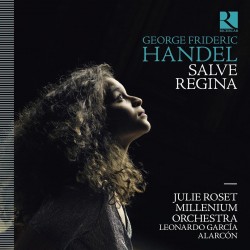
The standout disc for us, however, is one on a more intimate scale. The Belgian period-instrument Millenium Orchestra under Leonardo García Alarcón accompanies young soprano Julie Roset on a disc from the Ricercar label that pairs two works from Handel’s early years in Rome, the Salve Regina, HWV 241, and the Gloria in B flat major for soprano and strings, with the solo motet Silvete venti, HWV 242, of the mid-1720s. By any measure, these are extraordinary performances. Roset’s pure-toned voice, with pinpoint accuracy of pitch, could be compared to the young Emma Kirkby – replacing some of the latter’s silvery edge with a gently translucent glow right through her range (and with some daringly high ornamentation to boot). She shapes the phrases winningly, relishing the leaps and intense chromaticism of the Salve Regina’s ‘Ad te clamamus’ and pairing up fizzingly with Adria Gracia Galvez’s organ solo in the following ‘Eia ergo’ movement.
Silete venti gains extra colour from the added oboe, and here again Roset’s singing would melt a heart of stone, uniformly gleaming yet shaped to perfection, and inhabiting every twist and turn of Handel’s matchless vocal lines. Add to this the extraordinary textural depths uncovered by Alarcón and his players, and you have a sure-fire winner. The addition of the elevated ‘Praise the Lord with cheerful voice’ from Esther, with its enchanting, ringing harp solo, and ‘Tu del ciel ministro electo’ from the early Il trionfo del Tempo e del Disinganno (with solo violin), helps to create a marvellously designed programme, and some of the finest recent Handel singing on disc. As well as reinforcing the view that some of Handel’s most extraordinary music came from his Italian years, this is a recording that completely rekindles one’s enthusiasm for the composer, while giving centre stage to a singer of quite remarkable stylishness and expressive capabilities.
The Recordings (click on catalogue numbers for links)
Chandos Anthems 1, 4 & 6 CVS072
Coronation Anthems, Dettingen Te Deum ALPHA868
Salve Regina, Silete venti, etc. RIC442
Latest Posts
Music of the Iberian Peninsula, Part 3: More observations on the Golden Age
16th June 2026
Our last visit to the Iberian peninsula, a fortnight ago, was an insanely ambitious, necessarily broad-brush survey of the Spanish and Portuguese Golden Age, covering vocal and instrumental music, the sacred and the secular. This week, we take a more concise and (I hope) focussed look at a few of the sacred vocal masterpieces which exemplify the particular fervour and intensity of this remarkable period of musical history. They reflect the special place the peninsula had as a bulwark against the Reformation that had taken... read more
read more
Music of the Iberian Peninsula, Part 3: More observations on the Golden Age
16th June 2026
Our last visit to the Iberian peninsula, a fortnight ago, was an insanely ambitious, necessarily broad-brush survey of the Spanish and Portuguese Golden Age, covering vocal and instrumental music, the sacred and the secular. This week, we take a more concise and (I hope) focussed look at a few of the sacred vocal masterpieces which exemplify the particular fervour and intensity of this remarkable period of musical history. They reflect the special place the peninsula had as a bulwark against the Reformation that had taken... read more
read more
Carl Schachter, Arnold Whittall, and why music analysis matters
9th June 2026
Two recent deaths have robbed the world of music analysis of a pair of its most revered figures. Carl Schachter, who has died at the age of 93, was a pupil of (and subsequently collaborator with) Felix Salzer, himself one of Heinrich Schenker’s foremost students. Schachter continued to enrich and broaden the teaching of Schenkerian analysis, including important work on its application to issues of rhythm (which Schenker, focussing on harmonic and contrapuntal matters, largely bypassed). His influence went well beyond the... read more
read more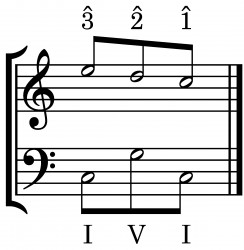
Carl Schachter, Arnold Whittall, and why music analysis matters
9th June 2026
Two recent deaths have robbed the world of music analysis of a pair of its most revered figures. Carl Schachter, who has died at the age of 93, was a pupil of (and subsequently collaborator with) Felix Salzer, himself one of Heinrich Schenker’s foremost students. Schachter continued to enrich and broaden the teaching of Schenkerian analysis, including important work on its application to issues of rhythm (which Schenker, focussing on harmonic and contrapuntal matters, largely bypassed). His influence went well beyond the... read more
read more
Music of the Iberian Peninsula, Part 2: ‘O quam gloriosum’ – The Spanish and Portuguese Golden Age
2nd June 2026
Over the past fortnight, I’ve been bathed in the most glorious, radiant, transformative light. Not the UK’s recent unseasonable heatwave, but the extraordinary vocal polyphony of the Siglo de Oro: the Spanish (and Portuguese) ‘Golden Century’. Extending from the late 15th to the early 17th century, this was a time of remarkable artistic flowering on the Iberian Peninsula, coinciding with the emergence of Spain and Portugal as global imperial powers with extensive colonial territories in the Americas, Africa and Asia. The... read more
read more