 FREE UK SHIPPING OVER £35!
The Spin Doctor Europadisc's Weekly Column
Romantic roots and the early Romantics
29th March 2022
29th March 2022
 While the wider Romantic movement, in philosophy and literature, has its roots in the revolutionary late-Enlightenment thinking of Jean-Jacques Rousseau and Immanuel Kant, the beginnings of musical Romanticism are harder to pinpoint. The conventional view has Beethoven and Schubert, the last great exponents of Viennese Classicism, as ‘transitional’ figures, before the full-blown early Romanticism of such figures as Chopin, Mendelssohn, Berlioz and Schumann. During his lifetime, however, not only was Beethoven regarded as a leading figure of the nascent Romantic movement in music (witness E.T.A. Hoffmann’s extraordinarily influential 1810 essay on Beethoven’s Fifth Symphony); he was also himself the inheritor of a Romantic strand detected by his contemporaries in Mozart and even Haydn. This will be less surprising to anyone familiar with the Sturm und Drang elements in Mozart and Haydn. The heady emotions of their minor-key works, and their indebtedness to the empfindsamer Stil (‘expressive style’) of C.P.E. Bach, with their strong emphasis on emotional authenticity and involvement, can neatly be viewed as pre-Romantic features, as can the golden thread of tight motivic organisation that links Haydn and Beethoven to the late-Romanticism of Johannes Brahms.
Three other strong Romantic traits are characteristic of Beethoven: the pronounced individuality of his musical style, utterances and gestures (which chimes with his contemporary Goethe’s ideas on the importance of the creative genius and originality); his revolutionary fervour (however tempered it was by an offsetting regard for aristocracy and monarchy); and, most particularly of all, his appropriation of Schiller’s idea of Freude (‘joy’) as a quintessentially Romantic force, a generosity of revolutionary spirit, as celebrated in the finale of the Ninth Symphony. The increased integration of Beethoven’s middle- and late-period styles also bear witness to the ‘organicism’ that was another hallmark of the wider Romantic movement, a further guarantor of authenticity.
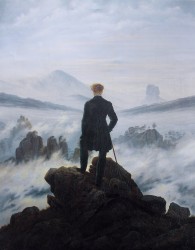
On an altogether more intimate scale, the German art song or Lied, as practised by both Beethoven and, most far-reachingly, Schubert, was founded on a growing repertoire of vernacular verse which emerged at the same time as the brothers Schlegel, Johann Gottfried Herder, and Johann Gottlieb Fichte were formulating ideas of German culture, folk and nationality that were to have extraordinary resonance throughout the 19th century and beyond. The ‘folk spirit’ (Volksgeist) suffuses the Lied output of Schubert and his successor in the genre, Robert Schumann, from the individual songs that make up the bulk of their output to the great song-cycles: Schubert’s Winterreise and Die schöne Müllerin, and Schumann’s Dichterliebe, Frauenliebe und -leben and Liederkreise. Not for nothing does the archetypal figure of Caspar David Friedrich’s Wanderer above the Mists (1818) – the embodiment of the lone Romantic hero – stand with his back to us on so many Lieder record covers.
In another quintessential genre, the piano miniature, Schubert led the way with his Impromptus and Moments musicaux, and Schumann was again among his principal inheritors, together with Mendelssohn (the Songs without Words – epitomising music’s power to encapsulate much without recourse to a text), John Field and, of course, Frédéric Chopin. Chopin’s output of piano music is a striking melting-pot of technical virtuosity, compositional genius, drawing-room elegance and folk-spirit, nowhere more obviously than in the collection of fifty-odd Mazurkas, but also in the dazzling Polonaises and Études, and the dreamily reflective Nocturnes.
Although musical Romanticism is often characterised (not without reason) as a largely Germanic movement, several of its key figures such as Chopin were non-German speakers. In a nod to the movement’s Francophone roots, one early pre-Romantic figure in the French opéra comique genre is the Liège-born André Grétry (1741–1813). His stage works, long neglected, are experiencing a timely revival, and the best of them (such as Richard Cœur-de-lion, 1784) paved the way for Méhul and Cherubini, while his treatment of serious historical subjects even anticipates Beethoven’s Fidelio. However, the opera that really set the Romantic ball rolling was Weber’s Der Freischütz (1821), whose ‘Wolf’s Glen’ scene with its air of the folk-infused supernatural appealed to a taste for the sublime (in the sense of the fantastically awe-inspiring), thereby causing a sensation whose frisson can still be felt in the best performances.
The Romantic penchant for the fantastic and sublime finds one of its most memorable incarnations in Hector Berlioz’s Symphonie fantastique (1830), whose autobiographical elements (anticipating Richard Strauss by over half a century), leitmotivic idée fixe and strikingly idiosyncratic orchestration all reek of Romantic sensibilities. No less remarkable is the Byronic Harold en Italie (1834), a symphony with solo viola which draws on Berlioz’s own peregrinations through Italy, while his Roméo et Juliette and Béatrice et Bénédict are evidence of another typically Romantic trait: a fascination with Shakespeare as a poet/dramatist of the people, as distinct from the archetypes of classical drama. Berlioz’s colourful life, as related in his era-defining Memoirs, and his flair for the monumental (Grande Messe des morts, Te Deum, La Damnation de Faust), set him up as a Byronic figure in his own right. He forms a kind of Gallic counterbalance to the quasi-‘Lake School’ of Felix and Fanny Mendelssohn, Robert and Clara Schumann, whose exuberance and spontaneity – coloured in Felix Mendelssohn’s case by his travels to Italy and Scotland, in Robert Schumann’s by the atmosphere of the Rhineland – testify to yet another strikingly Romantic characteristic: immersion in and surrender to one’s physical environment as reflection of the self.
A few Early-Romantic essentials:
Grétry - Richard Cœur de Lion (Niquet) CVS028
Beethoven - Symphony no.9 (Heras-Casado) HMM902431/32
Schubert - Song Cycles (C Prégardien) CC72665
Mendelssohn - A Midsummer Night’s Dream (Dausgaard) BIS2166
C Schumann & F Mendelssohn - Piano Trios, String Quartet CDA68307
Berlioz - Harold en Italie, Les Nuits d’été (Roth) 902634P
Latest Posts
Music of the Iberian Peninsula, Part 3: More observations on the Golden Age
16th June 2026
Our last visit to the Iberian peninsula, a fortnight ago, was an insanely ambitious, necessarily broad-brush survey of the Spanish and Portuguese Golden Age, covering vocal and instrumental music, the sacred and the secular. This week, we take a more concise and (I hope) focussed look at a few of the sacred vocal masterpieces which exemplify the particular fervour and intensity of this remarkable period of musical history. They reflect the special place the peninsula had as a bulwark against the Reformation that had taken... read more
read more
Music of the Iberian Peninsula, Part 3: More observations on the Golden Age
16th June 2026
Our last visit to the Iberian peninsula, a fortnight ago, was an insanely ambitious, necessarily broad-brush survey of the Spanish and Portuguese Golden Age, covering vocal and instrumental music, the sacred and the secular. This week, we take a more concise and (I hope) focussed look at a few of the sacred vocal masterpieces which exemplify the particular fervour and intensity of this remarkable period of musical history. They reflect the special place the peninsula had as a bulwark against the Reformation that had taken... read more
read more
Carl Schachter, Arnold Whittall, and why music analysis matters
9th June 2026
Two recent deaths have robbed the world of music analysis of a pair of its most revered figures. Carl Schachter, who has died at the age of 93, was a pupil of (and subsequently collaborator with) Felix Salzer, himself one of Heinrich Schenker’s foremost students. Schachter continued to enrich and broaden the teaching of Schenkerian analysis, including important work on its application to issues of rhythm (which Schenker, focussing on harmonic and contrapuntal matters, largely bypassed). His influence went well beyond the... read more
read more
Carl Schachter, Arnold Whittall, and why music analysis matters
9th June 2026
Two recent deaths have robbed the world of music analysis of a pair of its most revered figures. Carl Schachter, who has died at the age of 93, was a pupil of (and subsequently collaborator with) Felix Salzer, himself one of Heinrich Schenker’s foremost students. Schachter continued to enrich and broaden the teaching of Schenkerian analysis, including important work on its application to issues of rhythm (which Schenker, focussing on harmonic and contrapuntal matters, largely bypassed). His influence went well beyond the... read more
read more
Music of the Iberian Peninsula, Part 2: ‘O quam gloriosum’ – The Spanish and Portuguese Golden Age
2nd June 2026
Over the past fortnight, I’ve been bathed in the most glorious, radiant, transformative light. Not the UK’s recent unseasonable heatwave, but the extraordinary vocal polyphony of the Siglo de Oro: the Spanish (and Portuguese) ‘Golden Century’. Extending from the late 15th to the early 17th century, this was a time of remarkable artistic flowering on the Iberian Peninsula, coinciding with the emergence of Spain and Portugal as global imperial powers with extensive colonial territories in the Americas, Africa and Asia. The... read more
read more