 FREE UK SHIPPING OVER £35!
The Spin Doctor Europadisc's Weekly Column
How to Design a Record Cover
9th February 2022
9th February 2022
 When people buy recorded music in physical form – whether it’s a vinyl LP, a compact disc, a DVD or Blu-ray – they are not merely buying music for listening: they are making an investment in a product. And that investment (of time, and money) is reflected in the care given to the presentation of that product by the record companies involved. Label managers, art directors, graphic designers, editors, A&R executives and executive VPs all play their part in determining aspects of the album’s final appearance. Sometimes (though rarely) the musical artists themselves may even be consulted. The amount of time and effort put into these considerations often dwarfs that of the musicians and recording team spent on the audio aspect of the package.
After all, the days of plain record covers – when all records (rather like all motor cars) looked the same – are long gone. Record companies, like newspapers before them, eventually discovered that you could put pictures on the front cover and most customers wouldn’t mind too much; it might even generate a few extra sales. With this in mind, we attempted to unearth a few of the ‘do’s and don’ts’ of record covers. Here are some of our findings
1. There are no colours so lurid that they cannot be used for an album cover. If you really want your product to stand out from the crowd, don’t be shy: use the full spectrum available to you via whatever program or app you’re using. And remember to turn screen saturation down to its lowest setting, so that however vivid the colours appear to you, they will be even more lurid once in print.
2. Wherever possible, use a cover text colour that blends with the colours of the main design. No-one seriously thinks that prospective purchasers read what’s on the covers, and a pleasing blend is surely more important than boring old clarity and intelligibility. At the end of the day (probably the best time to design and worst time to purchase a classical album), the buyer should in any case feel as though they’ve had to work for their reward.
3. Similarly, text that’s too small or too big is preferable to Goldilocks-style ‘just right’ sizes. We’re selling records here, not eye charts. A miniscule typeface will make the buyer feel rewarded (see 2. above), while a giant one, preferably one that necessitates the splitting of words across two or more lines can be used for really important items (label name, designer name, etc.). (NB Certain words are available only in very large font sizes, e.g. KARAJAN, PAVAROTTI.)
4a. If contractually obliged to use the artists themselves on the cover artwork, try to make them seem as incongruous as possible, for example by doing things they wouldn’t otherwise do with their instruments: holding up bits of a dismembered piano, for instance, or reclining with their favourite bassoon. Few conductors really spend much time fondling their batons, so this is always a good photo-op ploy (‘It makes you look ever so musical!’). (Incidentally, few conductors are ever shown on record covers as they appear to most of the audience in the concert hall, i.e. from the rear. A rear-view recognition chart of the great conductors should be on the wall of every self-respecting music room.)
4b. The other way to incorporate musical artists into the cover art is to ape the style of very bad fashion catalogues. Kit them out in something glamorous or classy (tweeds or jeans work well on most men, frequently at the same time), and extra teeth-whitener or equivalent app will add to the effect. The aim here is always to reach ‘peak 70s’ (the golden age of cover art), so frilly shirts, velvet bow ties and DJs are also popular.
5. As can be inferred from 2. and 3. above, it is the designer’s job to make it as difficult as possible to determine what the music on the disc actually is. But an alternative ploy is to use the most obvious thing that comes to mind, even if it’s entirely inappropriate. We can cite here the recording of Richard Strauss’s Metamorphosen (written in the wake of the traumatic ending of World War II) that used a microscopically magnified image of a butterfly wing (what else?); and, for the same composer’s Alpine Symphony, the obligatory cover image of the Matterhorn in southwestern Switzerland, even though the work explicitly portrays an excursion to the Zugspitze in southern Bavaria, some 300km away. (As our fictional art director might say, ‘Who cares?! The Matterhorn screams Alpine!!! And whoever’s heard of the Zugspitze?!!’)
6. If the recording is of Russian (and particularly Soviet) music, flip as many letters as possible on their vertical axis: this will make them look really Яussian! Throw in a few red stars if you feel that you haven’t already made your point. In a similar vein, early music demands the obligatory still life, preferably with plenty of fruit; if musical instruments are unavoidable, at the very least, try to make sure that they do not feature on the recording itself. This will make the listener think you are indulging in ‘irony’, and consequently being very clever.
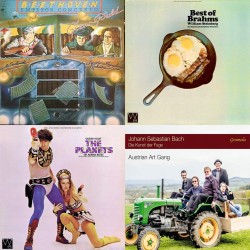
7. Finally, ignore all norms of good taste: nothing screams ‘buy me’ like hastily-conceived cover art. By way of illustration, we give four of our favourites: Beethoven and Glenn Gould (CBS) in 1960s trucker-style art; two gems from the Westminster Gold catalogue, world leaders in album covers so bad they’re almost good (we just about get the Flash Gordon association for Holst’s The Planets, but the hidden significance of eggs’n’bacon rearranged as a funny face for Brahms still escapes us); and (of course) Bach’s Art of Fugue on a tractor (Gramola)…
Further reading:
Anne D. Hoffnung: Contemporary Album Cover Design for the 1970s (London: Horn & Hound, 1971), pp 33-45
Seymour Sails: Audio-Visual Interaction for the Postmodern Age (Trumpton: Chigley UP, 2004), 78ff
Latest Posts
Music of the Iberian Peninsula, Part 3: More observations on the Golden Age
16th June 2026
Our last visit to the Iberian peninsula, a fortnight ago, was an insanely ambitious, necessarily broad-brush survey of the Spanish and Portuguese Golden Age, covering vocal and instrumental music, the sacred and the secular. This week, we take a more concise and (I hope) focussed look at a few of the sacred vocal masterpieces which exemplify the particular fervour and intensity of this remarkable period of musical history. They reflect the special place the peninsula had as a bulwark against the Reformation that had taken... read more
read more
Music of the Iberian Peninsula, Part 3: More observations on the Golden Age
16th June 2026
Our last visit to the Iberian peninsula, a fortnight ago, was an insanely ambitious, necessarily broad-brush survey of the Spanish and Portuguese Golden Age, covering vocal and instrumental music, the sacred and the secular. This week, we take a more concise and (I hope) focussed look at a few of the sacred vocal masterpieces which exemplify the particular fervour and intensity of this remarkable period of musical history. They reflect the special place the peninsula had as a bulwark against the Reformation that had taken... read more
read more
Carl Schachter, Arnold Whittall, and why music analysis matters
9th June 2026
Two recent deaths have robbed the world of music analysis of a pair of its most revered figures. Carl Schachter, who has died at the age of 93, was a pupil of (and subsequently collaborator with) Felix Salzer, himself one of Heinrich Schenker’s foremost students. Schachter continued to enrich and broaden the teaching of Schenkerian analysis, including important work on its application to issues of rhythm (which Schenker, focussing on harmonic and contrapuntal matters, largely bypassed). His influence went well beyond the... read more
read more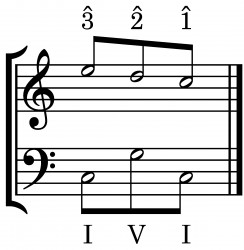
Carl Schachter, Arnold Whittall, and why music analysis matters
9th June 2026
Two recent deaths have robbed the world of music analysis of a pair of its most revered figures. Carl Schachter, who has died at the age of 93, was a pupil of (and subsequently collaborator with) Felix Salzer, himself one of Heinrich Schenker’s foremost students. Schachter continued to enrich and broaden the teaching of Schenkerian analysis, including important work on its application to issues of rhythm (which Schenker, focussing on harmonic and contrapuntal matters, largely bypassed). His influence went well beyond the... read more
read more
Music of the Iberian Peninsula, Part 2: ‘O quam gloriosum’ – The Spanish and Portuguese Golden Age
2nd June 2026
Over the past fortnight, I’ve been bathed in the most glorious, radiant, transformative light. Not the UK’s recent unseasonable heatwave, but the extraordinary vocal polyphony of the Siglo de Oro: the Spanish (and Portuguese) ‘Golden Century’. Extending from the late 15th to the early 17th century, this was a time of remarkable artistic flowering on the Iberian Peninsula, coinciding with the emergence of Spain and Portugal as global imperial powers with extensive colonial territories in the Americas, Africa and Asia. The... read more
read more