 FREE UK SHIPPING OVER £35!
The Spin Doctor Europadisc's Weekly Column
Black Swans
1st February 2022
1st February 2022
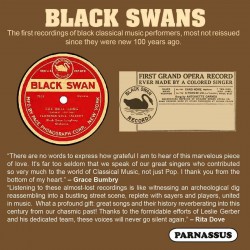 A record label devoted to the promotion of classically-trained African-American musicians, often in classical repertoire: it might sound like a 21st-century idea in response to the ongoing reassessment of a long-neglected neglected section of the artistic community. In fact, this was the aim of a short-lived but highly influential record company launched 101 years ago. The Black Swan label, founded by Harry Pace in 1921, also recorded jazz and blues musicians, but among its most notable achievements was the platform it provided for some of the earliest African-American classical artists to reach a wider audience during the era of acoustic recordings.
The label took its name from the popular moniker for the 19th-century singer, Elizabeth Taylor Greenfield (c.1820-1876). Although born into slavery, after emancipation in her early years she studied music as a child, singing at private parties. At her 1853 debut at New York City’s Metropolitan Hall, she performed before a whites-only audience of 4,000. The same year, she went to London to study with Sir George Smart, and in May 1854 performed before Queen Victoria at Buckingham Palace – the first African American to perform for British royalty. She was particularly noted for her performances of Handel, Bellini and Donizetti.
Although Greenfield died before the age of recording, she was still remembered by many as a musical pioneer, and the use of her nickname by the Black Swan label made her a kind of ‘patron saint’ of fellow African-American musicians. So it was appropriate, too, that the historical reissue label Parnassus, in delving into the archives of African-American singers and instrumentalists, should revive the name for two compilations of any long-unavailable recordings dating from the early acoustic years up until as recently as 1973. They bear witness to more than half a century of vibrant musical talents, some names familiar, many others less so.
Volume 1 of Black Swans (PACD96067) covers the years 1917-22, and the most recognisable name is that of Harry T. Burleigh (1866-1949), who studied at the National Conservatory of Music in New York when Antonín Dvořák was director, and who was chiefly responsible for introducing Dvořák to the repertoire of African-American spirituals. Burleigh left regrettably few recordings, but a 1919 account of ‘Go Down Moses’ captures a baritone voice of natural authority and keen communicative powers, even if a later 1944 broadcast of Jean-Baptiste Fauré’s ‘The Palms’ has a rather bucolic (but undeniably spirited) roughness to it.
One of the most remarkable voices on Volume 1 is that of tenor Roland Hayes (1887-1976) at the peak of his powers in 1918. The six numbers were all self-published (i.e. paid for by Hayes himself) on Columbia Records’ custom recording service, but they include excerpts from operas by Donizetti, Verdi and Leoncavallo (and intensely felt account of ‘Vesti la giubba from Pagliacci) that highlight not only Hayes’s linguistic skills but also the marvellously baritonal hue to his brilliant tenor voice.
Some of the other tracks included on the first volume are a bit hit-and-miss. It’s good to hear pianist R. Nathaniel Dett (1882-1943) in some of his own arrangements from piano suites; but the intonation in violinist Clarence Cameron White’s performance of his own Lament makes one wonder whether an attack of nerves in front of the acoustic recording horn might be to blame. Soprano Florence Cole-Talbert (1890-1961) made the five recordings in this collection a few years before her further training in France and Italy, and her subsequent historic appearance as Aida in Cosenza, Italy. Yet her potential is caught well in Steve Smolian’s expert restoration, and she is at her happiest in a sparkling performance of Luigi Arditi’s ‘Il bacio’, as well as the spiritual ‘Nobody Knows the Trouble I’ve Seen’.
Among the more neglected names, contralto Hattie King Reavis (1890-1970) proves that you don’t have to sound matronly to have a strong communicative voice in this register. Alongside Roland Hayes, however, the real find here is soprano Antoinette Smythe Garnes (1887-1938), a sparkling, featherlight voice with effortless top notes in Verdi’s ‘Caro nome’ (Rigoletto) and ‘Ah, fors' è lui – Sempre libera’ (La traviata).
If that whets your appetite for more, the good news is that Parnassus have recently issued a 2-disc companion volume, Black Swans: at Mid-Century (PACD960789), spanning the 1930s to 60s. The introduction of electrical recordings and (in the 1960s) stereo, means that the results will be more palatable to many, and Steve Smolian has once again done a splendid job, particularly on some of the more problematic tracks. As with classical recordings generally during the mid-20th century, there’s an appreciable rise in performance standards as the years progress.
There are too many treasures in this second volume to enumerate, but highlights include soprano Adele Addison (b.1925) in ‘Rejoice greatly’ from Handel’s Messiah in 1959, contralto Carol Brice (1918-1985) in an imposing account of Brahms’s Alto Rhapsody under Koussevitsky, and soprano Mattiwilda Dobbs (1925-2015) in a knockout 1955 live performance of the ‘Bell Song’ from Delibes’s Lakmé in Sydney. Soprano Anne Brown (1912-2009), the original Bess in Gershwin’s Porgy and Bess, is heard in a fascinating clutch of numbers ranging from spirituals to Otto Mortensen, while the sadly short-lived soprano Ruby Elzy (1908-1943) sings Serena’s ‘My Man’s Gone Now’ from Porgy and Bess in a 1935 recording that actually predates the opera’s premiere, in the role she created and under the baton of the composer himself. Baritone Todd Duncan (1903-1998) was the original Porgy, but here shows his skills as a ‘pure’ classical artist in songs by Brahms, Saint-Saëns and Mussorgsky.
Among the spiritual and traditional items included, baritones Thomas Carey (1931-2002) and William Warfield are particularly engaging. Once again, however, it is the classical items that provide some of the collection’s more fascinating tracks: soprano Dorothy Maynor (1910-1996) in a live 1945 broadcast of ‘Dove sono’ from Mozart’s Le nozze di Figaro under Eugene Ormandy; and baritone Robert McFerrin (1921-2006, father of Bobby) as Amonasro in a live Aida from Naples in 1956 – a rather too audible prompter thankfully does little to distract from the singer’s commanding performance.
Latest Posts
Music of the Iberian Peninsula, Part 3: More observations on the Golden Age
16th June 2026
Our last visit to the Iberian peninsula, a fortnight ago, was an insanely ambitious, necessarily broad-brush survey of the Spanish and Portuguese Golden Age, covering vocal and instrumental music, the sacred and the secular. This week, we take a more concise and (I hope) focussed look at a few of the sacred vocal masterpieces which exemplify the particular fervour and intensity of this remarkable period of musical history. They reflect the special place the peninsula had as a bulwark against the Reformation that had taken... read more
read more
Music of the Iberian Peninsula, Part 3: More observations on the Golden Age
16th June 2026
Our last visit to the Iberian peninsula, a fortnight ago, was an insanely ambitious, necessarily broad-brush survey of the Spanish and Portuguese Golden Age, covering vocal and instrumental music, the sacred and the secular. This week, we take a more concise and (I hope) focussed look at a few of the sacred vocal masterpieces which exemplify the particular fervour and intensity of this remarkable period of musical history. They reflect the special place the peninsula had as a bulwark against the Reformation that had taken... read more
read more
Carl Schachter, Arnold Whittall, and why music analysis matters
9th June 2026
Two recent deaths have robbed the world of music analysis of a pair of its most revered figures. Carl Schachter, who has died at the age of 93, was a pupil of (and subsequently collaborator with) Felix Salzer, himself one of Heinrich Schenker’s foremost students. Schachter continued to enrich and broaden the teaching of Schenkerian analysis, including important work on its application to issues of rhythm (which Schenker, focussing on harmonic and contrapuntal matters, largely bypassed). His influence went well beyond the... read more
read more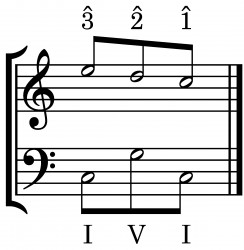
Carl Schachter, Arnold Whittall, and why music analysis matters
9th June 2026
Two recent deaths have robbed the world of music analysis of a pair of its most revered figures. Carl Schachter, who has died at the age of 93, was a pupil of (and subsequently collaborator with) Felix Salzer, himself one of Heinrich Schenker’s foremost students. Schachter continued to enrich and broaden the teaching of Schenkerian analysis, including important work on its application to issues of rhythm (which Schenker, focussing on harmonic and contrapuntal matters, largely bypassed). His influence went well beyond the... read more
read more
Music of the Iberian Peninsula, Part 2: ‘O quam gloriosum’ – The Spanish and Portuguese Golden Age
2nd June 2026
Over the past fortnight, I’ve been bathed in the most glorious, radiant, transformative light. Not the UK’s recent unseasonable heatwave, but the extraordinary vocal polyphony of the Siglo de Oro: the Spanish (and Portuguese) ‘Golden Century’. Extending from the late 15th to the early 17th century, this was a time of remarkable artistic flowering on the Iberian Peninsula, coinciding with the emergence of Spain and Portugal as global imperial powers with extensive colonial territories in the Americas, Africa and Asia. The... read more
read more