 FREE UK SHIPPING OVER £35!
The Spin Doctor Europadisc's Weekly Column
Čiurlionis: Founder of Lithuanian Art Music
23rd September 2025
23rd September 2025
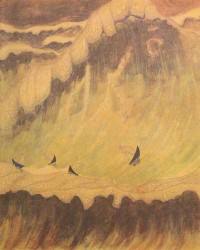 In recent years, the classical music of the Baltic states has received wide attention thanks to the works of Estonians Arvo Pärt and Erkki-Sven Tüür (not to mention the conductors of the Järvi dynasty) and the Latvians Pēteris Vasks and Ēriks Ešenvalds. However, the music of the southernmost Baltic country, Lithuania, is far less well known. The undisputed founder of a distinct Lithuanian art music tradition is the short-lived Mikolajus Konstantinas Čiurlionis (1875–1911), whose sesquicentenary falls this week. In Lithuania, he is revered as both composer and painter, a cultural figure who absorbed elements of folk style (albeit less radically than, say, Béla Bartók) and developed a strong national consciousness while retaining an essentially cosmopolitan aesthetic.
Čiurlionis was born on 22 September (Old Style: 10 September) 1875 into a Polish-speaking Lithuanian family, with Bavarian roots on his mother’s side. When he was still very young, his family moved to Druskininkai, some 30 miles to the southeast, close to what is now the border with Belarus, where his father served as town organist. The young Konstantinas (or ‘Kastukas’ as he was known) was the eldest of nine siblings (the family expanded rapidly once set up in Druskininkai), and showed signs of talent early on: by the age of four he could play the piano by ear, and by seven was a fluent sight-reader. His musical education first took him to Plungė in northeast Lithuania, and then (after his talents were recognised by Prince Michał Ogiński, who became his unofficial patron) to the Warsaw Conservatory, where he studied composition with Zygmunt Noskowski. As well as encountering the works of Wagner, he also became familiar with the writings of Hugo, Nietzsche, Poe and Wilde.
From Warsaw he progressed to the Leipzig Conservatory, where his composition teachers included Carl Reinecke. Like many other famous names, Čiurlionis found the conservative regime at Leipzig stifling (particularly after the more cosmopolitan atmosphere of Warsaw), but he acknowledged the secure basis his education there gave him. Although his funding dried up with the death of Ogiński, he completed his second course of studies there before returning to Druskininkai. Moving again to Warsaw, he shunned regular employment and instead taught music privately, allowing him time to compose. From around 1902, he became increasingly drawn to painting and, with his lifelong friend Eugeniusz Morawski (another budding composer) enrolled with the Warsaw School for Fine Arts on its foundation in 1904.
In 1905 Čiurlionis travelled to the Caucasus, which left a deep impression on him and caused him to ponder his own national identity. This increasingly growing consciousness led him to become a champion of Lithuanian culture, to the extent that his father lost his job because of the family habit of singing Lithuanian folksongs: Polish was still regarded as the correct language in which the educated classes should express themselves. Nevertheless, Čiurlionis became conductor of the groundbreaking Vilniaus Kanklės choir, and he also met Sofija Kymantaitė, ten years his junior, who would eventually become his wife, and who set about improving Čiurlionis’s Lithuanian language skills, in which (rather like Smetana in Czech) he was, to his acute embarrassment, far from fluent. Together they planned together an opera, Jūratė, based on a Baltic myth, even adopting for themselves the names of two of its chief protagonists.
However, it was in painting that Čiurlionis was making his name, and it was chiefly this that took him, in autumn 1908, to St Petersburg, where his attempts to depict music on canvas (including several cycles entitled ‘Sonata’) and a growing originality were admired by the Russian symbolists. Scriabin, too, was an admirer, and they shared a synaesthetic approach to music. The summer of 1909 he spent back in Druskininkai, but on returning to St Petersburg, wearied by a heavy workload, he sank into depression, and by early 1910 he was back at the family home. Belated recognition of Čiurlionis’s artistic talents led a group of supporters to raise funds for his treatment at a sanatorium in Warsaw. It was there, after taking a walk in the woods, that he developed pneumonia, and he died in April 1911. His daughter Danutė, born 11 months earlier, remained unseen by her father.
Čiurlionis’s career trajectory meant that music (especially private teaching) was the primary means of earning a living, while painting became in later years his chief passion. Yet his musical output is far from slender. Some 200 piano works survive, mostly in the form of miniatures (preludes, nocturnes and mazurkas) which reveal the strong influence of Chopin and Schumann, enriched by a predilection for the keyboard’s lower range. There are works for string quartet, organ music and choral works, too. But perhaps the best introduction to his late-Romantic soundworld, with its taste for fundamentally simple ideas developed with adventurous ostinati and a sure command of orchestral somority, are his two symphonic poems. Miške (‘In the Forest’, 1900) was composed while still a student in Warsaw, but its atmospheric span of some 17 minutes, rarely employing the louder end of the orchestral dynamic range, is already a highly assured piece of writing. More ambitious is Jūra (‘The Sea’, 1903–07), a single-movement span of over half an hour which, though not as revolutionary in form or substance as Debussy’s directly contemporaneous La Mer, is an immersive musical soundscape with some achingly beautiful quiet passages and immersively forthright tuttis.
There are very few recordings of Čiurlionis in the current catalogue, but those listed below will give a good idea of his style and range. His artistic output (music and painting) – admired by such figures as Stravinsky, Messiaen, Eisenstein, Gorky and Sartre – is well worth investigating, and as an alternative to this year’s more high-profile sesquicentennial (Ravel), now is the perfect time to do so.
Recommended recordings:
The Sea, In the Forest, Kestutis Overture ODE13442
Complete Music for String Quartet NFPMA9987
Masterclass: Carl Reinecke and his Students RK10122
Piano Music Vol.1 8572659
Latest Posts
Music of the Iberian Peninsula, Part 3: More observations on the Golden Age
16th June 2026
Our last visit to the Iberian peninsula, a fortnight ago, was an insanely ambitious, necessarily broad-brush survey of the Spanish and Portuguese Golden Age, covering vocal and instrumental music, the sacred and the secular. This week, we take a more concise and (I hope) focussed look at a few of the sacred vocal masterpieces which exemplify the particular fervour and intensity of this remarkable period of musical history. They reflect the special place the peninsula had as a bulwark against the Reformation that had taken... read more
read more
Music of the Iberian Peninsula, Part 3: More observations on the Golden Age
16th June 2026
Our last visit to the Iberian peninsula, a fortnight ago, was an insanely ambitious, necessarily broad-brush survey of the Spanish and Portuguese Golden Age, covering vocal and instrumental music, the sacred and the secular. This week, we take a more concise and (I hope) focussed look at a few of the sacred vocal masterpieces which exemplify the particular fervour and intensity of this remarkable period of musical history. They reflect the special place the peninsula had as a bulwark against the Reformation that had taken... read more
read more
Carl Schachter, Arnold Whittall, and why music analysis matters
9th June 2026
Two recent deaths have robbed the world of music analysis of a pair of its most revered figures. Carl Schachter, who has died at the age of 93, was a pupil of (and subsequently collaborator with) Felix Salzer, himself one of Heinrich Schenker’s foremost students. Schachter continued to enrich and broaden the teaching of Schenkerian analysis, including important work on its application to issues of rhythm (which Schenker, focussing on harmonic and contrapuntal matters, largely bypassed). His influence went well beyond the... read more
read more
Carl Schachter, Arnold Whittall, and why music analysis matters
9th June 2026
Two recent deaths have robbed the world of music analysis of a pair of its most revered figures. Carl Schachter, who has died at the age of 93, was a pupil of (and subsequently collaborator with) Felix Salzer, himself one of Heinrich Schenker’s foremost students. Schachter continued to enrich and broaden the teaching of Schenkerian analysis, including important work on its application to issues of rhythm (which Schenker, focussing on harmonic and contrapuntal matters, largely bypassed). His influence went well beyond the... read more
read more
Music of the Iberian Peninsula, Part 2: ‘O quam gloriosum’ – The Spanish and Portuguese Golden Age
2nd June 2026
Over the past fortnight, I’ve been bathed in the most glorious, radiant, transformative light. Not the UK’s recent unseasonable heatwave, but the extraordinary vocal polyphony of the Siglo de Oro: the Spanish (and Portuguese) ‘Golden Century’. Extending from the late 15th to the early 17th century, this was a time of remarkable artistic flowering on the Iberian Peninsula, coinciding with the emergence of Spain and Portugal as global imperial powers with extensive colonial territories in the Americas, Africa and Asia. The... read more
read more