 FREE UK SHIPPING OVER £35!
The Spin Doctor Europadisc's Weekly Column
A dot that went for a walk: The Art of Monophony
29th January 2025
29th January 2025
 In a quote now so famous that its exact source is seldom cited, the Swiss artist Paul Klee (1879–1940) stated that ‘A line is a dot going for a walk’. It chimes with similar formulations used in his Pedagogical Sketchbook of 1925, as does his further (oft-repeated) statement that ‘A drawing is simply a line going for a walk’. Klee was talking about graphic art, but his comments could also apply to music. If the ‘dot’ is taken to be a single note, then the ‘line’ is a melody. In its most basic form, this describes the technique of monophony: a single, unaccompanied musical line ‘going for a walk’. In the classic view of music history, this technique – essentially, unaccompanied melody – is most frequently associated with the music of classical antiquity, as well as the popular music of the middle ages (troubadours, trouvères, Minnesängers, etc.). But it also flourished in the sacred sphere – most obviously in the vast repertoire of plainchant (Old Roman, Ambrosian, Beneventan, Mozarabic, Gregorian, etc.), whether or not it was sung against the ‘accompaniment’ of a vocal drone which functioned to anchor the modal tonic.
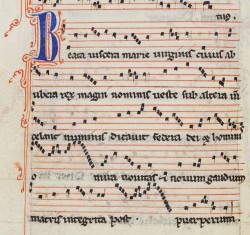
The poetic additions to the liturgy that constituted the conductus genre of the 12th and 13th centuries (featuring newly-composed words and music) were often written for two to three or even four lines, but there are also many monophonic examples. One of the best-known is the Notre Dame conductus Beata viscera, a seven-strophe hymn celebrating the mystery of the Virgin Mary. Its words are often attributed to Philip the Chancellor (Philippe le Chancelier, c.1160–1236), its music to Pérotin (Magister Perotinus, fl. c.1200). For those to whom plainchant is just so much meandering, the strophic, clearly-structured form of the work [see illustration] is likely to be highly attractive, even as it evokes – in the ecstatic melodic peaks of the refrain – the mystery of the Virgin Birth. The metrical structure of the poem, with its regular stress patterns, creates a rhythmicised patterning that is heightened by the distinction between the (mainly syllabic: one note per syllable of text) music of the strophes and the melismatic setting of the refrain ‘O mira novitas et novum...’ (‘O astonishing novelty and unaccustomed joy...’).
In recent years Beata viscera has become familiar to a wide listenership through its inclusion on the Hilliard Ensemble’s ECM album Officium, including the mesmerising interjections of Jan Garbarek’s saxophone. Purists, however, will prefer the voices-only version on the Hilliards’ Perotin album for the same label, underpinned by a subtle drone. For an altogether earthier performance of this absorbing piece, try the version incorporated as a communion hymn into Graindelavoix’s Glossa recording of Guillaume de Machaut’s Messe de Nostre Dame. Machaut himself (a poet, composer and cleric) left many examples of monophony, not least in his virelais: more about him next week!
If the middle ages were an early highpoint for monophony, the Renaissance was the golden age of polyphony (several lines going for separate walks simultaneously). It’s surprising, then, to find that the next peak in monophonic composition was the Baroque era: advances in instrument building and technique, combined with the clear tonal structures of implied harmonies, meant that even a ‘pure’ melody instrument such as the transverse flute could be entrusted with an extended multi-movement suite or sonata without any continuo support (e.g. J.S. and C.P.E. Bach). Georg Philipp Telemann’s 12 Fantasias for solo flute are shorter works, but taken as a group they constitute a major contribution to the flute repertoire, and to its emergence as a solo instrument whose ancient origins and closeness to the human voice gave it a uniquely evocative place in the instrumentarium.
That place was finally established by a series of now iconic solo flute works composed in the 20th century. Dating from the epochal year of 1913, Debussy’s Syrinx (originally ‘Flûte de Pan’) is instrumental monophony at its most evocative, meticulously organised (as many subsequent analyses have shown), but with an improvisatory feel that only a lone performer can convey, at once modern and rooted in ancient mystery. It spawned something of a boom in works for solo flute, which included Arthur Honegger’s similarly classically-inspired Danse de la chèvre (‘Dance of the Goat’, 1921), and likewise with roots in the stage dance of the 20th-century neoclassical revival.
Two further modernist classics deserve mention here: Edgard Varèse’s Density 21.5 (1936, rev. 1946) is a work whose title refers to the metallic density of Georges Barrère’s platinum flute, which it was designed to premiere. Its mixture of modality and atonality has, like Debussy’s Syrinx, proved highly compelling, not just to listeners and performers, but to scores of music analysts and theorists. The other chef d’œuvre in the solo flute repertoire is the technically challenging Sequenza I (1958) by Luciano Berio, which in its turn gave rise to a whole series of 14 Sequenze (1958–2002) for solo performers, many of them monophonic but employing ‘extended’ techniques, and seemingly a far cry from the plainchant and conductus of the medieval era. They threw down a gauntlet not just for performers but composers too. There now exists a vast repertoire of music which might broadly be termed ‘monophonic’, of which we’ve barely touched the surface here, but we hope this gives you a nudge to explore the world of monophony further. And it all starts with a single dot...
Recommended recordings:
Perotin (Hilliard Ensemble) 8377512
Telemann - Twelve Fantasias for Solo Flute (Solomon) CCS40617
Karl-Heinz Schütz: Syrinx EVCD097 (incl. Debussy, Honegger, Varèse)
The Solo Flute Vol.4: Modern (until 1960) (Mirjam Nastasi) ARS38104 (incl. Debussy, Honegger, Varèse, Berio)
Latest Posts
Music of the Iberian Peninsula, Part 3: More observations on the Golden Age
16th June 2026
Our last visit to the Iberian peninsula, a fortnight ago, was an insanely ambitious, necessarily broad-brush survey of the Spanish and Portuguese Golden Age, covering vocal and instrumental music, the sacred and the secular. This week, we take a more concise and (I hope) focussed look at a few of the sacred vocal masterpieces which exemplify the particular fervour and intensity of this remarkable period of musical history. They reflect the special place the peninsula had as a bulwark against the Reformation that had taken... read more
read more
Music of the Iberian Peninsula, Part 3: More observations on the Golden Age
16th June 2026
Our last visit to the Iberian peninsula, a fortnight ago, was an insanely ambitious, necessarily broad-brush survey of the Spanish and Portuguese Golden Age, covering vocal and instrumental music, the sacred and the secular. This week, we take a more concise and (I hope) focussed look at a few of the sacred vocal masterpieces which exemplify the particular fervour and intensity of this remarkable period of musical history. They reflect the special place the peninsula had as a bulwark against the Reformation that had taken... read more
read more
Carl Schachter, Arnold Whittall, and why music analysis matters
9th June 2026
Two recent deaths have robbed the world of music analysis of a pair of its most revered figures. Carl Schachter, who has died at the age of 93, was a pupil of (and subsequently collaborator with) Felix Salzer, himself one of Heinrich Schenker’s foremost students. Schachter continued to enrich and broaden the teaching of Schenkerian analysis, including important work on its application to issues of rhythm (which Schenker, focussing on harmonic and contrapuntal matters, largely bypassed). His influence went well beyond the... read more
read more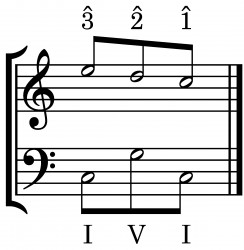
Carl Schachter, Arnold Whittall, and why music analysis matters
9th June 2026
Two recent deaths have robbed the world of music analysis of a pair of its most revered figures. Carl Schachter, who has died at the age of 93, was a pupil of (and subsequently collaborator with) Felix Salzer, himself one of Heinrich Schenker’s foremost students. Schachter continued to enrich and broaden the teaching of Schenkerian analysis, including important work on its application to issues of rhythm (which Schenker, focussing on harmonic and contrapuntal matters, largely bypassed). His influence went well beyond the... read more
read more
Music of the Iberian Peninsula, Part 2: ‘O quam gloriosum’ – The Spanish and Portuguese Golden Age
2nd June 2026
Over the past fortnight, I’ve been bathed in the most glorious, radiant, transformative light. Not the UK’s recent unseasonable heatwave, but the extraordinary vocal polyphony of the Siglo de Oro: the Spanish (and Portuguese) ‘Golden Century’. Extending from the late 15th to the early 17th century, this was a time of remarkable artistic flowering on the Iberian Peninsula, coinciding with the emergence of Spain and Portugal as global imperial powers with extensive colonial territories in the Americas, Africa and Asia. The... read more
read more