 FREE UK SHIPPING OVER £35!
The Spin Doctor Europadisc's Weekly Column
More Reissues from the Archives: BBC Legends Vol.4
25th October 2023
25th October 2023
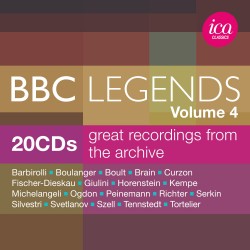 ICA Classics’ no-frills repackaging of releases from the BBC Legends series really is the gift that keeps on giving. The first two boxes of 20 discs apiece soon became sought-after collectors’ items, while the third was a huge hit with our customers earlier this year. All recordings come from the mind-bendingly vast BBC archives, and while the sound quality varies from just-about-acceptable mono to vivid, state-of-the-art stereo, and live performances occasionally feature intrusive audience noise, these discs – all originally issued individually by IMG Artists – are much more than a nostalgia trip. Several releases vie for top slot in certain works, and the epithet ‘legendary’ (so often deployed yet rarely deserved) applies quite properly to a very good proportion of them.
That’s certainly true of Volume 4, just released by ICA Classics. As with the earlier boxes in the series, there’s no booklet or notes, and the cardboard sleeves all feature the same cover design, rather than cover art from the original separate discs. Such information as there is – track details, detailed artist listings, recording dates and technical information – is consigned to the backs of the sleeves. The real information, however, is in the digitally-encoded recordings themselves, and here Volume 4 delivers in spades.
Proceedings kick off with an urgently compelling performance of perhaps Mahler’s trickiest symphony, the Seventh. Taken from an August 1980 concert in Edinburgh’s Usher Hall by the London Philharmonic Orchestra and Klaus Tennstedt, it blazes with immediacy and a command of the Mahlerian idiom that is second to none. For all the occasional fluff, this ranks very competitively against Tennstedt’s own commercially released accounts of the score on EMI, and few have come close to this level of understanding of the score – not least its ‘problematic’ Finale – in the more than four decades since. It’s coupled with a 1985 Proms performance of Mozart’s ‘Jupiter’ Symphony from the same forces that builds steadily to an exceptionally exuberant final movement.
The other Mahler symphony here is the Fourth, taped live in Prague in January 1967 and featuring the BBC Symphony Orchestra under Barbirolli as part of a tour of Central and Eastern Europe. It’s a leisurely-paced affair, full of ripe wisdom, and with Heather Harper as the engaging soloist in the ‘himmlische Leben’ of the last movement. There’s yet more Mahler on a disc devoted to a 1970 Royal Festival Hall recital by Dietrich Fischer-Dieskau, attentively partnered by pianist Karl Engel. Few will miss the usual orchestral accompaniments in the Lieder eines fahrenden Gesellen and four of the Rückert-Lieder when the performances are as acutely observed as these, and they actually seem to benefit from the more detailed nuance possible in the more intimate scoring. They book-end a selection of Mahler’s early Lieder und Gesänge which ranges from brooding introspection to delightful high spirits and good humour.
Bruckner might be less represented here than Mahler, but he’s certainly not outshone. Jascha Horenstein’s 1971 Proms performance of the mighty Fifth Symphony brings similar qualities to the BBC Symphony Orchestra’s playing to those Günter Wand delivered a decade or so later, including rich brass sonorities and some gloriously forthright timpani playing. This is one of the great traversals of Bruckner’s Fifth, and once again the occasional fluff (a screeching dissonance from the violins as they approach the tutti statement of first movement’s main subject) does little to distract from the essential rightness of Horenstein’s vision. Structural patience is never at the expense of an excitement that eludes lesser Brucknerians, and the slow movement flows along more winningly than has since become the norm.
An altogether more unexpected partnership is George Szell, no less, conducting the New Philharmonia in gripping performances of Beethoven’s Eighth and Ninth Symphonies from the Royal Festival Hall in November 1968. The mono sound does little to dampen thrill of these accounts, even though the choral sound is on the backward side (unlike the singing itself), and the solo quartet – Heather Harper, Janet Baker, Ronald Dowd and Franz Crass – is mightily impressive. As you’d expect, Szell keeps a tight rein on proceedings, his Beethoven sound forceful and urgent yet rich in tradition, and the concert ends in a veritable blaze of excitement. As does an outrageously ecstatic 1968 Proms performance of Scriabin’s Poem of Ecstasy by the USSR Symphony Orchestra under the baton of Evgeny Svetlanov. The thrill of an unmarked five-second Luftpause before the final jaw-dropping crescendo has to be heard to be believed. Those who were there still wax lyrical about this concert, and you can hear why in this exceptionally vivid performance.
Other orchestral highlights include a stonking account of Respighi’s Pines of Rome from Constantin Silvestri and the Bournemouth Symphony Orchestra in Bristol (1967), Adrian Boult in wonderfully clear-headed accounts of Schubert’s ‘Unfinished’ and Sibelius’s Seventh Symphonies (New Philharmonia and Royal Philharmonic orchestras respectively), and Rudolf Kempe with the BBC Symphony in Tippett’s Concerto for Double String Orchestra and Janáček’s Sinfonietta (the latter in Croydon’s Fairfield Hall in 1975). The Kempe disc is completed with Edith Peinemann’s sensitive 1976 Festival Hall account of Berg’s Violin Concerto (from the same concert as the Tippett), and other concertos in the box include a fascinating 1972 performance by the great Paul Tortelier of Elgar’s Cello Concerto with the BBC Symphony under Boult, joined in a 1974 account of Brahms’s Double Concerto by his son Yan Pascal on violin. Clifford Curzon forms an unlikely but fruitful partnership with Pierre Boulez at the helm in Beethoven’s ‘Emperor’ and Mozart’s ‘Coronation’ Concertos (1971 and 1974 respectively). There’s more Mozart in the form of the Third Horn Concerto on a disc featuring the great Dennis Brain, and also an astonishing, far from routine account of the Grieg Piano Concerto by Arturo Benedetti Michelangeli. But the concerto palm must go to the thrillingly edge-of-the-seat performances of Liszt’s Piano Concertos by John Ogdon from 1967 and 1971, completed with equally spellbinding solo works by Liszt.
Nadia Boulanger – one of last century’s great teachers and choral conductors – brings plenty of insight to the Requiem (in its expanded orchestral version) by her teacher Gabriel Fauré, and more still to her sister Lili’s choral works, including the extended setting of Psalm 130 (a French version of the De profundis). Yet the singing of the BBC Symphony Chorus at this 1968 Croydon concert is overshadowed by that of the New Philharmonia Chorus in an April 1969 Royal Albert Hall performance of Britten’s War Requiem, with the composer conducting the chamber orchestra (the Melos Ensemble) and Carlo Maria Giulini at the helm of the New Philharmonia. Supremely well-sung, played and conducted, this ranks as one of the most compelling accounts of this work on disc, the thrill of the live performance palpable in every bar. The solo trio – Stefania Woytowicz, Peter Pears and Hans Wilbrink – is the equal of any, and this ranks as one of the unmissable recordings on the present set.
Finally, there are solo piano recitals: Sviatoslav Richter peerless in Schubert Sonatas at the Royal Festival Hall in March 1979, before a rapt audience, and Rudolf Serkin at his grittily elemental best in Beethoven’s ‘Hammerklavier’ and Op.110 Sonatas from the same venue (1968 and 1971, the earlier in mono). They cap a box of musical treasures which only those immune to the sheer excitement and immediacy of live performances could possibly want to pass over.
The Recording:
BBC Legends Vol.4 (various artists) ICAB5174
Latest Posts
Music of the Iberian Peninsula, Part 3: More observations on the Golden Age
16th June 2026
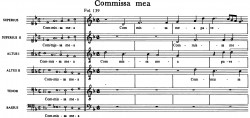
Our last visit to the Iberian peninsula, a fortnight ago, was an insanely ambitious, necessarily broad-brush survey of the Spanish and Portuguese Golden Age, covering vocal and instrumental music, the sacred and the secular. This week, we take a more concise and (I hope) focussed look at a few of the sacred vocal masterpieces which exemplify the particular fervour and intensity of this remarkable period of musical history. They reflect the special place the peninsula had as a bulwark against the Reformation that had taken... read more
read more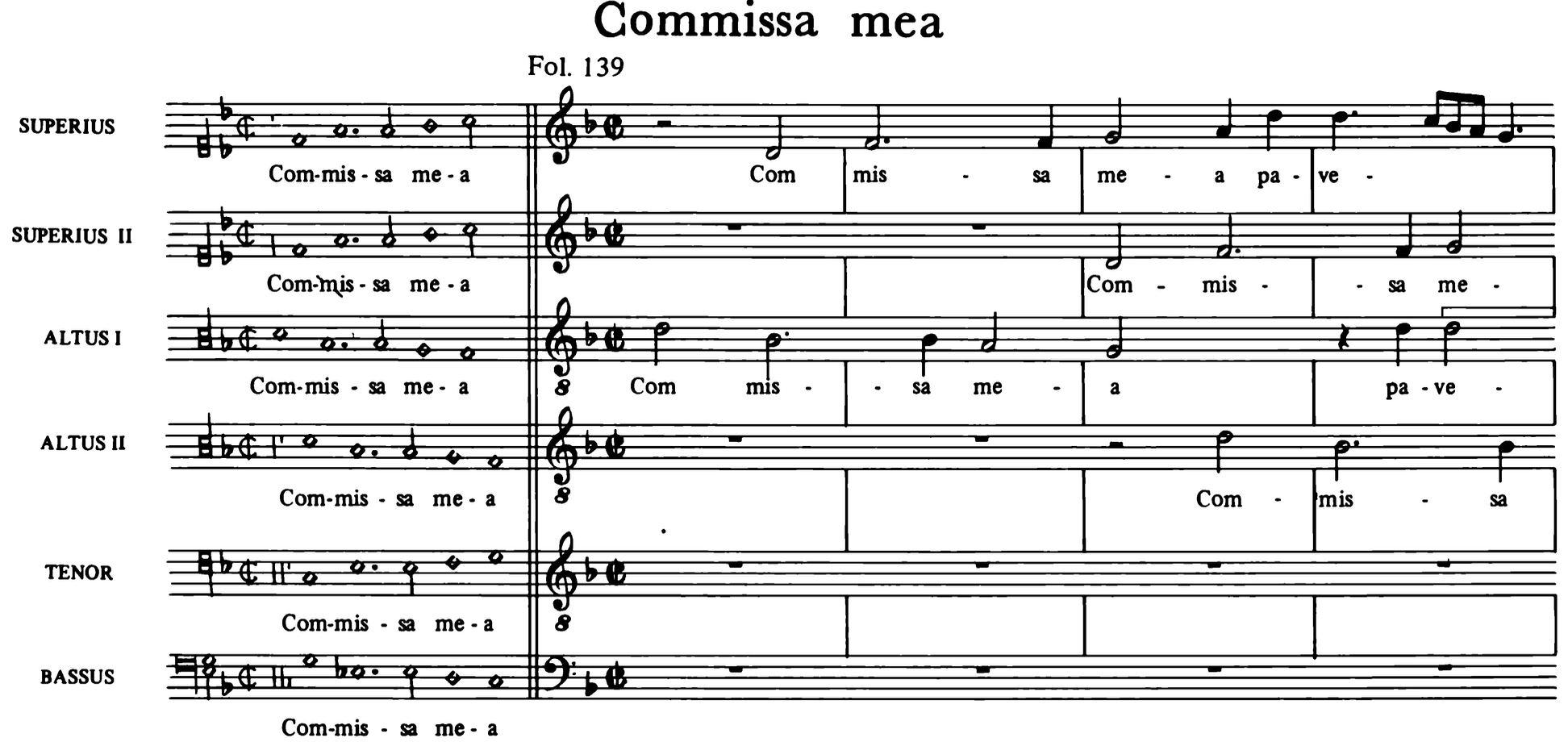
Music of the Iberian Peninsula, Part 3: More observations on the Golden Age
16th June 2026
Our last visit to the Iberian peninsula, a fortnight ago, was an insanely ambitious, necessarily broad-brush survey of the Spanish and Portuguese Golden Age, covering vocal and instrumental music, the sacred and the secular. This week, we take a more concise and (I hope) focussed look at a few of the sacred vocal masterpieces which exemplify the particular fervour and intensity of this remarkable period of musical history. They reflect the special place the peninsula had as a bulwark against the Reformation that had taken... read more
read more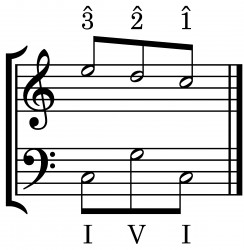
Carl Schachter, Arnold Whittall, and why music analysis matters
9th June 2026
Two recent deaths have robbed the world of music analysis of a pair of its most revered figures. Carl Schachter, who has died at the age of 93, was a pupil of (and subsequently collaborator with) Felix Salzer, himself one of Heinrich Schenker’s foremost students. Schachter continued to enrich and broaden the teaching of Schenkerian analysis, including important work on its application to issues of rhythm (which Schenker, focussing on harmonic and contrapuntal matters, largely bypassed). His influence went well beyond the... read more
read more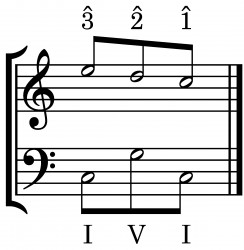
Carl Schachter, Arnold Whittall, and why music analysis matters
9th June 2026
Two recent deaths have robbed the world of music analysis of a pair of its most revered figures. Carl Schachter, who has died at the age of 93, was a pupil of (and subsequently collaborator with) Felix Salzer, himself one of Heinrich Schenker’s foremost students. Schachter continued to enrich and broaden the teaching of Schenkerian analysis, including important work on its application to issues of rhythm (which Schenker, focussing on harmonic and contrapuntal matters, largely bypassed). His influence went well beyond the... read more
read more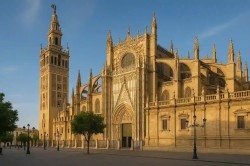
Music of the Iberian Peninsula, Part 2: ‘O quam gloriosum’ – The Spanish and Portuguese Golden Age
2nd June 2026
Over the past fortnight, I’ve been bathed in the most glorious, radiant, transformative light. Not the UK’s recent unseasonable heatwave, but the extraordinary vocal polyphony of the Siglo de Oro: the Spanish (and Portuguese) ‘Golden Century’. Extending from the late 15th to the early 17th century, this was a time of remarkable artistic flowering on the Iberian Peninsula, coinciding with the emergence of Spain and Portugal as global imperial powers with extensive colonial territories in the Americas, Africa and Asia. The... read more
read more