 FREE UK SHIPPING OVER £35!
The Spin Doctor Europadisc's Weekly Column
300 Years Ago in Leipzig...
27th May 2023
27th May 2023
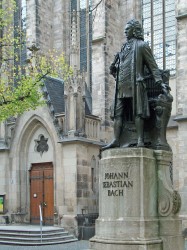 One of this year’s more remarkable but less heralded musical anniversaries falls on 30 May. On that date 300 years ago, Johann Sebastian Bach began his tenure as Thomaskantor in Leipzig, having moved from Cöthen with his growing family (including his recently wed second wife, Anna Magdalena) the previous weekend. The application for the Leipzig post was an unusually protracted one. Following the death in the previous of the previous Thomaskantor, Johann Kuhnau (1660–1722), Bach had applied for the post – regarded as the pre-eminent cantorate in Protestant Germany – towards the end of 1722. On 7 February 1723 two cantatas specially-written by him (now catalogued as BWV 22 and BWV 23) were performed in Leipzig’s Thomaskirche (St Thomas’s Church). But if Bach thought the job was in the bag, he could think again…
The Leipzig Council’s preferred choice was famously Georg Philipp Telemann (1681–1767), who in 1714 had stood godfather to Bach’s second son, Carl Philipp Emanuel. Telemann was on the verge of accepting the post when his existing employers in Hamburg made him a better offer. Leipzig’s second choice was Christoph Graupner (1683–1760), but he was unable to secure release from his post with the landgrave of Darmstadt. So it was that Bach – the third choice for the job (!!!) – took up his post in May 1723. He moved from a relative backwater to a city that – thanks to its university, its renowned trade fairs for the new book publishing industry, and also its attractive surroundings – was earning a reputation as ‘little Paris’.
Bach’s main responsibilities in Leipzig were the education of pupils at the Thomasschule (St Thomas’s School), and the provision of music for Leipzig’s two main churches, St Thomas’s and St Nicholas’s (the Nikolaikirche). Music was not offered as a subject at Leipzig University, and so the Thomasschule was a sort of musical ‘hub’, through which Bach met many of the city’s most outstanding musicians. Notwithstanding the later tribulations he had in his dealings with the town council, Bach’s years in Leipzig – from May 1723 to his death there on 28 July 1750 – were his longest in any post. And while some of his most famous works, including the ‘Brandenburg’ Concertos, many of the organ works and the majority of his chamber music, were composed before his move to Leipzig, it was there that he wrote and compiled many of his greatest works: the St John and St Matthew Passions, Mass in B minor, the four collections of keyboard music that make up the Clavier-Übung, and The Art of Fugue.
During his initial years in Leipzig, however, Bach’s Herculean task (apart from the teaching that took up most of his time) was to write a series of annual cantata cycles for all the Sundays and feast days in the church year (three such cycles survive more or less intact). And he began with a cantata for the First Sunday after Trinity which, judging from the neat appearance of the manuscript score, must have been composed while he was still packing up his belongings in Cöthen. Die Elenden sollen essen, BWV 75, is a bold statement of intent from a composer fresh in the job and full of self-confidence. Although its scoring is relatively modest (two oboes, one oboe d’amore, a single trumpet, strings and continuo, plus a four-part vocal ensemble), its layout in two parts – performed either side of the sermon that was one of the focal points of the main Sunday church service – and its variety of textures, with at least one recitative and aria for each voice type, ensure that this work has an imposing effect. (Bach may have put his own personal stamp on the work by casting it in 14 movements, for this was his ‘own’ symbolic number according to the theory of numerology, whereby A=1, B=2, C=3, and H=8.)
From the very opening gesture – an upward leap of a minor sixth in dotted rhythm, falling back a semitone, then a rhetorical flourish on the oboe, setting in train a French-style introductory chorus in triple time which eventually breaks into a faster fugue in quadruple metre – this is a work that commands attention. The theological theme is the biblical parable of the rich man and the poor Lazarus, the worthlessness of earthly riches and the heavenly reward that awaits those who endure poverty and suffering in this world. (In retrospect, there’s an irony here, for Bach’s later run-ins with the council returned again and again to what he perceived as their ‘penny pinching’.)
Bach uses both secco and accompanied recitatives (with string ‘halos’ in two movements anticipating those of the St Matthew Passion), while the arias are in a range of da capo-type forms which maintain formal variety and carry the text forward. Sensitivity to the meaning of the texts had been a hallmark of Bach’s cantatas from his early years in Mühlhausen onwards, and the same care and thoughtfulness is evident here. The soprano aria in Part 1 of the cantata includes an obligato part for the newly-invented oboe d’amore, while the bass aria in Part 2 is a typically commanding one scored for strings, continuo and trumpet. Part 2 opens with a sinfonia for the same instrumental forces, a chorale fantasia in which the trumpet intones the hymn tune ‘Was Gott tut, das ist wohlgetan’. That chorale also ends each of the work’s two parts, in a four-part harmonisation that is enlivened by lively orchestral ritornelli.
BWV 75 has been one of my personal favourites among Bach cantatas since student days, when in late-night listening sessions we used to devour the latest releases in the Harnoncourt-Leonhardt cycle released (with accompanying scores) in imposing 2-LP boxes by Telefunken/Teldec. Leonhardt’s performance of this work still conveys the frisson of new discovery, something that most subsequent recordings, however polished, never quite match. Gardiner’s approach is often too forceful and aggressive, Koopman applies too many extra ornaments (a fatal error in Bach, where so much is written in, especially on recordings), while Suzuki – who couples the work with the two cantatas Bach wrote for the Leipzig audition – sounds a little too careful to clinch top recommendation. Best of the current crop by a considerable margin is the Ricercar Consort under Philippe Pierlot (on the Mirare label): sung with one voice per part, but with such enthusiasm, stylishness and sensitivity that even diehard OVPP opponents should succumb to its charms. The couplings are BWV 22 and the astonishing later chorale cantata BWV 127, composed some two years into Bach’s Leipzig tenure.
Also recommended is a new release marking this notable tercentenary: Ælbgut and Capella Jenensis bring together cantatas by all three top contenders for the Leipzig job on the Accentus label. For those who want to delve further into the background of perhaps one of the most consequential appointments in music history, it makes for fascinating listening.
Next week: a centenary!
Recommended recordings:
Bach - Cantatas 22, 75 & 127 (Pierlot) MIR332
Bach - Cantatas 22, 23 & 75 (Suzuki) BISCD901
Leipzig 1723: Telemann, Graupner, Bach (Ælbgut, Capella Jenensis) ACC30598
Latest Posts
Music of the Iberian Peninsula, Part 3: More observations on the Golden Age
16th June 2026
Our last visit to the Iberian peninsula, a fortnight ago, was an insanely ambitious, necessarily broad-brush survey of the Spanish and Portuguese Golden Age, covering vocal and instrumental music, the sacred and the secular. This week, we take a more concise and (I hope) focussed look at a few of the sacred vocal masterpieces which exemplify the particular fervour and intensity of this remarkable period of musical history. They reflect the special place the peninsula had as a bulwark against the Reformation that had taken... read more
read more
Music of the Iberian Peninsula, Part 3: More observations on the Golden Age
16th June 2026
Our last visit to the Iberian peninsula, a fortnight ago, was an insanely ambitious, necessarily broad-brush survey of the Spanish and Portuguese Golden Age, covering vocal and instrumental music, the sacred and the secular. This week, we take a more concise and (I hope) focussed look at a few of the sacred vocal masterpieces which exemplify the particular fervour and intensity of this remarkable period of musical history. They reflect the special place the peninsula had as a bulwark against the Reformation that had taken... read more
read more
Carl Schachter, Arnold Whittall, and why music analysis matters
9th June 2026
Two recent deaths have robbed the world of music analysis of a pair of its most revered figures. Carl Schachter, who has died at the age of 93, was a pupil of (and subsequently collaborator with) Felix Salzer, himself one of Heinrich Schenker’s foremost students. Schachter continued to enrich and broaden the teaching of Schenkerian analysis, including important work on its application to issues of rhythm (which Schenker, focussing on harmonic and contrapuntal matters, largely bypassed). His influence went well beyond the... read more
read more
Carl Schachter, Arnold Whittall, and why music analysis matters
9th June 2026
Two recent deaths have robbed the world of music analysis of a pair of its most revered figures. Carl Schachter, who has died at the age of 93, was a pupil of (and subsequently collaborator with) Felix Salzer, himself one of Heinrich Schenker’s foremost students. Schachter continued to enrich and broaden the teaching of Schenkerian analysis, including important work on its application to issues of rhythm (which Schenker, focussing on harmonic and contrapuntal matters, largely bypassed). His influence went well beyond the... read more
read more
Music of the Iberian Peninsula, Part 2: ‘O quam gloriosum’ – The Spanish and Portuguese Golden Age
2nd June 2026
Over the past fortnight, I’ve been bathed in the most glorious, radiant, transformative light. Not the UK’s recent unseasonable heatwave, but the extraordinary vocal polyphony of the Siglo de Oro: the Spanish (and Portuguese) ‘Golden Century’. Extending from the late 15th to the early 17th century, this was a time of remarkable artistic flowering on the Iberian Peninsula, coinciding with the emergence of Spain and Portugal as global imperial powers with extensive colonial territories in the Americas, Africa and Asia. The... read more
read more