 FREE UK SHIPPING OVER £35!
The Spin Doctor Europadisc's Weekly Column
Music and Holy Week
5th April 2023
5th April 2023
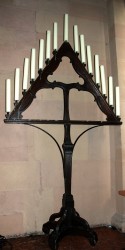 As Christians around the world prepare to celebrate the feast of Easter – the most important date in the Church’s calendar – many will this week observe Holy Week: the week between Palm Sunday and Easter Day which is the culmination of the Lenten fast, and the occasion for particularly solemn church services. Holy Week reaches its most intense period with the three days (triduum) spanning Maundy Thursday, Good Friday and Holy Saturday. They mark, respectively, the Last Supper and the betrayal and arrest of Jesus; his trial, crucifixion and entombment; and the harrowing of Hell. During the Renaissance and Baroque periods in particular, the services held on these days prompted composers to write some of their most profound and intensely beautiful music.
Of particular expressive power are the Tenebrae services: Matins and Lauds on the Thursday, Friday and Saturday which, for practical reasons, have long been observed on the preceding evenings (Wednesday for Maundy Thursday, Thursday for Good Friday, Friday for Holy Saturday), during which the candles of the Tenebrae candelabra are gradually extinguished, with the service ending in darkness, followed by the strepitus (‘great noise’) made by slamming a book shut, symbolising the earthquake that followed Jesus’s death. These services have a unique intensity, which is often enhanced to extreme degrees by the music which forms and integral part of the proceedings.
The service of Matins on these three days is divided into three nocturns, each consisting of three Psalms (after each of which a candle is extinguished) with their preceding antiphons, and followed by three pairs of readings and responsories. The Tenebrae Responsories by Tomás Luis de Victoria (c.1548–1611) and Carlo Gesualdo (1566–1613) have long been regarded as outstanding, with many fine recordings of Gesualdo’s settings in particular over the last few years. The readings that precede the responsories of the first nocturn on each day are taken from the Lamentations of Jeremiah, and these too have been the focus of significant settings by composers from trellis to Palestrina and Lassus. The Iberian peninsula has a particular place of honour with its Lamentations settings, with superb settings by not just Victoria but Cristóbal de Morales (1500–1553), Alonso Lobo (1555–1617) and Manuel Cardoso (1566–1650).
One of the final components of each Tenebrae service (performed near the conclusion of Lauds) is the Miserere, its text taken from Psalm 50 (51), of which the most celebrated setting is by Gregorio Allegri (1582–1652). Allegri’s Miserere, with its simple harmonic progressions lavishly embellished with ornamentation, high soprano solo, and alternating with verses in plainchant, was for many years the exclusive property of the Papal chapel (the Sistine Chapel) in the Vatican, and captivated the likes of Mozart, Burney and Mendelssohn. Its transmission by various means to the present day has resulted in a conflation and corruption of the putative original (the solo high Cs for the soprano are thought not to be original), but however one hears it, if well performed it is an astonishing experience, whether live or on disc.
Standing to one side, as it were, of the mainstream of Tenebrae settings is the unique French Baroque genre of the Leçons de Ténèbres: exquisitely virtuosic chamber settings of the Lamentations for solo voice and instruments, originally designed for private performance in the chamber (and later the chapel) of Louis XIV. The settings (some multiple, others only partial) by Marc-Antoine Charpentier, Michel Lambert, Michel Richard de Lalande and François Couperin are the most notable examples, and provide a fascinating counterbalance to the extreme polyphonic intensity of the Italian and Iberian traditions.
Another distinctive genre of Holy Week music has been the settings of the sayings of Jesus on the cross (the so-called ‘Seven Last Words’). the most famous version – originally for orchestra, alternating with readings of the text, and later adapted for string quartet, piano and, finally, choral performance – is that by Haydn, first performed in Cádiz in 1786. But there are many others, both choral and instrumental, ranging from Schütz and Pergolesi to Gounod, Franck, MacMillan and Murail among many others. Pergolesi and Haydn are among the composers who also composed important settings of the Stabat Mater, the 13th-century poem contemplating the suffering of Jesus’s mother Mary as she stands at the foot of the cross during his crucifixion. Though strictly speaking the Stabat Mater is for performance on the feast of Our Lady of Sorrows (15 September), it is frequently heard in the weeks leading up to Easter (just as Handel’s Messiah – originally and Easter work – has been co-opted to Christmas).
No survey of music for Holy Week, however brief, would be complete without mention of the long tradition of settings of the Passion: Jesus’s sufferings and death as related in the four Gospels. The Passions of the late Renaissance and Baroque periods were preceded by a tradition of plainsong Passions, but it was the advent of the polyphonic Passion in the late 15th century and, even more importantly, the arrival of Luther’s translation of the Latin narratives that gave the genre a real boost. 16th-century settings of Luther’s texts include those by Johann Walter, Jacob Meiland and Melchior Vuilpius, while the dramatic Passions of the 17th century include settings of St Luke, St John and St Matthew by Heinrich Schütz.
Of the ‘oratorio Passions’ (interpolating non-biblical texts in the form of chorales, recitatives and arias) composed before Bach, those by Johann Theile (St Matthew, 1673) and Reinhard Keiser (St Mark, c.1705) are particularly noteworthy. But the Bach’s two surviving settings – the dramatic St John and the more expansive and meditative St Matthew – undoubtedly represent the apex of the genre, and all subsequent Passion settings have, to a greater or lesser extent, been written in their shadow.
In 1712 Keiser was also the first of several composers – including both Handel and Telemann – to set Bathold Heinrich Brockes’s poetic Biblical paraphrase, Der für die Sünde der Welt gemartete und sterbende Heiland Jesus. Handel’s setting of the Brockes-Passion has received renewed attention in recent years, with several fine recordings, but one of the most popular Passions of the late 18th century was Der Tod Jesu by Carl Heinrich Graun, to a text by Karl Wilhelm Ramler (also set by Telemann and C.P.E. Bach).
It is no doubt the narrative immediacy of the Passion genre, and its long tradition of vernacular texts, that has ensured its continued potency to the present day. Among the works to be included more loosely in the Passion genre is John Stainer’s The Crucifixion (1877), enormously popular well into the following century but now much less frequently performed. The most frequently cited 20th-century example is Krzysztof Penderecki’s St Luke Passion (1965), while Arvo Pärt’s Passio (1982) has also achieved great popularity. And Passions continue to be composed with surprising frequency: the most recent to come our way is Bent Sørensen’s St Matthew Passion (2019) performed by the Norwegian Soloists’ Choir on BIS, a beautifully contemplative work of striking originality.
With so much astonishing music to choose from, any shortlist is inevitably highly selective and personal: a starting point from which to explore further. There is enough to choose from in the traditions outlined here to last well beyond one week, however holy: the musical musings and expressive outpourings inspired by the liturgies and narratives of by Holy Week are enough to last several lifetimes!
A few recommendations:
Couperin - Leçons de Ténèbres + Gesualdo - Tenebrae Responsores for Maundy Thursday (Tenebrae) SIGCD622
Victoria - Tenebrae Responsories (Stile Antico) HMM902272
Cardoso - Requiem, Lamentations, Magnificat & Motets (Cupertinos) CDA68252
Lalande - Lecons de Tenebres (Ensemble Correspondances) HMC902206
Allegri - Miserere + Palestrina - Stabat Mater (Willcocks) 4663732
Haydn - Seven Last Words of Christ on the Cross (Savall) AVSA9854
Pergolesi - Stabat Mater (Piau/Rousset) ALPHA449
JS Bach - St Matthew Passion (Pichon) HMM90269193
Telemann - Brockes-Passion (Jacobs) HMM93201314
Sørensen - St Matthew Passion (Norwegian Soloists’ Choir) BIS2611
Latest Posts
Music of the Iberian Peninsula, Part 3: More observations on the Golden Age
16th June 2026
Our last visit to the Iberian peninsula, a fortnight ago, was an insanely ambitious, necessarily broad-brush survey of the Spanish and Portuguese Golden Age, covering vocal and instrumental music, the sacred and the secular. This week, we take a more concise and (I hope) focussed look at a few of the sacred vocal masterpieces which exemplify the particular fervour and intensity of this remarkable period of musical history. They reflect the special place the peninsula had as a bulwark against the Reformation that had taken... read more
read more
Music of the Iberian Peninsula, Part 3: More observations on the Golden Age
16th June 2026
Our last visit to the Iberian peninsula, a fortnight ago, was an insanely ambitious, necessarily broad-brush survey of the Spanish and Portuguese Golden Age, covering vocal and instrumental music, the sacred and the secular. This week, we take a more concise and (I hope) focussed look at a few of the sacred vocal masterpieces which exemplify the particular fervour and intensity of this remarkable period of musical history. They reflect the special place the peninsula had as a bulwark against the Reformation that had taken... read more
read more
Carl Schachter, Arnold Whittall, and why music analysis matters
9th June 2026
Two recent deaths have robbed the world of music analysis of a pair of its most revered figures. Carl Schachter, who has died at the age of 93, was a pupil of (and subsequently collaborator with) Felix Salzer, himself one of Heinrich Schenker’s foremost students. Schachter continued to enrich and broaden the teaching of Schenkerian analysis, including important work on its application to issues of rhythm (which Schenker, focussing on harmonic and contrapuntal matters, largely bypassed). His influence went well beyond the... read more
read more
Carl Schachter, Arnold Whittall, and why music analysis matters
9th June 2026
Two recent deaths have robbed the world of music analysis of a pair of its most revered figures. Carl Schachter, who has died at the age of 93, was a pupil of (and subsequently collaborator with) Felix Salzer, himself one of Heinrich Schenker’s foremost students. Schachter continued to enrich and broaden the teaching of Schenkerian analysis, including important work on its application to issues of rhythm (which Schenker, focussing on harmonic and contrapuntal matters, largely bypassed). His influence went well beyond the... read more
read more
Music of the Iberian Peninsula, Part 2: ‘O quam gloriosum’ – The Spanish and Portuguese Golden Age
2nd June 2026
Over the past fortnight, I’ve been bathed in the most glorious, radiant, transformative light. Not the UK’s recent unseasonable heatwave, but the extraordinary vocal polyphony of the Siglo de Oro: the Spanish (and Portuguese) ‘Golden Century’. Extending from the late 15th to the early 17th century, this was a time of remarkable artistic flowering on the Iberian Peninsula, coinciding with the emergence of Spain and Portugal as global imperial powers with extensive colonial territories in the Americas, Africa and Asia. The... read more
read more