FREE UK SHIPPING OVER £35!

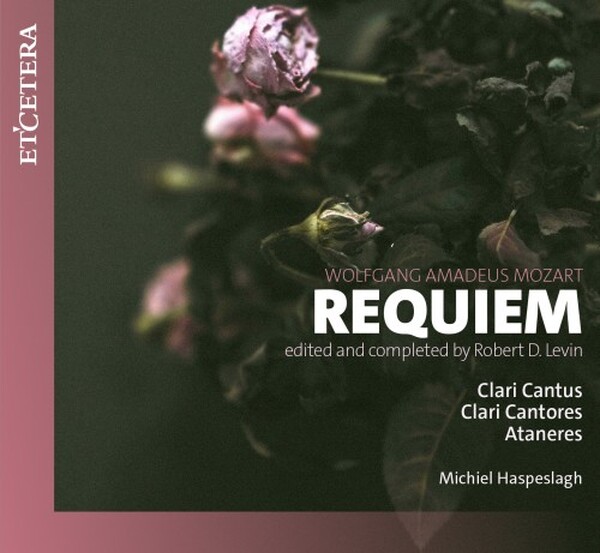
Mozart: Requiem (ed. Levin) | Etcetera KTC1862

Mozart: Requiem (ed. Levin)

£13.34

In stock - available for despatch within 1 working day

New Item

Label: Etcetera

Cat No: KTC1862

Barcode: 8711801018621

Format: CD

Number of Discs: 1

Genre: Vocal/Choral

Release Date: 8th May 2026
Contents

Artists

Dagmara Dobrowolska (soprano)
Sandra Paelinck (mezzo-soprano)
Leander Van Gijsegem (tenor)
Thomas Vandenabeele (bass)
Clari Cantus (choir)
Clari Cantores (choir)
Ataneres (orchestra)

Conductor

Michiel Haspeslagh

Works

Mozart, Wolfgang Amadeus

Ave verum corpus, K618
Requiem in D minor, K626 (revised & completed by Robert Levin)

Artists

Dagmara Dobrowolska (soprano)
Sandra Paelinck (mezzo-soprano)
Leander Van Gijsegem (tenor)
Thomas Vandenabeele (bass)
Clari Cantus (choir)
Clari Cantores (choir)
Ataneres (orchestra)

Conductor

Michiel Haspeslagh

About

This release brings us to the version by American musicologist Robert Levin. His Harvard doctorate focused on Mozart's unfinished works, and as part of it he developed Mozart's sketch for the Amen fugue into a full composition. The German conductor and Mozart specialist Helmuth Rilling was so impressed that he asked Levin to revise the entire Requiem – a task Levin accepted after long hesitation. The premiere took place in 1991, marking the 200th anniversary of Mozart's death.

In his version, Levin tries to find a balance between completely erasing Süssmayr (like Maunder and Druce) and merely adjusting orchestration (like Beyer). If you're accustomed to the Süssmayr version, Levin's Amen fugue at the end of the Lacrymosa and his reworked Osanna fugues in the Sanctus and Benedictus may take some getting used to. Elsewhere he acts more as a subtle restorer, stroking with a gentle brush – for example to liven the rather static accompaniment in the Sanctus. He makes the orchestration lighter and more transparent.

Süssmayr's version remains by far the most frequently performed, but among the approximately twenty alternative completions, Levin's is the most popular. Yet it too receives criticism. Many consider any modification to be sacrilege – or evidence of great arrogance. Moreover, Levin draws heavily on Mozart's Great Mass in C minor (1783) for inspiration for his Amen and Osanna, a work stylistically quite different from the Requiem.

Does Levin come closer to Mozart's intentions? Who knows...

Error on this page? Let us know here

Need more information on this product? Click here