FREE UK SHIPPING OVER £35!

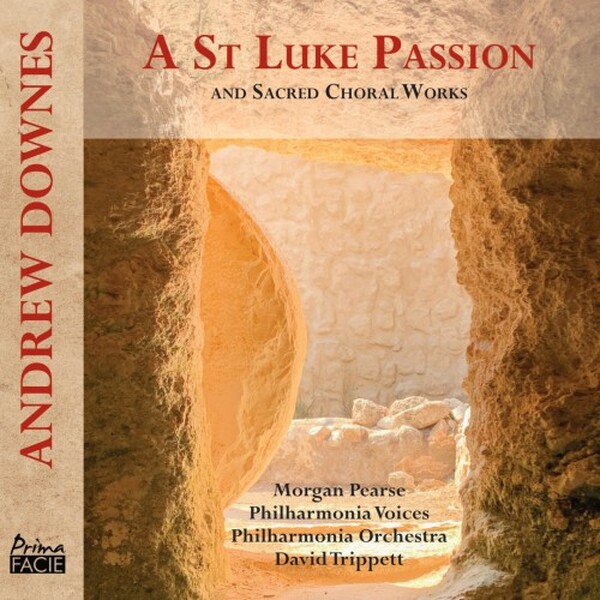
A Downes - A St Luke Passion and Sacred Choral Works | Prima Facie PFCD281

A Downes - A St Luke Passion and Sacred Choral Works

£11.91

In stock - available for despatch within 1 working day

New Item

Label: Prima Facie

Cat No: PFCD281

Barcode: 5065026206015

Format: CD

Number of Discs: 1

Genre: Vocal/Choral

Release Date: 27th March 2026
Contents

About

Prima Facie releases the premiere recording of Andrew Downes’s A St Luke Passion with The Philharmonia and Philharmonia Voices conducted by David Trippett. Commissioned by the Wolverhampton Civic Choir in 1993 to be performed alongside Britten’s 1948 cantata Saint Nicolas, Downes’s A St Luke Passion is the centrepiece of the album which includes several a cappella works. This is the first album in a trilogy of recordings of the large-scale choral works of Midlands composer Andrew Downes (1950-2023), who spent his entire life in Birmingham and the rural Midlands.

Downes’s lyrical gift places him squarely in the Late Romantic English tradition as a successor to Howells, his teacher. Firmly rooted in the Midlands, Downes follows in the footsteps of other local composers who came before him – Elgar, Granville Bantock, Julius Harrison, Francis Edward Bache, Christopher Edmunds and John Joubert. From a musical family, his father was a horn player in the CBSO and his uncle a founding member of The Philharmonia. A talented boy treble, Downes became a countertenor choral scholar at St John’s, Cambridge, later performing Handel opera roles alongside Fisher-Dieskau.

Combining contrapuntal ingenuity and textural athleticism, Downes’s choral works paid homage to Tudor church music. However, his music was not solely rooted in the western tradition, for he sought out inspiration from African drumming, modal scales from North Indian classical music, jazz and rock music, reflecting the depth of responsibility he felt as an educator to instruct and enthuse in a broad range of traditions. For example, his Violin Sonatas are based on Indian rāgas and incorporate striking rhythmic displacements and syncopations to brilliant effect.

Downes loved the “smooth, timeless quality” of plainsong, and in particular the contrapuntal works of Palestrina and Monteverdi, whose freer approach to instrumentation provided inspiration for his St Luke Passion, which was scored for choir, tenor soloist, keyboard, percussion and strings. When the crowd arrests and drags Jesus away, the cello line bursts forth accompanied by a menacing snare drum. In the tussle between Pontius Pilate and the crowd, Downes has the chorus and orchestra play in different time signatures simultaneously. “This multi-dimensional effect is straight out of African tribal music where each player has a regular pattern, but in a different time from everyone else”, Downes explains. When Jesus is nailed to the cross, Downes called on the clang of an anvil to bring to life the most psychologically disturbing parts of the text.

Swinging from Bernstein-like exuberance to African-inspired rhythmic passages, Downes finds an unexpected unity with ancient ecclesiastical music to create a message of communion across musical styles, eras and places in his St Luke Passion.

Downes not only continued the choral tradition of his English forefathers but in his educational work he passed on the flame and paved the way for future generations to follow him. At the Birmingham School of Music (now the Royal Birmingham Conservatoire), where he was Head of Composition and Creative Studies for 30 years, he devised and designed imaginative and groundbreaking courses, pioneered the study and practice of ethnomusicology, building a composition department of international importance and directed themed festivals and concerts.

As conductor David Trippett explains:

“Downes is a unique voice that blends deeply choral instincts with a creative eclecticism that sparks and surprises in its imaginative reach.

“A proud Black Country native, he carried the identity of his home region into his compositions, from local landscapes in the Clent and Malvern Hills to regional poets whose words he set.

“He is both an original and steeped in tradition, supported by firm foundations in the rural Midlands, Elgar’s ‘living centre of music’ at England’s heart.”

Error on this page? Let us know here

Need more information on this product? Click here