FREE UK SHIPPING OVER £35!

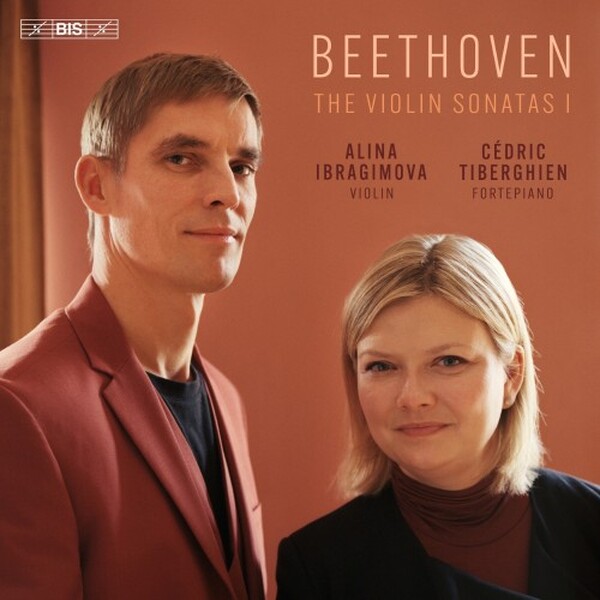
Beethoven: The Violin Sonatas Vol.1

The Europadisc Review

Beethoven: The Violin Sonatas Vol.1

Alina Ibragimova (violin), Cedric Tiberghien (fortepiano)
£12.83

The partnership between Alina Ibragimova and Cédric Tiberghien has firmly established itself as one of the most compelling in contemporary chamber music, not least in their survey of the complete Mozart violin sonatas (Hyperion), and their even earlier (and now sadly unavailable) account of Beethoven’s violin sonatas (Wigmore Hall Live). Now, they launch a new partnership with the BIS label, for whom Ibragimova and her Chiaroscuro Quartet have already recorded a critically-acclaimed series of Haydn, Schubert and Beethoven quartets. Once again, ... read more

The partnership between Alina Ibragimova and Cédric Tiberghien has firmly established itself as one of the most compelling in contemporary chamber music, not least in their survey of the complete Moza... read more

Beethoven: The Violin Sonatas Vol.1

Beethoven: The Violin Sonatas Vol.1

Alina Ibragimova (violin), Cedric Tiberghien (fortepiano)

The partnership between Alina Ibragimova and Cédric Tiberghien has firmly established itself as one of the most compelling in contemporary chamber music, not least in their survey of the complete Mozart violin sonatas (Hyperion), and their even earlier (and now sadly unavailable) account of Beethoven’s violin sonatas (Wigmore Hall Live). Now, they launch a new partnership with the BIS label, for whom Ibragimova and her Chiaroscuro Quartet have already recorded a critically-acclaimed series of Haydn, Schubert and Beethoven quartets. Once again, they turn their attention to Beethoven, launching a new survey of the violin sonatas with a crucial difference: Tiberghien now plays a Paul McNulty fortepiano modelled after a 1794 Walter instrument. Ibragimova’s 1570 Amati instrument, too, is set up in the Classical style, but she is no dyed-in-the-wool purist when it comes to deploying tasteful vibrato where the extra sweetness and expressivity is needed.

These immensely persuasive and stylish performances of Beethoven's Violin Sonatas nos. 1, 2, 3 and 5 offer a reminder of why their partnership is so successful. Combining intellectual rigour with spontaneity, technical brilliance with expressive restraint, they approach these early and middle-period works not as vehicles for display but as vibrant and consistently fresh conversations between equals.

Beethoven's first three violin sonatas, op.12, composed in the late 1790s, already reveal a composer intent on expanding the inherited Classical model. Although nominally for piano ‘with violin’, these works elevate both instruments to genuine partnership, and Ibragimova and Tiberghien embrace this balance with remarkable sensitivity. Throughout the performances, one is struck by the naturalness of their dialogue. Neither player dominates; instead, phrases are exchanged, challenged and developed with an almost conversational ease.

In Sonata no.1 in D major, the opening Allegro con brio immediately establishes the duo's approach. Boldly poised, the tempi are lively without feeling rushed, and articulation is crisp and transparent. Ibragimova's tone possesses a striking purity, allowing Beethoven's melodic contours to emerge with clarity even in the most demonstrative passages. Tiberghien's fortepianism is equally impressive, combining rhythmic vitality with a finely calibrated sense of touch. The central theme-and-variations movement unfolds with elegance and poise, while the concluding Rondo sparkles with wit and energy.

Placed second in the running order, the Sonata no.3 in E flat major, which sometimes feels to me as if Beethoven is trying a bit too hard, receives a particularly sympathetic and convincing reading. The violin’s faster passagework in the opening has a wonderful vitality and just the right amount of bite (as for that matter does the fortepiano in the development section). There is also a keen sense of architectural design, balancing grandeur and intimacy, as well as a range of colour that is enhanced by the ‘period’ instruments. Particularly impressive is the Adagio con molta espressione, where both musicians achieve an atmosphere of profound concentration without lapsing into sentimentality. The finale, full of unexpected twists and turns, and an exuberant energy, is delivered with infectious enthusiasm.

The Sonata no.2 in A major, sometimes overshadowed by its companions, is a particular favourite of mine, and it receives an especially engaging performance. Here the duo highlights the music's lyrical charm and subtle humour. The first movement's playful exchanges are rendered with impeccable timing and a palpable sense of Beethovenian mischief, while the Andante (taken at a surprisingly broad tempo given the qualifying più tosto allegretto) reveals the performers' gift for sustained cantabile playing. Ibragimova's phrasing feels almost vocal in its character and sensitivity to nuance, and Tiberghien's accompaniment provides both support and commentary. The final Allegro piacevole benefits from the fortepiano’s light touch (matched by a slender tone from the violin) and a fine sense of Classical proportion.

The climax of the programme is undoubtedly the Sonata no.5 in F major, op.24, universally known as the ‘Spring’ Sonata. Its popularity can sometimes encourage performances that emphasise its pastoral charm at the expense of its structural sophistication. Ibragimova and Tiberghien avoid this trap entirely, and their interpretation captures the work's warmth and lyricism while remaining alert to its underlying tensions and complexities.

The opening Allegro assai unfolds with a sense of effortless flow. Its famous opening theme sings naturally, avoiding any hint of indulgence, while Tiberghien shapes the piano writing with exceptional refinement. Ibragimova has found a more natural way than in her Wigmore performance with the accents in the dynamic second subject group. And although the running time is longer than in that earlier recording, the extra vitality brought by the instruments and a finely-focussed recording actually make it feel more flowing. In the Adagio molto espressivo, the duo demonstrate their ability to sustain long musical lines and create a deeply intimate atmosphere. The brief Scherzo is perky, playful and nimble, characterised by precise ensemble and a subtle rhythmic flexibility.

The final Rondo is a particular delight. Its buoyant rhythms and sunny disposition are conveyed with freshness and charm, yet the performers never lose sight of the music's gentle sophistication. The animated minore section has just the right degree of abandon. Every phrase feels purposeful, every dialogue meaningful. The result is a reading that sounds both spontaneous and meticulously considered.

What distinguishes these performances above all is the sense of renewed discovery they convey. Despite the familiarity of this repertoire, and having performed it together for many years, Ibragimova and Tiberghien consistently reveal new details within Beethoven's textures and structures. Their use of historically informed principles – lean sonorities, sparing vibrato, transparent textures and sharply defined articulation – illuminates the music without ever feeling doctrinaire. The performances remain fundamentally expressive, driven by a deep understanding of Beethoven's evolving musical language.

Equally noteworthy is the quality of ensemble: years of collaboration have produced an almost instinctive rapport, evident in the precision of their timing and the flexibility of their phrasing. They listen to one another constantly, responding in ways that feel both spontaneous and inevitable.

Even given the current absence from the catalogue of the Faust-Melnikov cycle on Harmonia Mundi, there is notable competition in this repertoire from Viktoria Mullova on the Signum label (variously paired with Kristian Bezuidenhout and Alasdair Beatson). Yet these fine new performances more than hold their own as exemplary interpretations of some of the composer's most rewarding chamber music. Combining technical excellence, stylistic insight and genuine communicative power, Ibragimova and Tiberghien offer readings that are both intellectually stimulating and emotionally engaging. For listeners seeking Beethoven performances of exceptional integrity and imagination, this partnership remains difficult to surpass.

  • Chateau de Versailles Spectacles
  • Avie
  • Supraphon

The Spin Doctor Europadisc's Weekly Column

Music of the Iberian Peninsula, Part 2: ‘O quam gloriosum’ – The Spanish and Portuguese Golden Age

Music of the Iberian Peninsula, Part 2: ‘O quam gloriosum’ – The Spanish and Portuguese Golden Age  2nd June 2026

2nd June 2026

Over the past fortnight, I’ve been bathed in the most glorious, radiant, transformative light. Not the UK’s recent unseasonable heatwave, but the extraordinary vocal polyphony of the Siglo de Oro: the Spanish (and Portuguese) ‘Golden Century’. Extending from the late 15th to the early 17th century, this was a time of remarkable artistic flowering on the Iberian Peninsula, coinciding with the emergence of Spain and Portugal as global imperial powers with extensive colonial territories in the Americas, Africa and Asia. The steady progress of the Reconquista from the late 11th to the late 15th century saw the prevailing Mozarabic liturgical rite replaced by the Roman liturgy; the union of Spain through the 1469 marriage of Ferdinand of Aragon and Isabella of Castille, and the subsequent marriage of their daughter Joanna ('the Mad') to the Habsburg Philip the Fair (son of the Holy... read more

View Older Posts

Gramophone Record of the Month

Played on Record Review