FREE UK SHIPPING OVER £35!

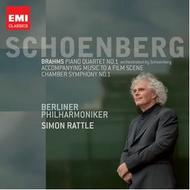
Schoenberg - Orchestral Works | EMI 4578152

Schoenberg - Orchestral Works

New Item

Label: EMI

Cat No: 4578152

Barcode: 5099945781520

Format: CD

Number of Discs: 1

Genre: Orchestral

Release Date: 8th August 2011
This product has now been deleted. Information is for reference only.

Contents

About

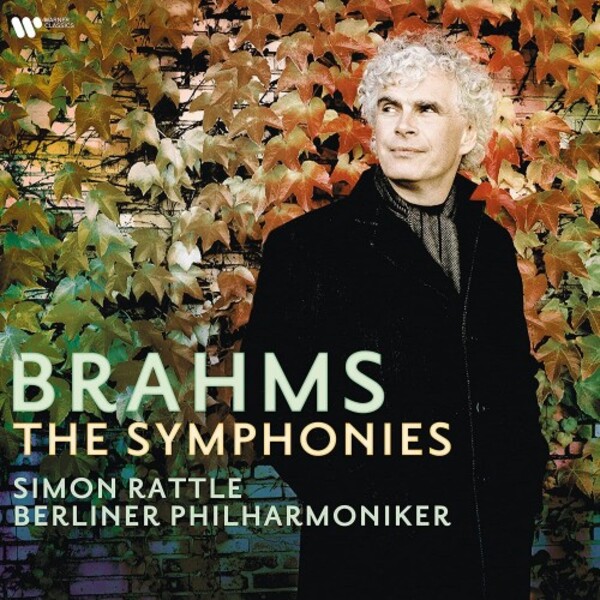
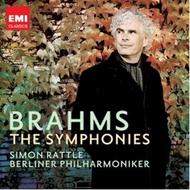
Following the release of the complete Brahms symphonies ("Altogether a marvellous achievement." The Daily Telegraph), Sir Simon Rattle and the Berliner Philharmoniker have performed and recorded a programme of orchestral works by Arnold Schoenberg, who was a great admirer of Brahms.

In these three contrasting works, the spirits of Modernism, Romanticism and Classicism are invoked by Arnold Schoenberg – a revolutionary whose aesthetic roots lay firmly in tradition. Sir Simon Rattle, who first established his international reputation with masterpieces of the 20th century, explores these musical cross-currents with the Berliner Philharmoniker, long supreme in Austro-German repertoire.

The repertoire, recorded in concert at Berlin’s Philharmonie in late October/early November 2009, consists of Schoenberg’s orchestration of Brahms’s Piano Quartet in G minor, Begleitungsmusik zu einer Lichtspielszene (Accompanying Music to a Film) and the full orchestra version of the Chamber Symphony No. 1.

In these three contrasting works, the spirits of Modernism, Romanticism and Classicism are invoked by Arnold Schoenberg – a revolutionary whose aesthetic roots lay firmly in tradition. Sir Simon Rattle, who first established his international reputation with masterpieces of the 20th century, explores these musical cross-currents with the Berliner Philharmoniker, long supreme in Austro-German repertoire.

Immediately after the recent performances/recordings, Sir Simon and the Orchestra set off on a coast-to-coast U.S. tour performing the Brahms symphonies and this Schoenberg programme at New York’s Carnegie Hall and in San Francisco, Los Angeles, Boston, Chicago and Ann Arbor.

Schoenberg said that he had arranged Brahms’s Piano Quartet in G minor, Op. 25 for orchestra in 1937 for several reasons: “1) I like this piece; 2) It is seldom played; 3) It is always played badly, because the better the pianist, the louder he plays and you hear nothing from the strings. I wanted once to hear everything, and this I achieved.” He also stated that he intended to write his orchestration strictly in the style of Brahms, going no further than Brahms would have gone “if he had lived today.

Mark Swed, in The Los Angeles Times, said of the LA performance, “When [Schoenberg] made the version in 1937, he had recently moved from Berlin to Los Angeles and was clearly entranced by the resplendent light of his new home. He garbs the quartet in garish instrumental colors … Rattle emphasized everything in the most polystylistic way possible. A horn solo in the solo movement had a raw jazzy quality; a clarinet solo in the Gypsy-inspired last movement was klezmer-like. A xylophone clattered, a bass drum thumped. But within this ruckus was also ravishing ensemble playing and, from Rattle, the inspiration not only for great characterization but also for momentum.

Allan Kozinn in The NY Times wrote of the Carnegie Hall performance, “It can be hard to banish the original sound and texture from your inner ear, however convincing the new interpretation may sound. But it can be worth the effort, as Mr. Rattle and his musicians demonstrated in a vital, shapely account that found levels of drama in Schoenberg’s magnification that a performance of the chamber version could not possibly equal.

Simon Rattle previously recorded this work with the City of Birmingham Symphony Orchestra in 1985.

Begleitungsmusik zu einer Lichtspielszene (Accompanying Music to a Film Scene) was a 1929 commission from the Heinrichshofen Verlag in Magdeburg to write music for a hypothetical film that was, in fact, never produced. Schoenberg was a widely cultured man who took great interest in the development of film and the opportunities that ‘talkies’ offered composers. He based his work, “a brief 12-tone essay” on the themes of threat, danger, fear and catastrophe. Begleitungsmusik zu einer Lichtspielszene was premiered in 1930 by the Frankfurt Radio Orchestra under the baton of Hans Rosbaud. Although Balanchine used the 9-minute freely atonal work for a ballet, Opus 34, the score is rarely performed.

Schoenberg originally composed his Chamber Symphony No. 1 Op 9b in 1906 for 15 players in a single movement but he came to feel that it sounded unbalanced and therefore expanded it for full orchestra in 1922. He reworked it in 1935 and this is the version performed and recorded by the Berliners. In the Chicago Tribune John Von Rhein wrote “I admired the achingly beautiful string playing and depth of feeling Rattle brought to the music. … Amazingly, given the huge instrumental palette, every textural strand was clear …. Rattle kept the dizzying profusion of incident going at an energized yet sensitive pace. As an example of orchestral virtuosity at the highest level, this concert would be hard to beat.” The Chicago Sun-Times said that, “to hear the swirling, 22-minute Schoenberg work written less than ten years after Brahms’s death played with such conviction and with the rich and gleaming sound of the Berlin strings and its famously balanced wind and brass sections was a true joy.” This is Simon Rattle’s first recording of the full orchestral version, in the 1935 revision.


Simon Rattle became Chief Conductor and Artistic Director of the Berliner Philharmoniker in September 2002. His contract was recently extended to 2018. As well as fulfilling a taxing concert schedule in Berlin, they tour extensively and have received many awards for their recordings and pioneering educational work. Their concert programmes cover a wide range of repertoire, from Bach and Rameau through to Gubaidulina and Lindberg.

Rattle is Artistic Director of the Salzburg Easter Festival, where he has conducted the Berliner Philharmoniker in staged productions of Fidelio, Così fan tutte, Peter Grimes and Pelléas et Mélisande, a concert performance of Idomeneo and a wide range of concert programmes. He will complete a five-year complete Wagner Ring Cycle project with the Berliner Philharmoniker at the Aix-en-Provence and Salzburg Easter Festivals in 2010.

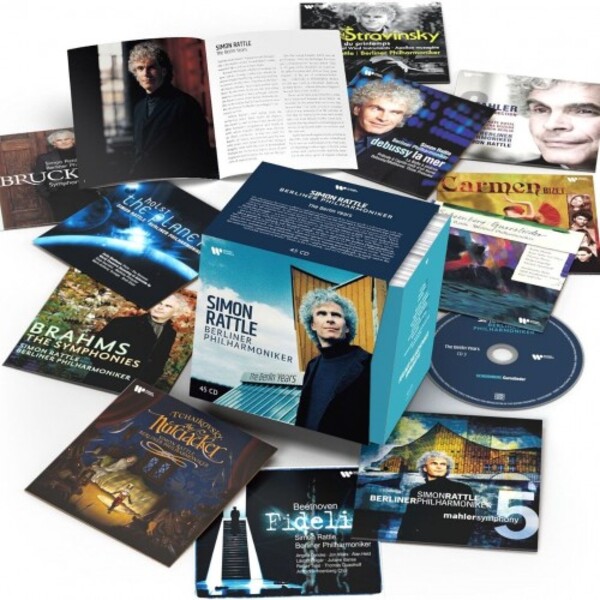
Simon Rattle’s association with EMI dates back to the 1970s and has resulted in many award-winning and ground-breaking releases. Previous critically acclaimed recordings with the Berliner Philharmonker encompass works by Bruckner, Brahms, Holst, Shostakovich, Prokofiev, Schoenberg, Richard Strauss, Schubert, Mahler and Debussy.

Sir Simon Rattle recently signed a new contract with EMI Classics, extending their exclusive and productive relationship well into a fourth decade. Over the next four years, Rattle will make twelve CDs with EMI Classics; the agreement ensures that he, the label and the Berliner Philharmoniker will continue to build on their previous notable successes, which have included three Grammy Awards in the US, three Classical Brit and three Gramophone Awards in the UK, and two Echo Klassik Awards in Germany.

Project highlights in the next year include Tchaikovsky’s complete Nutcracker ballet and a program of American music, headlined with a new commission by Wynton Marsalis.


recorded in concert - 30 October - 7 November 2009

Error on this page? Let us know here

Need more information on this product? Click here