FREE UK SHIPPING OVER £35!

Steinway Legends - Mitsuko Uchida | Steinway Legends (Philips) 4758510

Steinway Legends - Mitsuko Uchida

New Item

Label: Steinway Legends (Philips)

Cat No: 4758510

Barcode: 0028947585107

Format: CD

Number of Discs: 2

Genre: Instrumental

Release Date: 11th June 2007

This product has now been deleted. Information is for reference only.

Contents

Works

Mozart
Rondo in A minor, K511

Mozart
Piano Sonata no.18 in D, K576

Mozart
Fantasia in D minor, K397

Schubert
Impromptu no.4, op.90, D899

Schubert
Six German Dances, D820

Schubert
Piano Sonata no.15 in C, D840

Beethoven
32 Piano Variations in C minor, WoO80

Schumann
Kreisleriana, op.16

Debussy
from 12 Etudes pour le piano: pour les Arpeges composes; poue les Sonorites opposees; poue les Notes repetees; poue les Agrements

Berg
Sonata, op.1

Artists

Mitsuko Uchida

Works

Mozart
Rondo in A minor, K511

Mozart
Piano Sonata no.18 in D, K576

Mozart
Fantasia in D minor, K397

Schubert
Impromptu no.4, op.90, D899

Schubert
Six German Dances, D820

Schubert
Piano Sonata no.15 in C, D840

Beethoven
32 Piano Variations in C minor, WoO80

Schumann
Kreisleriana, op.16

Debussy
from 12 Etudes pour le piano: pour les Arpeges composes; poue les Sonorites opposees; poue les Notes repetees; poue les Agrements

Berg
Sonata, op.1

Artists

Mitsuko Uchida

About

Mozart’s Rondo in A minor, K. 511 has been viewed as expressing through its exceptional pathos and poignancy a personal resignation to death; however, it could also be a deliberate exercise in the Empfindsamkeit of C. P. E. Bach, whose style Mozart had blended with the galant some five years earlier in the Fantasy in D minor, K 397, when his interest in the works of J. S. Bach and Handel were keenest. Earliest of all is the Sonata in F, K. 332, one of four that Mozart composed during his 1778 stay in Paris. Displaying his musical wares in abundance, Mozart guides the listener agreeably from one mood to another in a thematically rich opening Allegro. The elegant Adagio seems tailor-made for a French audience. The finale begins with showy pseudo-virtuosity (never beyond the abilities of a well trained amateur) and ends with appealing shyness.

Schubert’s German Dances, D 820 were written in 1824 during his stay in rural Hungary at the summer estate of the Esterházy family as tutor in music to their daughters. Not published until 1931, they soon attracted the attention of Anton von Webern, who orchestrated them. The D899 Impromptus date from 1827 and are among Schubert’s best-known piano works. The E-flat, the second of the set, pits an extroverted opening section comprised of unbroken running triplets with an emphatic, brooding section in B minor that eventually gives way to the triplets but makes a dramatic return just before the end. The A-flat is even more passionate by its compactness, its opening in the tonic minor and stormy Trio in C-sharp minor. Schubert’s Sonata in A, D 664 is perhaps the most congenial of his works in the form, as well as the most modestly scaled. Its corresponding lyric beauty has made it among the best loved of his sonatas.

Beethoven’s Variations in C minor date from 1806, the same year as the Fourth Symphony, Violin Concerto and later “Razumovsky’ String Quartets, making it a product of his musical maturity despite its lack of an opus number.

E.T.A. Hoffmann was among Schumann’s favorite authors. The character of Kapellmeister Kreisler appeared in several of Hoffman’s works. Schumann composed his suite of eight pieces “after” Kreisler in rapid succession over three days in 1838. The juxtaposition of turbulent music in G minor with more introspective sections associated with B-flat may evoke the emotional dualism of the character. Beginning passionately, it closes in eerie spareness.

Debussy composed his Twelve Etudes in 1915, after preparing an edition of Chopin’s piano works begun at the suggestion of his publisher, Jacques Durand, to whom Debussy dedicated the last of his important piano works. The four included here come from the second book albeit appearing in reverse order of their placement in the score. Strumming guitars of La puerta del vino from the Preludes are recalled in the compound arpeggios of the first. “Opposing sonorities” contrasts texture, register and articulation. The next is a whispering scherzo, prominently employing the whole-tone scale. Pour les agrements was described by the composer as a “barcarolle on an Italianate sea”.

Berg’s one-movement Sonata, premiered in 1911, dates from his years of study with Schoenberg in Vienna and strongly reflects his teacher’s own tonal works. The move to atonality and the twelve-tone technique would come soon but not yet.

Also Available

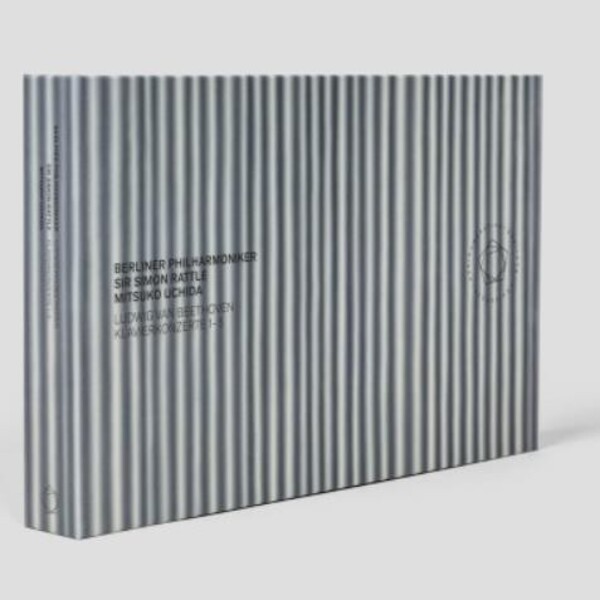
Beethoven - Piano Concertos 1-5

£32.15

(Berlin Philharmonic)

Mitsuko Uchida plays Chopin in Warsaw, 1970

£25.71

(NIFC (National Institute Frederick Chopin))

Error on this page? Let us know here

Need more information on this product? Click here