FREE UK SHIPPING OVER £35!

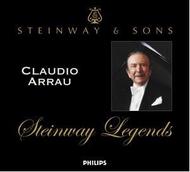
Steinway Legends - Claudio Arrau | Steinway Legends (Philips) 4758509

Steinway Legends - Claudio Arrau

New Item

Label: Steinway Legends (Philips)

Cat No: 4758509

Barcode: 0028947585091

Format: CD

Number of Discs: 2

Genre: Instrumental

Release Date: 11th June 2007
This product has now been deleted. Information is for reference only.

Contents

Works

Beethoven
Sonta no.14, op.27/2 ’Moonlight’

Mozart
Rondo in A minor, K511

Schubert
Allegretto in C minor, D915

Liszt
Sonata in B minor, S178

Balakirev
Islamey

Chopin
Impromptus nos.1-4

Schumann
Faschingsschwank aus Wien, op.26

Beethoven
’Eroica’ Variations, op.35

Artists

Claudio Arrau

Works

Beethoven
Sonta no.14, op.27/2 ’Moonlight’

Mozart
Rondo in A minor, K511

Schubert
Allegretto in C minor, D915

Liszt
Sonata in B minor, S178

Balakirev
Islamey

Chopin
Impromptus nos.1-4

Schumann
Faschingsschwank aus Wien, op.26

Beethoven
’Eroica’ Variations, op.35

Artists

Claudio Arrau

About

The works on these two CDs are ones that Arrau performed and recorded regularly throughout his career. The sole exception is Balakirev’s “oriental fantasy”, Islamey [Track 10, CD 1], recorded in 1928, one year after Arrau won the Geneva International Competition, which required the piece of all contestants. The jury in Geneva included Alfred Cortot, José Vianna da Motta, Josef Pembaur and Arthur Rubinstein. The latter likened the contest between Arrau and the other competitors to “a race between a thoroughbred and some cart horses.” Arrau later dropped all pianistic showpieces like this from his programs, making the recording a valuable souvenir of his early playing.

Arrau’s 1966 recording of Beethoven’s “Moonlight” Sonata [Tracks 1-3, CD 1] memorably conjures the successive moods of its three movements: Brooding and mysterious in the first; the shy, happy song of the second; and the brilliant, stormy finale. The Sonata was composed in 1801. The next year, Beethoven produced his “Eroica” Variations, op 35 [Track 10, CD 2]. The nickname derives from the theme of the variations, which Beethoven also used in 1803 for the finale of his “Eroica” Symphony.

Mozart’s Rondo in A minor, K511 [Track 4, CD 1] always suggested to Arrau “a presentiment of death”, perhaps due to its date of composition, March 1787, occurring only a few weeks before Mozart learned of his father’s final illness (Leopold died at the end of May). But its sombre mood also suggests the empfindsamer Stil (expressive style) of C. P. E. Bach and was composed when Mozart seemed to be choosing particular musical styles in which to work.

Like so many of Schubert’s works, the Allegretto, D 911 [Track 5, CD 1], from the spring of 1827, remained unpublished (and presumably unheard) until 1870. Schumann’s “Viennese Carnival Prank” [Tracks 5-9, CD 2] dates from his stay in the Austrian capital during the winter of 1839-40 and is one of his later works in the romantic-imaginative style shared by Carnaval, the Davidsbündlertänze and Phantasiestücke.

Arrau was reputed to have played Liszt’s Transcendental Etudes when he was 12. His cogent exposition of Liszt’s pathbreaking study in musical metamorphosis, the Sonata in B minor [Tracks 6-9, CD 1], confirms his reputation as a peerless Liszt interpreter. Arrau came to eschew bravura for its own sake; however this 1970 recording demonstrates that he could still unleash it when it served the composer’s purposes, particularly in the “demonic” final climax. The “Fantasy-Impromptu,” Op 66 [Track 4, CD 2] has become one of Chopin’s most familiar works, particularly in the U. S., where it acquired further popularity when its middle section became the melody for a popular song, “I’m Always Chasing Rainbows”.

Error on this page? Let us know here

Need more information on this product? Click here