FREE UK SHIPPING OVER £35!

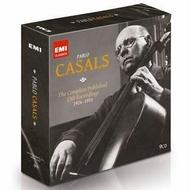
Pablo Casals - The Complete Published EMI Recordings 1926-1955 | EMI 6949322

Pablo Casals - The Complete Published EMI Recordings 1926-1955

New Item

Label: EMI

Cat No: 6949322

Barcode: 5099969493225

Format: CD

Number of Discs: 9

Release Date: 4th May 2009
This product has now been deleted. Information is for reference only.

Contents

Artists

Pablo Casals

Artists

Pablo Casals

About

Pau Casals i Defilló or Pablo Casals as we was known throughout his glittering career was born on 29th December 1876 in El Vendrell in the Catalan part of Spain where his father was a parish choirmaster and organist. He taught Pablo singing, piano, violin, organ and how to compose. At six he heard a travelling musician playing a home-made cello and his father made him one. On hearing his first proper cello when he was eleven made him decide that this would be his instrument.

In 1888 he enrolled in the Municipal School of Music in Barcelona to study musical theory as well as piano and cello. Such was his remarkable progress that he gave a solo recital at the age of fourteen and graduated with honours two years later.

Albéniz, the great Spanish composer, heard him in a café trio and gave him a letter of introduction to the private secretary to María Cristina, the Queen Regent, in Madrid. He was duly granted a royal stipend to study composition at the Capital’s Music Conservatory and played at informal concerts in the palace. In 1895 he spent a year in Paris earning his living by playing second cello in the theatre orchestra of the Folies Marigny. He returned to Catalonia the following year and taught at the Music School.

In 1897 he appeared as soloist playing the Lalo Concerto with the Madrid Symphony Orchestra and the Queen awarded him the Order of Carlos III.

In 1899 he played at London’s Crystal Palace and for Queen Victoria at her summer residence, in November and December that year he was soloist at prestigious Lamoureux concerts in Paris to great public and critical acclaim. With the pianist Harold Bauer he toured Spain and the Netherlands in 1900/1, the United States in 1901/2 and South America in 1903. On 15th January 1904 he played at the White House for President Theodore Roosevelt and on 9th March he made his Carnegie Hall debut, playing Richard Strauss: Don Quixote under the baton of the composer.

In 1905 he moved to Paris where with the pianist Alfred Cortot and violinist Jacques Thibaud he established the famous trio which would last until 1934. The trio recorded Haydn, Beethoven, Schubert, Mendelssohn and Schumann in versions which, even today, are regarded as touchstones of greatness. He also recorded cello sonatas by Beethoven and Brahms as well as the cello concertos by Dvořák and Elgar together with Bruch’s Kol Nidrei. Arguably his greatest recording was made by himself alone: In three periods during the years 1936, 1938 and 1939 he committed to disc the six suites by Bach.

Besides being a master of the cello he was a conductor and created an orchestra in his native Catalonia – Orquesta Pau Casals, Barcelona – indeed Cortot conducted it when Thibaud and Casals were the soloists in the recording of the Brahms Concerto for Violin and Cello and orchestra.

He was also a composer and amongst his creations are works for chorus as well as for his instrument – the most famous being an arrangement of the Catalan folksong El cant dels ocells (“Song of the Birds”).

For such a great man who gave so much music to the world, alas, his life was blighted by cruel fate. In 1936 Civil War broke out in Spain and his orchestra ceased its activities. He settled in a village in France close to the border with Spain where he gave concerts to assist those who opposed the fascist junta. So fierce was his anger at Francisco Franco’s dictatorial regime that he refused to appear in countries that recognised it as the legitimate government, an embargo that he only broke once when he played at the White House in November 1961 at the invitation of President John F. Kennedy whom he admired.

Celebrations to mark the bicentenary of the death of Bach in Prades in Conflent (about 20 miles west of Perpignan) prompted him to resume his career as both cellist and conductor and he continued to lead these festivals until 1966. By this time he had been living in the country of his mother’s birth, Puerto Rico for 10 years and married for nine of those to a local student, Marta Montañez Martínez. Casals had been married once before; from 1906 and 1912 he was associated with Guilhermina Suggia, a talented young Portuguese cellist but, although she often referred to herself in concert programmes as Mme P. Casals, they never married. In 1914 he married the American singer Susan Metcalfe; they separated fourteen years later but did not divorce until 1957 when he married for the second time. Casals and his wife set up home in a house called “El Pesebre” in the town of Ceiba on the east coast of the island whilst the capital, San Juan, inaugurated the annual Casals Festival in the same year.

During the 1960s Casals gave many master classes throughout the world. His last major public engagement was to conduct one of his last works: Himne a les Nacions Unides (Hymn of the United Nations) on 24th October 1971, two months before his 95th birthday. He died in 1973 but in 1979 his remains were returned for burial at his birthplace in Catalonia having failed by two years to see the end of Franco and the return of democratic rule for which he had fought so hard. He was posthumously honoured by the new government with the issue of a commemorative postage stamp in honour of the centenary of his birth in 1976.

Tracklisting:

CD 1

Johann Sebastian Bach 1685-1750
Suite No. 1 in G, BWV 1007
[ 1] I. Prélude 2.28
[ 2] II. Allemande 3.40
[ 3] III. Courante 2.32
[ 4] IV. Sarabande 2.22
[ 5] V. Menuet I & II 3.14
[ 6] VI. Gigue 1.50

Recorded: 2.VI.1938, Paris; 2LA 2583 – 88; DB 3671 - 73

Suite No. 2 in D minor, BWV 1008
[ 7] I. Prélude 3.43
[ 8] II. Allemande 3.54
[ 9] III. Courante 2.16
[10] IV. Sarabande 4.05
[11] V. Menuet I & II 3.19
[12] VI. Gigue 2.35

Recorded: 25.XI.1936, Abbey Road Studios, London / 2EA 4476 & 4481 – 85; DB 3399 – 3401

Suite No. 3 in C, BWV 1009
[13] I. Prélude 3.28
[14] II. Allemande 3.45
[15] III. Courante 3.14
[16] IV. Sarabande 3.30
[17] V. Bourrée I & II 3.23
[18] VI. Gigue 3.04

Recorded: 25.XI.1936, Abbey Road Studios, London / 2EA 4470 – 75; DB 3402 - 3404

Pablo Casals violoncello
Producer: unknown / Balance engineer: M. Caily (1 – 6)
MONO/ADD  This compilation (P) 1988 by EMI Records Ltd. Digital remastering (P) 2003 by EMI Records Ltd.

CD2

Suite No. 4 in E flat, BWV 1010
[ 1] I. Prélude 4.15
[ 2] II. Allemande 3.45
[ 3] III. Courante 3.55
[ 4] IV. Sarabande 4.09
[ 5] V. Bourrée I & II 3.37
[ 6] VI. Gigue 2.35

Recorded: 13 – 16.VI.1939, Paris; 2LA 3140 & 3115 – 7; DB 6538 - 40

Suite No. 5 in C minor, BWV 1011
[ 7] I. Prélude 7.18
[ 8] II. Allemande 3.17
[ 9] III. Courante 2.03
[10] IV. Sarabande 2.45
[11] V. Gavotte I & II 4.29
[12] VI. Gigue 2.20

Recorded: 14 & 15.VI.1939, Paris; 2LA 3126 – 7 & 3130 – 4; DB 6541 - 43

Suite No. 6 in D, BWV 1012
[13] I. Prélude 5.06
[14] II. Allemande 7.31
[15] III. Courante 3.42
[16] IV. Sarabande 4.17
[17] V. Gavotte I & II 3.04
[18] VI. Gigue 3.59

Recorded: 3.VI.1938, Paris; 2LA 2593 – 2600; DB 3674 - 77

Pablo Casals violoncello
Producer: unknown / Balance engineer: M. Caily
MONO/ADD This compilation (P) 1988 by EMI Records Ltd. Digital remastering (P) 2003 by EMI Records Ltd.

CD3

Ludwig van Beethoven 1770-1827
Cello Sonata No. 1 in F, Op. 5 No. 1
[ 1] I. Adagio sostenuto – 3.11
[ 2] Allegro 11.12
[ 3] II. Allegro vivace 7.34

Recorded: 19 & 20.VI.1939, Paris; 2LA 3141 – 44 & 3148 – 49; DB 3908 – 10

Cello Sonata No. 2 in G minor, Op. 5 No. 2
[ 4] I. Adagio sostenuto ed espressivo – 5.40
[ 5] Allegro molto più tosto presto 7.52
[ 6] II. Rondo: Allegro 9.40

Recorded: 20 & 21.VI.1939, Paris; 2LA 3150 – 55; DB 3911 – 13

Cello Sonata No. 3 in A, Op. 69
[ 7] I. Allegro ma non tanto 9.34
[ 8] II. Scherzo: Allegro molto 3.12
[ 9] III. Adagio cantabile – Allegro vivace 7.15

Recorded: 6 & 7.III.1930, London; CC 19019 – 21 & 19031 – 32; DB 1417 – 19

[10] Menuett in G, WoO 10 No. 2 (arranged for cello and piano) 2.35

Recorded: 7.III.1930, London; CC 19033; DB 1419

Pablo Casals violoncello
Mieczyslaw Horszowski piano [1] – [6] / Otto Schulhof piano [7] – [10]
Producer: unknown / Balance engineer: unknown
MONO/ADD  This compilation & digital remastering (P) 1994 by EMI Records Ltd.

CD4

Ludwig van Beethoven 1770-1827
Cello Sonata No. 4 in C, Op. 102 No. 1
[ 1] I. Andante – Allegro vivace 8.38
[ 2] II. Adagio – Tempo d’andante – Allegro vivace 7.43

Recorded: 26 & 27.XI.1936, London; 2EA 4492 – 95; DB 3065 – 66

Cello Sonata No. 5 in D, Op. 102 No. 2
[ 3] I. Allegro con brio 7.25
[ 4] II. Adagio con molto sentimento d’affetto 9.23
[ 5] III. Allegro – Allegro fugato 4.56

Recorded: 21 & 22.VI.1939, Paris; 2LA 3156 – 61; DB 3914 – 16

Johannes Brahms 1833-1897
Cello Sonata No. 2 in F, Op. 99
[ 6] I. Allegro vivace 9.29
[ 7] II. Adagio affettuoso 8.04
[ 8] III. Allegro passionate 7.44
[ 9] IV. Allegro molto 4.21

Recorded: 28.XI.1936, London; 2EA 4496 – 4503; DB 3059 - 62

Pablo Casals violoncello
Mieczyslaw Horszowski piano
Producer: unknown / Balance engineer: unknown
MONO/ADD / This compilation & digital remastering (P) 1994 by EMI Records Ltd.

CD5

Antonin Dvořák 1842-1904
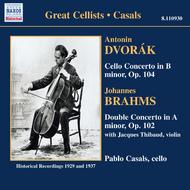
Cello Concerto in B minor, Op. 104
[ 1] I. Allegro 13.35
[ 2] II. Adagio ma non troppo 10.31
[ 3] III. Finale: Allegro moderato 11.49

Recorded: 28.IV.1937, Deutsches Haus (Slovansky Hall), Prague / 2HC 220 – 9; DB 3288 – 92

Pablo Casals violoncello
Czech Philharmonic Orchestra
conducted by George Szell
Producer: Fred Gaisberg / Balance engineer: Charles Gregory

Edward Elgar 1857-1934
Cello Concerto in E minor, Op. 85
[ 4] I. Adagio – Moderato – 7.54
[ 5] II. Lento – Allegro molto 4.41
[ 6] III. Adagio – 4.03
[ 7] IV. Allegro – Moderato – Allegro, ma non troppo 11.12

Recorded: 14.X.1945, No. 1 Studio, Abbey Road, London / 2EA 10641 – 7; DB 6338 – 40 & DBS 6341

Pablo Casals violoncello
BBC Symphony Orchestra
conducted by Sir Adrian Boult
Producer: Walter Legge
Balance engineer: Arthur Clarke

Max Bruch 1838-1920
[ 8] Kol Nidrei, Op. 47 11.54

Recorded: 27.XI.1936, No. 1 Studio, Abbey Road, London / 2EA 4153 – 5; DB 3063 – 4

Pablo Casals violoncello
London Symphony Orchestra
conducted by Sir Landon Ronald
Producer: Fred Gaisberg
Balance engineer: unknown
MONO/ADD / This compilation (P) 1990 by EMI Records Ltd. / Digital remastering (P) 2004 by EMI Records Ltd.

CD6

Ludwig van Beethoven 1770-1827
Trio for piano, violin and violoncello No. 7 in B flat, Op. 97 “Archduke”
[ 1] I. Allegro moderato 9.24
[ 2] II. Scherzo: Allegro & Trio 6.31
[ 3] III. Andante cantabile, ma però con moto 12.58
[ 4] IV. Allegro moderato – Presto 6.23

(P) 1998 DRM  Recorded: 18 & 19.XI. and 3.XII.1928, Small Queen’s Hall, London; / CC 14759 – 14768; DB 1223 – 1227
Recording Producer: Unknown / Balance engineers: F.C. Buckley, E. Gower, H. Fleming & A.S. Clarke

Franz Schubert 1797-1828
Trio for piano, violin and violoncello in B flat, D. 898
[ 5] I. Allegro moderato 10.26
[ 6] II. Andante un poco mosso 8.55
[ 7] III. Scherzo: Allegro & Trio 3.43
[ 8] IV. Rondo: Allegro vivace – Presto 8.10

(P) 1998 DRM  Recorded: 5 & 6.VII.1926, Kingsway Hall, London; CR 533 – 540; DB 947 – 950
Recording Producer: Unknown / Balance engineers: A.S. Clarke, R.E. Beckett & A.J. Twine

Ludwig van Beethoven 1770-1827
[ 9] 7 Variations in E flat, WoO 46, on “Bei Männern, welche Liebe fühlen”, from Die Zauberflöte (Mozart) for violoncello and piano 10.02

(P) 2003 remastering Recorded: 21.VI.1927, Large Queen’s Hall, London; BR 1394 – 97; DA 915 – 916
Recording Producer: Unknown / Balance engineers: A.S. Clarke, D.E. Larter, A.D. Lawrence & M. Alexander
Alfred Cortot piano
Jacques Thibaud violin
Pablo Casals violoncello
MONO/ADD 

CD7

Felix Mendelssohn-Bartholdy 1809-1847
Trio for piano, violin and violoncello No. 1 in D minor, Op. 49
[ 1] I. Molto allegro ed agitato 9.03
[ 2] II. Andante con moto tranquillo 7.17
[ 3] III. Scherzo: Leggiero e vivace 4.01
[ 4] IV. Finale: Allegro assai appassionato 8.31

(P) 2003 DRM  Recorded: 20 & 21.VI.1927, Large Queen’s Hall, London; CR 1385 – 1387 & 1389 – 1393; DB 1072 – 1075
Recording Producer: Unknown / Balance engineers: A.S. Clarke, A.D. Lawrence, D.E. Larter & M. Alexander

Robert Schumann 1810-1856
Trio for piano, violin and violoncello in D minor, Op. 63
[ 5] I. Mit Energie und Leidenschaft 12.15
[ 6] II. Lebhaft, doch nicht zu rasch 4.18
[ 7] III. Langsam, mit inniger Empfindung 6.13
[ 8] IV. Mit Feuer 7.19

(P) 2003 DRM  Recorded: 15 & 18.XI. and 3.XII.1928, Small Queen’s Hall, London; CC 14740 – 14744 & 14756 - 14758; DB 1209 – 1212
Recording Producer: Unknown / Balance engineers: F.C. Buckley, A.S. Clarke, H. Fleming, E. Gower & F. Rennie

Ludwig van Beethoven 1770-1827
[ 9] 10 Variations in G, Op. 121a, on “Ich bin der Schneider Kakadu”, from Die Schwestern von Prag (Müller) for piano, violin and violoncello 18.52

(P) 2003 DRM Recorded: 6.VII.1926, Kingsway Hall, London; CR 541 – 545; 2XEA 5185 SH 230 (World Records) (P) 1975 EMI Records Ltd
Recording Producer: Unknown / Balance engineers: A.S. Clarke, R.E. Beckett & A.J. Twine
Alfred Cortot piano
Jacques Thibaud violin
Pablo Casals violoncello
MONO/ADD

CD8

Haydn: Trio for piano, violin and violoncello in G, HobXV25
[ 1] I. Andante 3.31
[ 2] II. Poco adagio cantabile 6.12
[ 3] III. Rondo all’ongarese (Presto) 3.11

(P) 2003 DRM
Alfred Cortot, piano
Jacques Thibaud, violin
Pablo Casals , violoncello
Recorded: 20.VI.1927, Large Queen’s Hall, London BR 1381 – 1384; DA 895 - 896
Recording Producer: Unknown / Balance engineers: A.S. Clarke, A.D. Lawrence & D.E. Larter

Brahms: Double Concerto for violin & violoncello in A minor, Op. 102
[ 4] I. Allegro 15.04
[ 5] II. Andante 6.50
[ 6] III. Vivace ma non tanto 8.32

 (P) 2003 DRM
Jacques Thibaud, violin
Pablo Casals , violoncello
Orquesta Pau Casals, Barcelona
conducted by Alfred Cortot
Recorded: 10 & 11.V.1929, Barcelona / CJ 2156 – 2163; DB 1311 - 1314
Recording Producer: Unknown / Balance engineers: A.S. Clarke & H.E. Davidson

Luigi Boccherini 1743-1805 (ed. Friedrich Grützmacher)
Cello Concerto in B flat
[ 7] I. Allegro moderato 9.04
[ 8] II. Adagio non troppo 6.22
[ 9] III. Rondo: Allegro 7.02

2003 DRM
Pablo Casals violoncello
London Symphony Orchestra
conducted by Sir Landon Ronald
Recorded: 29.XI.1936; No. 1 Studio, Abbey Road, London DB 3056/8 – 2EA.4156/61
Producer: Lawrance Collingwood / Balance engineer: Arthur Clarke

Luigi Boccherini 1743-1805
[10] Adagio & Allegro (from Sonata No. 6 in A) 7.43

Recorded: 16&17.VI.1929; Barcelona DB.1392 – CJ.2275/6 [GBAYC0300350]

Pablo Casals violoncello
Blas-Net piano
 (P) 2003 DRM
Producer: none present / Balance engineer: Harold Davidson
MONO/ADD

TOTAL TIME (Estimate) 74.00

This compilation (P) 2009 by EMI Records Ltd. © EMI Records Ltd. 2009

CD9

Giuseppe Tartini 1692-1770
[ 1] Grave ed espressivo (from Concerto in D) 4.10

Recorded: 14.VI.1929; Barcelona DB.1400 – CJ.2265 [GBAYC0300354]

Antonin Dvořák 1842-1904 (arr Alfred Grünfeld)
[ 2] Songs my mother taught me 2.43

Recorded: 19.VI.1929; Barcelona DB.1399 – CJ.2292 [GBAYC0300355]

Nikolai Rimsky-Korsakov 1844-1908 (arr. Strimer)
[ 3] Flight of the Bumble-bee (from The Tale of Tsar Saltan) 1.12

Recorded: 19.VI.1929; Barcelona DB.1399 – CJ.2292 [GBAYC0300356]

Franz Joseph Haydn 1732-1809 (arr. Alfredo Piatti)
[ 4] Tempo di Minuetto (from Sonata No. 1 in C) 3.57

Recorded: 21.VI.1929; Barcelona DB.1391 – CJ.2300 [GBAYC0300359]

Johann Sebastian Bach 1685-1750 (arr. Siloti)
[ 5] Andante (from Unaccompanied Sonata No. 2 in A minor) 3.43

Recorded: 19.VI.1929; Barcelona DB.1404 – CJ.2286 [GBAYC0300363]

Felix Mendelssohn 1809-1847
[ 6] Song without words in D, Op. 109 4.29

Recorded: 17.VI.1929; Barcelona DB.1399 – CJ.2277 [GBAYC0300364]

Antonio Vivaldi 1678-1741 (arr. Joachim Stutschewzky)
[ 7] Largo (from Concerto Op. 3 No. 11 in D minor) 3.32

Recorded: 15.VI.1929; Barcelona DA.1118 – BJ.2271 [GBAYC0300366]

Giuseppe Valentini 1680-1759 (arr. Alfredo Piatti)
[ 8] Gavotte 1.55

Recorded: 21.VI.1929; Barcelona DA.1118 – BJ.2299 [GBAYC0300367]

Blas de Laserna 1751-1816 (arr. Gaspar Cassadó)
[ 9] Tonadilla 1.36

Recorded: 21.VI.1929; Barcelona DA.1118 – BJ.2299 [GBAYC0300368]

Pablo Casals violoncello
Blas-Net piano
(P) 2003 DRM (CD0716; BARCODE 0303475; PMCD;
Producer: none present / Balance engineer: Harold Davidson

Johann Sebastian Bach 1685-1750 (arr. Siloti)
[10] Aria (from Suite No. 3 in D) 3.45

Recorded: 5.III.1930; Small Queen’s Hall, London DB.1404 – CC.19017 [GBAYC0300357]

Robert Schumann 1810-1856
[11] Träumerei 3.23

Recorded: 5.III.1930; Small Queen’s Hall, London DA.833 – BB.19018 [GBAYC0300360]

Pablo Casals violoncello
Otto Schulhof piano
2003 DRM
Producer: unknown / Balance engineer: unknown

SARDANES DE CONCERT

Pau (Pablo) Casals 1876-1973
[12] Festivola (1908) 4.01
2XLA 210 band 1

Enrique Casals 1892-1986
[13] Heroica (1919) (dedicated to his brother, Pablo) 5.47
2XLA 210 band 3
[14] Tarragona (1927) 3.21
2XLA 210 band 4
[15] Lluny (1918) 6.33
2XLA 209 band 1

Julio Garreta 1875-1925
[16] La Rosada (1902) 5.41
2XLA 209 band 2
[17] Innominada (1915) 5.44
2XLA 210 band 2

Manel Saderra 1908-2000
[18] Dubte (1948) 5.45
2XLA 209 band 3

Cobla “La Principal de Gerona”
Pablo Casals artistic direction
Date and Venue: June 1955, Prades, France
Producer: unknown / Balance engineer: unknown
MONO/ADD

TOTAL TIME (Estimate) 73.00
This compilation (P) 2009 by EMI Records Ltd. © EMI Records Ltd. 2009

ADDITIONAL NOTE:

The Sardana (plural: Sardanes) is the national dance of Catalonia, which acquired its present form in the mid-19th century. It is danced in a circle to the music provided by a Cobla, a street band consisting of pipe and tabor, double bass, and a variety of wind instruments especially two types of Catalan shawm – the tiple (‘treble’) and tenora. They are double-reed instruments, being the forerunner of the modern oboe, yet keep the pirouette and the old steep bore gradient of the original designs dating from the 16th- and 17th-centuries but are otherwise brought up to date with keywork of the 19th-century type. Both are transposing instruments: the tiple is pitched in F (a fourth above the oboe); and the tenora is a fifth lower, in B flat, with a long metal bell for the second tenora player to be able to reach low notes, down to f# (sounding e).

Their penetrating but very expressive sounds are backed by five brass instruments and a double bass, while the leader of the band makes introductory flourishes on a small pipe and tabor – a memory of times early in the 19th century when this, with shawm and bagpipe, alone provided music for the dance. The dance itself may alternate between 2/4 and 6/8 time.

Being such a nationalist and supporter of Catalonia it is not surprising that Pablo Casals, together with his family and friends, should provide music and support for the continued performance of such a Cobla by directly overseeing this recording.

Also Available

Beethoven / Brahms - Orchestral Works

£11.91

(Naxos - Historical)

Casals - Encores & Transcriptions vol.3

£11.91

(Naxos - Historical)

Haydn/Elgar/Boccherini - Cello Concertos

£11.91

(Naxos - Historical)

Error on this page? Let us know here

Need more information on this product? Click here