FREE UK SHIPPING OVER £35!

Steinway Legends - Maurizio Pollini | Steinway Legends (Deutsche Grammophon) 4776621

Steinway Legends - Maurizio Pollini

New Item

Label: Steinway Legends (Deutsche Grammophon)

Cat No: 4776621

Barcode: 0028947766216

Format: CD

Number of Discs: 2

Genre: Instrumental

Release Date: 11th June 2007

This product has now been deleted. Information is for reference only.

Contents

Works

Beethoven
Piano Sonata no.21 in C, op.53 ’Waldstein’

Schumann
Etudes Symphoniques, op.13

Stravinsky
Three movements from Petrushka

Webern
Variations, op.27

Schumann
Arabeske in C, op.18

Chopin
Berceuse in D flat, op.57

Chopin
Etudes op.25, nos.1, 7, 9, 10, 11 & 12

Liszt
Piano Sonata in B minor, S178

Debussy
Etudes: pour les Notes repetees; pour les Sonorites opposees; pour les Arpeges composes; pour les Accords

Artists

Maurizio Pollini

Works

Beethoven
Piano Sonata no.21 in C, op.53 ’Waldstein’

Schumann
Etudes Symphoniques, op.13

Stravinsky
Three movements from Petrushka

Webern
Variations, op.27

Schumann
Arabeske in C, op.18

Chopin
Berceuse in D flat, op.57

Chopin
Etudes op.25, nos.1, 7, 9, 10, 11 & 12

Liszt
Piano Sonata in B minor, S178

Debussy
Etudes: pour les Notes repetees; pour les Sonorites opposees; pour les Arpeges composes; pour les Accords

Artists

Maurizio Pollini

About

In recent years, Pollini has programmed all 32 Beethoven Sonatas and recorded them as well. The Waldstein, whose nickname is the surname of Beethoven’s great benefactor and the work’s dedicatee, Count Ferdinand von Waldstein, was composed in 1803, and comes just after the Eroica Symphony in the chronology of Beethoven’s works. In that same year he acquired an Erard piano that replaced an earlier one by the Viennese maker Walther. The composer’s increasingly symphonic thinking for piano is reflected in this sonata. Its scope and overt virtuosity anticipate the Appassionata to come.

Robert Schumann composed his Etudes symphoniques, op 13 (variously translated into English as “Symphonic Etudes” or “Symphonic Studies”) from 1834-1837 and they were published in the latter year. They are as many variations, described by the composer as in “orchestral character”, based on a C-sharp minor theme by the father of Schumann’s first love, Ernestine von Fricken. It was Schumann’s belief that “the piano expresses itself essentially and peculiarly in three things above all: Richness of part-writing and harmonic change (e.g. Beethoven and Schubert); through use of the pedal (e.g. Field); or through volubility (e.g. Czerny and Herz).”

Stravinsky transcribed three dances from his ballet Petrouchka for Arthur Rubinstein, who popularized them in that form. Webern’s Piano Variations, op 27, written in 1935-36, is one of those works “composed in an uncompromisingly modern musical language [serialism]” that Pollini is determined to program in order to break down the audience’s prejudices. “The composers must follow their own clear way, and the public must follow after them.

Schumann’s Arabesques, op 18 [Track 1 of CD 2], from his Viennese sojourn of 1838-39, possess a character of psychological indeterminacy that Pollini brings out more than do many other pianists. His Chopin brings clarity of line and texture to the fore, especially in the group of Etudes from op 25 that he has chosen which include the familiar nicknamed “Aeolian Harp” [Track 3], “Butterfly [Track 5] and “Winter Wind [Track 7].

Liszt’s Sonata in B minor is one of the summits of Romantic pianism. Tim Page, in the Washington Post, offered this description of Pollini’s approach: “Lesser interpreters strain to make this piece as wild-eyed and metaphysical as possible, conjuring up shadows of profundities that may or may not be there. For his part, Pollini seemed to have nothing grander in mind than to make firm, objective musical sense of it all — to play this as a 19th-century piano sonata rather than a dreamy, soft-focus evocation of mystical transport”. However one responds to his interpretation, one cannot ignore Pollini’s extraordinary handling of texture and dynamics.

In contrast to his two books of Preludes and Images, Debussy’s twelve Etudes were composed in August and September 1915 and are dedicated to the memory of Chopin. He wrote to his publisher that they would be prove useful “in teaching pianists that to embark on a musical career they must first have a formidable technique.” Less overtly Impressionistic than his earlier piano works, they are both sparer in texture and harmonically more audacious, resembling etchings and drypoint. This suits Pollini’s approach to the technical problems posed in his selection: repeated notes; opposing sonorities; compound arpeggios; chords.

Also Available

Beethoven - Piano Sonatas opp. 101 & 106

£11.91

(Deutsche Grammophon)

Maurizio Pollini: Chopin Recital

£5.95

(Deutsche Grammophon)

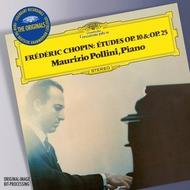
Chopin - Etudes Op.10 & Op.25

£9.15

(Deutsche Grammophon - Originals)

Error on this page? Let us know here

Need more information on this product? Click here